A Celestial Show Unfolds Across Continents
Sandego.net – Millions of skywatchers witnessed one of nature’s most spectacular events as a total solar eclipse swept across multiple continents on Wednesday. The lunar shadow traced a dramatic arc from the Arctic regions down through Europe, offering observers a chance to see the moon completely obscure the sun’s brilliant disk. This celestial alignment, where the moon passes directly between Earth and the sun, created moments of unexpected darkness during daylight hours for countless people.
The phenomenon began in the far north, where residents of northern Russia experienced totality in the middle of their day. As the shadow moved southeast, Greenland and Iceland enjoyed the longest viewing window, with totality lasting approximately two minutes and fifteen seconds during late afternoon and early evening hours. These northern locations benefited from clear skies and extended observation periods.
Spain’s Sunset Spectacle
A Rare Evening Darkening
Perhaps the most extraordinary viewing occurred in Spain and the northeastern corner of Portugal, where the eclipse coincided with sunset. This timing created a double celestial event that astronomers describe as particularly rare. In the Spanish city of León, totality commenced at 8:28 p.m. local time and concluded at 8:30 p.m., giving residents just under two minutes of complete darkness as the sun dipped toward the horizon.
Dr. Ryan French, a solar astrophysicist based at the Laboratory for Atmospheric and Space Physics in Boulder, Colorado, deliberately chose a location north of Madrid to experience what he described as a shorter but potentially clearer eclipse. The totality there lasted one minute and forty-five seconds.
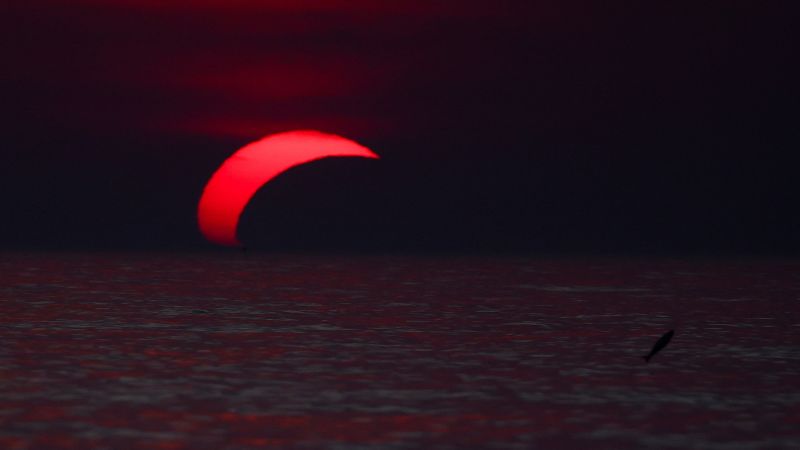
For pretty much the entirety of Spain, by the time the sun sets sort of over the horizon, the total eclipse will have happened, but the sun will set in a partial eclipse, a beautiful sight seeing the sun set as a crescent sun.
Global Broadcast Coverage
For those unable to travel to prime viewing locations, multiple organizations provided live coverage. The European Space Agency transmitted totality footage from Spain’s Astrophysical Observatory of Javalambre in Teruel. NASA simultaneously hosted a live broadcast beginning at 1:15 p.m. ET, showcasing perspectives from various points along the eclipse path.
Partial Eclipse Experiences
While totality remained confined to a narrow corridor, millions experienced partial eclipses across broader regions. The United Kingdom, which will not witness a total solar eclipse until 2090, observed approximately ninety-five percent coverage of the sun during this event. This represents one of the most significant partial eclipses the nation has experienced in recent decades.
New York will see a 10% eclipse, so you know a very small slice of the sun missing. But if you’re in Europe, obviously that slice is much larger.
The partial eclipse unfolded at different times depending on geographic location. Residents of Alaska and northern Canada watched the morning event, while the northern United States and eastern Canada experienced afternoon coverage. Evening viewers in the United Kingdom, Ireland, mainland Europe, and northwestern Africa witnessed the sunset eclipse phenomenon.
The Mechanics of Darkness
The eclipse did not begin with sudden darkness. Instead, it progressed through stages that built anticipation among observers. The partial phase, lasting between seventy and eighty minutes depending on location, saw the moon gradually advance across the sun’s face. During this approach, the moon appeared to take a bite from the solar disk.
As totality approached, a fascinating optical phenomenon emerged. When the moon crossed directly in front of the sun, sunlight filtered through valleys along the moon’s edge, creating luminous points of light known as Baily’s beads. These glowing drops of light surrounded the dark lunar silhouette, creating a crown-like effect. The phenomenon honors English astronomer Francis Baily, who first documented these beads during an annular eclipse on May 15, 1836.
The sky’s appearance transformed dramatically as totality neared. The ambient light dimmed in an eerie manner, and the Baily’s beads typically vanished quickly, making way for the diamond ring effect that signals the beginning of totality.
Looking Beyond the Eclipse
The celestial excitement extended beyond the eclipse itself. One of the year’s premier meteor showers, the Perseids, reached its peak between Wednesday night and Thursday morning. NASA organized a live watch party on YouTube beginning at midnight ET on Thursday, allowing enthusiasts to observe the meteor display alongside eclipse-related discussions.
For safety, observers were reminded to use certified eclipse glasses or handheld solar viewers whenever the sun remained visible. This precaution applies to all phases of the eclipse, from the initial partial coverage through totality and back to full sunlight. The brief period of darkness during totality allows for safe naked-eye viewing, but protective eyewear must be worn immediately as the sun reappears.
The eclipse demonstrated how celestial mechanics continue to captivate human imagination, connecting modern observers with ancient astronomical traditions while providing valuable scientific data about our solar system’s dynamics.
Related Reading
Frequently Asked Questions
What is A rare sunset total solar eclipse?
A rare sunset total solar eclipse is the main topic of this guide. The article explains the context, practical details, and next steps readers should understand.
Why does A rare sunset total solar eclipse matter?
A rare sunset total solar eclipse matters because readers are looking for a useful answer, not just a short summary. Good content should match search intent and help them decide what to do next.