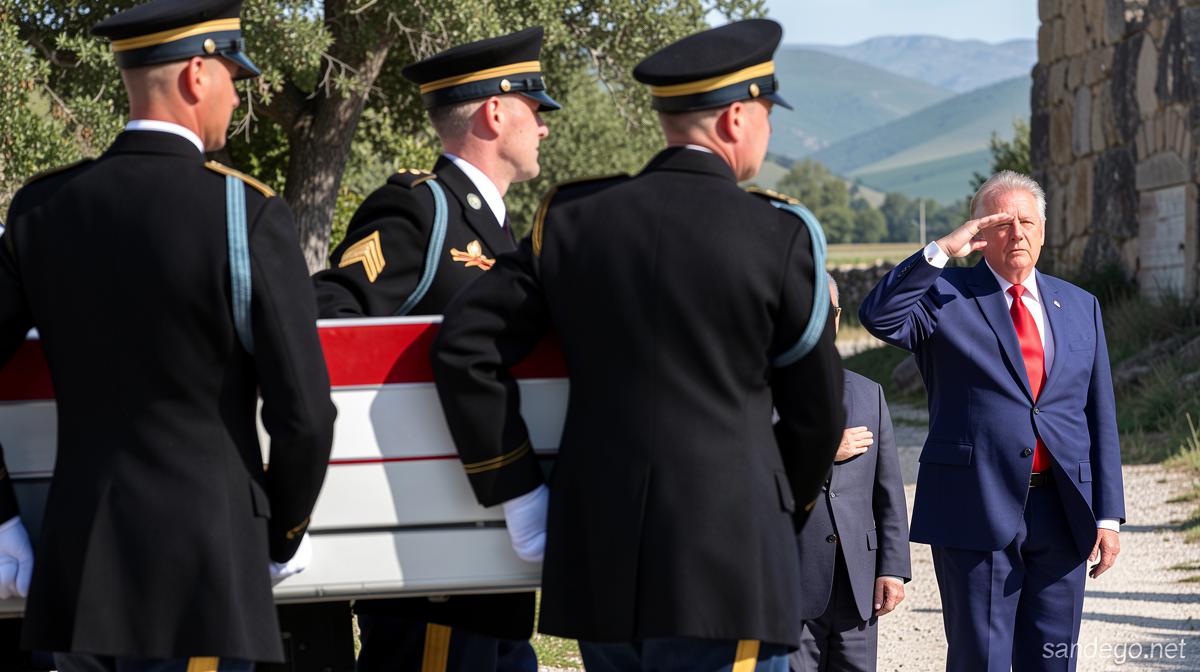
Trump greets the fallen as he faces: A President's Burden: Trump Witnesses Fallen Soldiers Return from Iran Conflict The Dover Ritual Sandego.net – On
A President’s Burden: Trump Witnesses Fallen Soldiers Return from Iran Conflict
The Dover Ritual
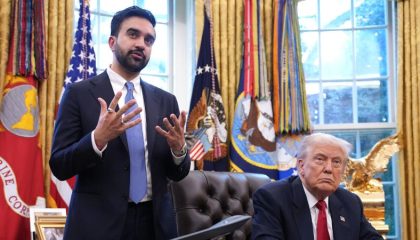
Sandego.net – On Wednesday, President Donald Trump stood on the tarmac at Dover Air Force Base in Delaware, witnessing the solemn return of four American service members who lost their lives during the ongoing Iran war. Their remains, covered in American flags within silver cases, descended from a military cargo plane while families and the president observed the quiet ceremony. As the nation faces potential escalation in this Middle Eastern conflict—threatening thousands of American troops stationed across the region—Trump watched the human cost of his leadership being transferred from aircraft to waiting vehicles.
The entire procession lasted barely twenty minutes. Silver cases moved from the plane’s belly, were carried across the concrete, and loaded into vans that would transport them home. Trump stood at attention, saluting with his gaze fixed forward. The only sounds breaking the silence were the plane’s auxiliary engine and a heart-wrenching cry from a family member positioned directly across from the president on the tarmac.
Reflections on Responsibility
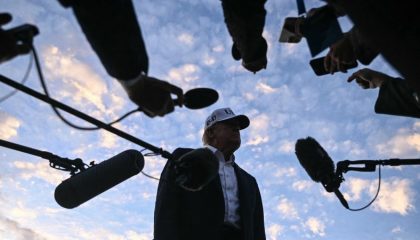
Traveling to Dover for these ceremonies represents one of the most profound responsibilities a president can bear. Before departing Washington for this visit, Trump acknowledged the emotional weight of the occasion. “For me, it’s one of the hardest things to do as a president, but has to be done,” he stated, boarding his new Air Force One, which had been donated by Qatar.
The president also emphasized that the conflict he initiated over four months ago was passing what military leaders and presidents have called the “Dover Test”—an informal assessment used for decades to evaluate whether wars justify their human toll on the American people. Trump insisted that public opinion supported the military effort. “Americans aren’t against the war,” he declared. “A poll just came out. Americans don’t want high gasoline prices, but they’re not against the war.”
“For me, it’s one of the hardest things to do as a president, but has to be done.”
Public Opinion and Historical Context
Contrary to Trump’s assertion, recent polling data tells a different story. A Washington Post survey published last week revealed that 68% of Americans believe the Iran war is not worth fighting, while only 28% support continuing the conflict. This forty-point negative margin exceeds the divisions seen during either the Iraq or Afghanistan wars according to Washington Post-ABC News polling.
Trump has frequently referenced those earlier conflicts, noting that both lasted longer and resulted in significantly more casualties than the Iran war has experienced to date. He uses these comparisons to suggest that the current situation remains manageable. During his first term, Trump also visited Dover multiple times due to the Iraq and Afghanistan conflicts. While he was visibly moved by the raw emotions of bereaved families, he consistently placed blame on previous administrations for initiating wars they could not conclude.
“Americans aren’t against the war. A poll just came out. Americans don’t want high gasoline prices, but they’re not against the war.”
The Fallen and the Future
The four Americans returning home Wednesday were 1st Lt. Tyler James Feehan, Staff Sgt. Michael Emmanuel Swinton, Sgt. Angel S. Rampersad and Pvt. Isabella Gonzales. Their ages ranged from nineteen to twenty-five years old, and they came from across the nation—from Hawaii to North Carolina, from New York to Texas. They died far from their families, in Jordan and Iraq.
Before the transfer ceremony, Trump met privately with the families of the fallen. He extended a special invitation to Feehan’s relatives to travel with him aboard Air Force One to Georgia. Speaking at an event in Marietta, Trump described the morning as particularly difficult. “Standing there watching this sight, which is – very, very tough to – very tough to watch,” he said. “To be honest with you, very tough. I think it’s the toughest thing I do. If anything, I do all this stuff, but I think it’s the toughest thing I do.”
To Feehan’s family, whom Trump noted lived nearby, he described a young man with extraordinary promise. “This is a son who was like a flawless, perfect person. Beautiful, beautiful son, handsome in every way, brilliant, respected by everybody,” he said, as Feehan’s grieving family listened.
Meanwhile, policy discussions continue as Trump weighs options for intensifying the conflict, including potential strikes on Iranian infrastructure such as roads, bridges, and power plants. Despite these threats, officials indicate he has not yet approved the most aggressive measures, instead maintaining nightly strikes that have yet to produce significant Iranian concessions or sufficiently degrade their military capabilities.
Related SEO Topics
- Home
- Artikel terkait Trump greets the fallen as he faces
- How arsonists used cats to spread Italy’s wildfires
- Florida teen drops addiction case against Meta ahead of second ‘bellwether’ trial
- Nicaragua’s Ortega said he will end elections. Why isn’t the US treating this like Cuba and Venezuela?
- Speaker Johnson muscles through plan to fund Iran war and promote Trump’s ‘SAVE America Act’
Frequently Asked Questions
What is Trump greets the fallen as he faces?
Trump greets the fallen as he faces is the main topic covered in this article, with practical context to help readers understand the subject clearly.
Why does Trump greets the fallen as he faces matter?
Trump greets the fallen as he faces matters because it helps readers compare options, avoid common mistakes, and make a more informed decision.
How should readers use this Trump greets the fallen as he faces guide?
Use the key points, examples, and related links in this page as a starting point, then review the latest details before making a final decision.