
School official ignored warnings of gun before 6-year-old shot teacher, prosecutor says at trial
School official ignored warnings of gun before 6-year-old shot teacher, prosecutor says at trial
School official ignored warnings of gun before – During the opening of her criminal trial, prosecutors accused Ebony Parker, the former assistant principal of a Virginia elementary school, of failing to act on repeated alerts from teachers that a 6-year-old student might have a firearm. The case, which has drawn national attention, centers on Parker’s alleged negligence in the aftermath of a classroom shooting that occurred at Richneck Elementary in Newport News, Virginia, in January 2023.
Prosecution highlights Parker’s failure to intervene
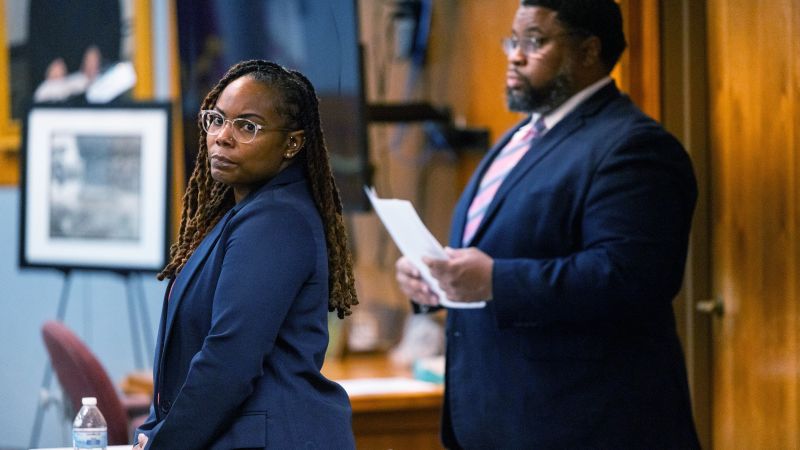
Assistant Commonwealth Attorney Josh Jenkins asserted in his opening remarks that Parker was the sole individual in the school with the authority and awareness to address the looming threat. “There was only one person in the school that day that had both the authority to act and the knowledge of the ongoing crisis, and that person you will see was Dr. Parker,” Jenkins stated. The trial, which began on Tuesday, involves eight counts of felony child abuse and disregard for life, each corresponding to a bullet fired by the student during the incident.
“There was only one person in the school that day that had both the authority to act and the knowledge of the ongoing crisis, and that person you will see was Dr. Parker,” Assistant Commonwealth Attorney Josh Jenkins said.
The case hinges on whether Parker exercised due diligence in the face of multiple red flags. Prosecutors argue that she knew about the student’s disciplinary history, including an incident from the previous school year in which he choked his teacher, Susan White. Despite these concerns, Parker did not take steps to investigate or address the possibility of the child carrying a weapon, according to court documents.
Defense claims lack of immediate danger
Opposing the prosecution’s narrative, Parker’s defense attorney, Curtis Rogers, argued that the student’s teacher, Abby Zwerner, may have been uncertain about the presence of a firearm. “She did not act as if there was a gun present,” Rogers stated. “So if she thought there was a gun present, then her actions should have been to separate the child from his classmates, or separate the classmates from (the child). She didn’t do that.”
“She did not act as if there was a gun present,” defense attorney Curtis Rogers said. “So if she thought there was a gun present, then her actions should have been to separate the child … from his classmates, or separate the classmates from (the child). She didn’t do that.”
The trial is set to examine whether Parker’s inaction constituted a “willful act or omission in the care of such students,” as described in the charges. Prosecutors claim her behavior demonstrated a reckless disregard for human life, given the opportunity to prevent the shooting. Zwerner, who survived the attack, will testify as the first witness for the prosecution, recounting the events that unfolded on the day of the incident.
The shooting and its aftermath
The incident occurred in January 2023 when a 6-year-old boy, known as “JT,” brought a gun to school. The weapon, which was unsecured and taken from his mother’s purse, was later found in his backpack. During class, JT shot Zwerner in the chest and hand, an act that has led to legal scrutiny of the school’s leadership. In the wake of the tragedy, several officials were held accountable: Parker resigned two weeks after the incident, the principal was reassigned, and the school board voted to replace the superintendent.
While the criminal trial focuses on Parker’s responsibilities, the case also reflects a broader trend of legal accountability in school shootings. Parents in Michigan and Georgia have been convicted of serious charges for allowing their children to access weapons, whereas law enforcement officers accused of inaction during the Parkland and Uvalde shootings were acquitted by juries. Parker appears to be the first school educator to face trial for such circumstances, marking a significant shift in how educational leaders are held liable for student-related violence.
Before the shooting, multiple teachers had expressed concerns to Parker about the child’s potential to bring a weapon. According to prosecutors, these warnings were dismissed, and Parker even advised against searching the student’s belongings for a gun. The boy’s mother, Deja Taylor, has already been sentenced to two years in state prison for felony child neglect in 2023, alongside a 21-month federal term on related charges. She was released from state custody to community supervision on May 13, as noted by the Virginia Department of Corrections.
Parker has pleaded not guilty to the charges, which include class 6 felonies carrying a maximum sentence of five years. The trial is expected to span approximately three days, during which both sides will present evidence and testimonies. In the civil case that preceded the criminal trial, a jury awarded Zwerner $10 million, citing Parker’s failure to address the concerns. Parker has since filed an appeal, highlighting the legal distinction between civil and criminal proceedings.
While the civil case provided a glimpse of the arguments likely to be used in the criminal trial, the prosecution is expected to delve deeper into Parker’s decision-making process. The trial will determine whether her actions—or inactions—constituted a criminal offense. As the proceedings unfold, the case will serve as a test case for how schools and educators are held responsible when a juvenile commits acts of violence on campus.
The shooting has sparked discussions about the role of school officials in ensuring safety, particularly in cases where students have a history of aggression. Prosecutors emphasize that Parker’s awareness of the child’s behavioral issues should have prompted more decisive action. Meanwhile, the defense maintains that the threat was not immediately clear, and that the child’s mother was ultimately responsible for the weapon’s presence.
With the trial in progress, the legal community and public will be watching closely to see how the case is resolved. The outcome could set a precedent for similar cases in the future, influencing the standards for accountability among school staff. As the trial continues, the story of JT’s attack and its aftermath remains a focal point for questions about preparedness, awareness, and responsibility in educational settings.
