
National Mall prayer event sparks concern about Trump administration eroding the wall between church and state
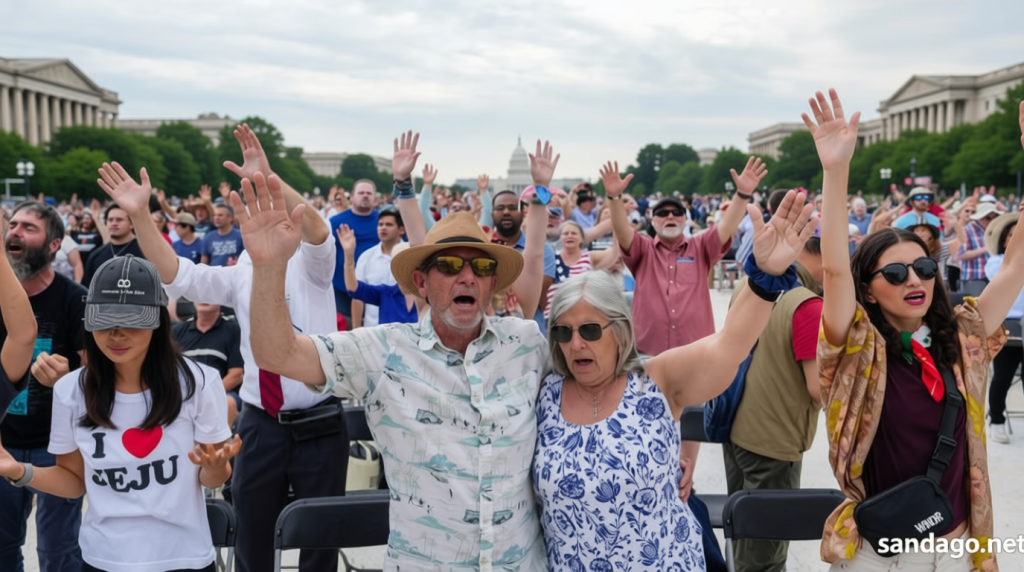
National Mall Prayer Event Sparks Debate Over Religious Influence in Government
National Mall prayer event sparks concern – On Sunday, a day-long prayer gathering held on the National Mall attracted significant attention, raising questions about the Trump administration’s approach to maintaining the separation between church and state. Organized through a combination of public funding and private contributions, the event is seen as a recent instance of the administration’s efforts to blend religious expression with governmental functions. The occasion, titled “Rededicate 250: A National Jubilee of Prayer, Praise & Thanksgiving,” coincides with commemorations marking the 250th anniversary of American independence. It is set to include remarks from President Donald Trump and other high-ranking officials, alongside contributions from faith leaders and musicians.
Event Organization and Participants
The prayer event is managed by Freedom 250, a nonpartisan nonprofit linked to the National Park Foundation. This organization serves as a fundraising arm for the National Park Service, ensuring the event aligns with broader historical initiatives. The gathering aims to foster reflection and unity among attendees, emphasizing shared values ahead of the nation’s founding anniversary. While the invitation extends to all Americans, the majority of faith figures participating are evangelical Christians, with only a few notable exceptions, such as an Orthodox rabbi and two conservative Catholic bishops.
Senior adviser Danielle Alvarez of Freedom 250 expressed optimism about the event’s potential, stating, “Rededicate 250 will be a powerful moment to reflect on where we have been, recommit ourselves to the ideals that define us, and look toward the future with renewed hope and purpose.” This sentiment underscores the event’s dual purpose: celebrating the nation’s heritage and encouraging collective spiritual engagement. The administration, however, has framed the initiative as a tribute to America’s historical roots in faith, a perspective that has drawn both support and scrutiny.
Constitutional Controversy
The event has sparked a divided response among legal experts regarding its adherence to the First Amendment’s separation of church and state. Andrew Koppelman, a constitutional law professor at Northwestern University, argued that the gathering is permissible since no court has issued an injunction against it. However, he contended that the event “contrary to the fundamental purposes of the Constitution,” by reinforcing a specific religious identity over a pluralistic one. “This kind of divisive embrace of a particular religion and trying to associate the incumbent administration with that religion is bad for religion, bad for government, and bad for America,” Koppelman remarked.
In contrast, Douglas Laycock of the University of Texas School of Law labeled the event “flagrantly unconstitutional,” emphasizing that the government is actively promoting a specific faith. “It is explicit government promotion of religion, not just religion in general, but of a fairly specific version of one particular religion,” he explained. Meanwhile, Michael Moreland, a law and religion scholar at Villanova University, suggested that the intersection of religious faith and public spaces is not inherently problematic. “I think it’s kind of overemphasizing that idea of separation to think an event like this raises any constitutional problems,” Moreland said, noting that practices such as congressional prayers and presidential inaugurations have long been accepted as part of the public square.
Administration’s Defense
House Speaker Mike Johnson, a prominent Christian figure, defended the event during an appearance on Fox News. He framed the gathering as a celebration of the nation’s “religious and moral tradition,” accusing critics of seeking to “erase the history of America and pretend as if we’re not a nation that was dedicated originally to God.” Johnson’s remarks highlight the administration’s broader narrative that the United States was founded as a Christian nation, a claim that has been central to its faith-based policies.
White House spokeswoman Taylor Rogers echoed this sentiment, stating that the event will serve as a “beautiful and unifying moment” to honor the contributions of “great men and women of faith” to American history. “Rededicate 250 will be a fantastic event in our nation’s capital to celebrate freedom of religion for all people of faith — a cornerstone of the sacred principles enshrined in our Constitution by the founding fathers,” she said. The administration’s rhetoric has been instrumental in shaping the event’s public perception, with the phrase “one nation under God” resonating strongly in its messaging.
Critics’ Perspective on Christian Nationalism
Opponents of the event have accused the Trump administration of advancing Christian nationalism, a movement that asserts the United States was established as a Christian nation and should be guided by Christian principles. Rabbi Jonah Dov Pesner of the Religious Action Center of Reform Judaism highlighted concerns over the use of the term “Judeo-Christian” to describe the event. “The term Judeo-Christian, which Baldwin used to describe the event, and which members of the Trump administration have repeatedly used…” Pesner continued, suggesting that this language may obscure the nation’s diverse religious foundations.
The debate reflects a broader tension between acknowledging religious heritage and ensuring government neutrality in matters of faith. Critics argue that the administration’s actions risk privileging Christianity over other belief systems, potentially undermining the constitutional guarantee of religious freedom. This viewpoint is supported by historical precedents, such as the 1947 Supreme Court case Everson v. Board of Education, which established the principle of separation between church and state.
Despite these concerns, the event’s organizers maintain that it is a legitimate expression of national identity. By emphasizing faith as a cornerstone of American values, they aim to bridge cultural and ideological divides. However, the controversy surrounding the gathering illustrates the ongoing challenges in defining the role of religion within the public sphere. As the nation celebrates its 250th anniversary, the question remains: does this event honor the country’s diverse spiritual roots, or does it reinforce a singular religious narrative?
Historical Context and Broader Implications
The National Mall, a historic site of civic and cultural significance, has hosted numerous events that blend religious and secular themes. From presidential inaugurations to memorial services, the space has long been a symbol of unity and shared purpose. Yet, the prayer event has reignited discussions about the extent to which government should engage with religious practices. Some argue that the event’s focus on Christianity aligns with the nation’s historical trajectory, while others view it as a modern attempt to institutionalize religious influence.
Freedom 250’s involvement in the event further underscores the administration’s commitment to faith-based initiatives. The organization’s role in shaping the National Mall’s programming has been criticized for prioritizing Christian perspectives in public celebrations. This trend is part of a larger pattern of policies that have included tax cuts for religious institutions, executive actions promoting religious values, and public statements highlighting the role of faith in governance.
As the event unfolds, it serves as a microcosm of the larger debate over religious influence in American democracy. The administration’s use of the term “Judeo-Christian” has been particularly scrutinized, with critics asserting that it marginalizes non-Christian traditions. Meanwhile, supporters contend that the phrase accurately reflects the nation’s spiritual history, including the contributions of Jewish and Christian figures to its founding.
Ultimately, the National Mall prayer event encapsulates the ideological clash between those who see religion as an integral part of national identity and those who advocate for strict secularism in government. Whether it is viewed as a constitutional exercise or a partisan overreach, the gathering has become a focal point in discussions about the evolving role of faith in the American political landscape. As the nation marks this milestone, the event’s legacy will depend on how its participants and observers navigate the balance between tradition and modern governance.
