Trump’s Election Speech: What We Know and What It Means for 2026
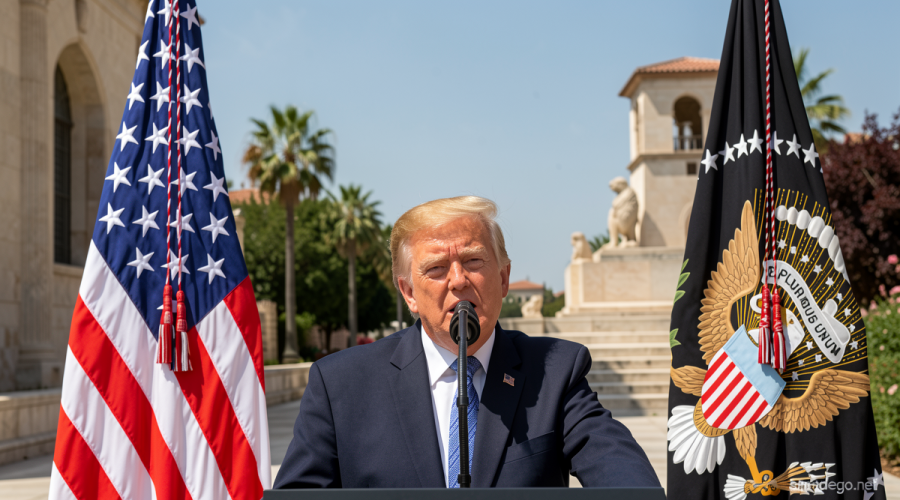
Sandego.net – President Donald Trump delivered a primetime address from the White House on Thursday evening that initially seemed unremarkable. Yet this particular speech regarding possible weaknesses within the American electoral framework may ultimately be remembered as a pivotal moment—especially when viewed as a preview of potential strategies Trump could employ to challenge the 2026 election results.
Declassified Documents and Their Significance
Similar to his April primetime address concerning the Iran conflict, Thursday’s presentation could have easily functioned as a standard daytime press briefing. The centerpiece of Trump’s remarks involved newly declassified documents that he asserted had been concealed from both himself and the American public. According to Trump, these papers demonstrated that the American election infrastructure is “catastrophically short” of the necessary standards.
However, an initial examination by CNN revealed that these documents primarily address vulnerabilities that were already well-documented within the American electoral system. Many of the concerns raised were also featured in a 2021 evaluation conducted by the United States intelligence community. Furthermore, much of the material that was recently made public appears to have undergone insufficient scrutiny. Trump himself referenced “raw intelligence” during his address, suggesting the information had not been fully processed.
The China Connection and Voter Files
Notably, before Trump alleged a massive cover-up, the first major piece of evidence he presented involved China allegedly acquiring hundreds of millions of American voter records. This claim, however, was not entirely new. The 2021 assessment had already noted that China “probably also continued longstanding efforts to gather information on US voters and public opinion; political parties, candidates and their staffs; and senior government officials.”
The intelligence community’s evaluation determined that China had been engaged in this activity since at least 2008, aiming to shape how it could influence American policy. Importantly, the assessment concluded that China did not actually interfere in the 2020 election. Trump also mentioned that China, as of 2019, was “undermining domestic confidence” in him—but this represents a different category of concern than direct election interference.
What the Evidence Actually Shows
Trump did not present concrete proof that any foreign nation had actually altered election outcomes or swung votes. Following the speech, conservative journalist John Solomon—who collaborated with the White House on releasing these documents—conceded that the intelligence community possessed “zero evidence that a foreign power flipped a vote in 2020, 2022 or 2024.” This represents a considerable acknowledgment, particularly when contrasted with Trump’s persistent assertions over the years.
“Put together, these disclosures reveal an election system so broken and so vulnerable that no one can possibly defend it,” Trump claimed. “It is not defensible.”
A Statement of Intent for 2026
Despite these limitations, the speech carried considerable weight as a potential declaration of future intentions. Considering Trump’s established pattern of falsely claiming that unfavorable elections are rigged—and the violence that erupted on January 6, 2021—his choice to deliver this address less than four months before an election that appears challenging for Republicans should give pause to the American political landscape.
Trump did not signal a heavy-handed federal intervention in election administration, such as disrupting voting procedures or deploying military personnel to polling stations, which some critics had anticipated. Instead, he appeared to set the stage for another episode of alleging stolen elections. He even went so far as to hyperbolically state that American elections were “worse than any Third World country.”
“But most importantly, addressing this crisis of election security demands that Congress must pass the SAVE America Act,” Trump said. He paused for effect, even sounding somewhat angry. Then he added: “How easy is that to do? Unless you want to cheat. The only reason you wouldn’t do it is you want to cheat because your policies are so bad and your candidates are so pathetic that you can’t get elected any other way.”
Political Reactions and Future Implications
The “SAVE America Act” does not currently seem likely to achieve passage. Several prominent members of Trump’s own party have encouraged him to recognize this reality. Nevertheless, if Congress fails to approve the legislation, it would not be difficult to envision Trump’s response following a potential Republican defeat in 2026.
All 24 Democratic governors issued a joint statement after the speech, asserting that Trump intended to “intimidate and silence voters.” They expressed concern that the president was laying groundwork for challenging election outcomes regardless of the actual results.
The speech ultimately serves as both a retrospective examination of existing vulnerabilities and a forward-looking strategy. Whether the concerns raised are genuine or politically motivated, Trump’s message is clear: he is preparing the American public for the possibility that the 2026 election may not meet his expectations—and that he will not hesitate to question its legitimacy if circumstances warrant it.