How Do You Costume an Uber-Rich Family? A Fashion-Forward Answer
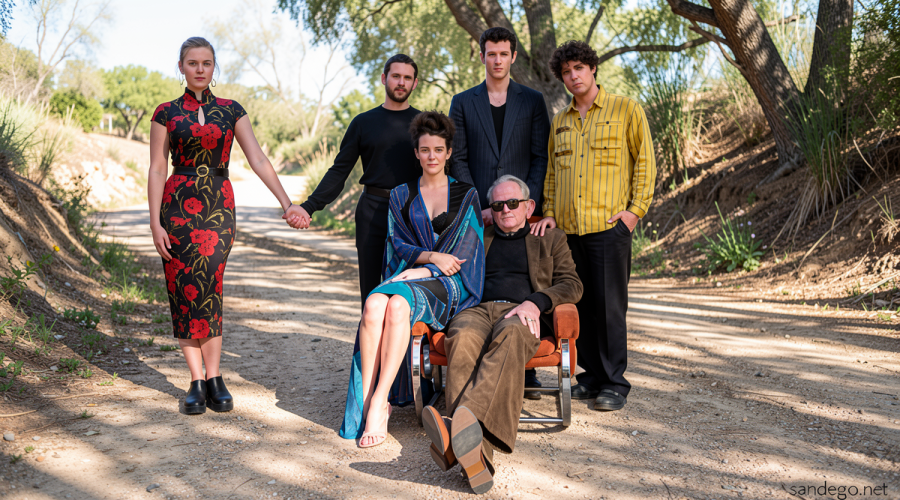
Sandego.net – How do you costume an uber-rich, dysfunctional family? The answer lies in treating their world like an endless dress-up party. In Karim Aïnouz’s latest film “Rosebush Pruning,” the American family is so intimately tethered by blood, desire, and an excessive interest in designer labels that any outsider’s arrival guarantees friction. When Elle Fanning’s character Martha, the girlfriend of eldest son Jack (Jamie Bell), is introduced, his sister Anna (Riley Keough) quickly dismisses the perceived intruder. She venomously characterizes Martha’s perfectly chic black and red floral dress as high street garb.
The Zara Dismissal and Family Dynamics
“It’s obviously not Zara,” costume designer Bina Daigeler clarified on a video call. “You can’t see who made it, which made it easier for Anna to say, ‘oh, it’s probably a Zara dress.'” The conclusion to one of the film’s more explicitly uncomfortable scenes, Anna’s remark follows a request by her widowed father (Tracy Letts), blind since the matriarch’s passing, to describe their guest’s appearance: dress, handbag, hair, bosom. Anna’s attitude speaks to the jealousy that fuels the movie’s wider narrative – Jack is adored, largely inappropriately, by all the members of his family – while his father’s probing highlights a warped sense of entitlement.
“The fittings were like a dress up party, and I think that suited the movie because it’s a family absolutely crazy about fashion.”
The four siblings – Anna, Jack, middle brother Ed (Callum Turner) and younger brother Robert (Lukas Gage) – are all adult and all still living at the family home, a modernist property in the hinterlands of Catalonia, Spain. By their own account they’re all overly enthusiastic about fashion, with access to the kind of wealth that allows them to focus solely on the pursuit of clothes and style, and this pre-occupation is tightly woven into the film’s dialogue. Indeed, the movie opens with Ed quizzing an older Greek man he’s befriended on the Belgian designer Ann Demeulemeester, before berating him for confusing his Bottega Veneta loafers for Sebago.
Loosely based on the 1965 Marco Bellocchio film, “Fists in the Pocket,” “Rosebush Pruning” is Aïnouz’s second English language film and was co-written by Efthimis Filippou. With its unconventional family dynamic, it adopts a similar energy to Yorgos Lanthimos’s absurd family drama “Dogtooth,” (also co-written by Filippou), while its eat the rich style of satire puts it in conversation with Emerald Fennell’s “Saltburn.” Aïnouz’s new feature, however, is extreme in its brand of dysfunction and study of incestuous lust, amped up by its arresting cinematography.
Costume Design as Family Reflection
Here it is Ed, whose early voiceovers announce the lay of land, that ultimately devises a violent plan to disrupt the family’s co-dependency, allowing Jack, an anomaly amongst the “lazy, mediocre, vapid, egotists,” a chance to live independently with his girlfriend. “It was very intuitive, between me and Karim, we had fun together immediately,” said Daigeler, who was Oscar-nominated for her work on 2020’s “Mulan” and led the costume department on the acclaimed Cate Blanchett vehicle “Tár.” “We’d meet early in the house before anybody else and exchange ideas. He mentioned the Spanish painter Joaquín Sorolla a lot, and I love Sorolla. He’s often on my moodboards.”
We were in Barcelona, near the sea, in the mountains with the family – all these emotions are somehow reflected in Sorolla’s paintings.” The fittings, she added, “were like a dress up party, and I think that suited the movie because it’s a family absolutely crazy about fashion. We are talking about a very deconstructed family, so I wanted to merge that into the costume design, making combinations that perhaps were not straightforward.” Of the brothers, Robert’s style is invariably the loudest, with the youngest son favoring silk shirts and knits by Versace, a brand he is infatuated with to an almost concerning degree: he dreams about Donatella and moreover, owns the same model of gun that killed Gianni.
Ed likes texture and typically wears light, neutral colors or sports-coded silhouettes, while Jack, mostly in plain tees or shirts, reaches a sartorial high point with a pistachio green suit he wears to view a house. The film’s biggest plot twist finds the sibling’s mother, played by Pamela Anderson, alive and living with her girlfriend Emma (Elena Anaya), which provided Daigeler with an additional environment to interpret. “That was also interesting and very fun,” noted the costume designer, who explored looser silhouettes for Anderson and, at one key moment, put the couple in matching boilersuits and rain boots. “She’s left everything and built her wardrobe up again, so we wanted something simple but elegant. Emma’s a little bit more masculine with stronger design choices – the pants and men’s shirts are a little rougher, for example.” In the neon-drenched world of ‘I Love Boosters,’ fashion is for the people. It is Anna’s wardrobe however, that most typifies the core family’s relationship with clothes and