
Officials across the U.S. push to remove Cesar Chavez’s name from streets, parks and holidays
Officials across the U.S. push to remove Cesar Chavez’s name from streets, parks and holidays
Recent claims of sexual misconduct against Cesar Chavez have sparked debates about his legacy, prompting local leaders to reconsider naming conventions for public spaces. The allegations, which include accusations of abuse by Dolores Huerta, are forcing a reassessment of how his name is celebrated in communities nationwide.
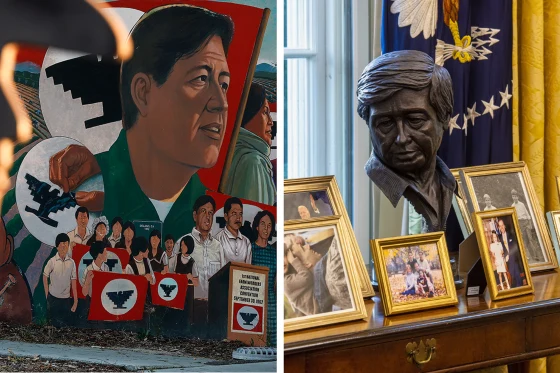
Chavez’s name is prominent in cities like Los Angeles, where Cesar Chavez Avenue runs through downtown. Phoenix also features a library and park bearing his name, while countless roads from Utah to Michigan carry his moniker. In California alone, over thirty schools are named after him, honoring his role in labor rights and civil rights movements.
“Chavez, a co-founder of what became the United Farm Workers, coerced me into sex once and raped me on another occasion,” said Dolores Huerta, 95, in a statement. She revealed her claims to The New York Times, which published an investigation detailing her and two other women’s accounts of being molested as children by Chavez.
As the controversy grows, officials in multiple states are exploring the possibility of renaming streets, parks, and holidays. Some have suggested shifting the focus to Dolores Huerta or renaming March 31—formerly Cesar Chavez Day—to Farm Workers Day. Public calls for change have intensified, urging leaders to address the past while recognizing the movement’s broader impact.
Chavez’s family expressed shock at the allegations, stating they were “deeply saddened” by the accusations of sexual impropriety from nearly five decades ago. They emphasized their commitment to the causes Chavez championed, while acknowledging the need to support survivors.
California Governor Gavin Newsom and his spouse, Jennifer Seibel Newsom, admitted they were unaware of Huerta’s experiences until recently. During a news conference, Newsom noted, “We’ll have to reflect on the movement’s legacy and its significance beyond one individual.”
The Congressional Hispanic Caucus described the allegations as “deeply disturbing,” advocating for the renaming of locations associated with Chavez to better honor the community and farmworkers who drove the movement forward. Los Angeles County Supervisor Hilda Solis echoed this, stating she would introduce a motion to evaluate renaming efforts and remove related imagery from civic art.
“We can honor the farmworker movement while confronting the truths it has uncovered,” Solis added. The debate highlights a tension between celebrating a civil rights icon and addressing his personal actions, as officials navigate the path forward.
