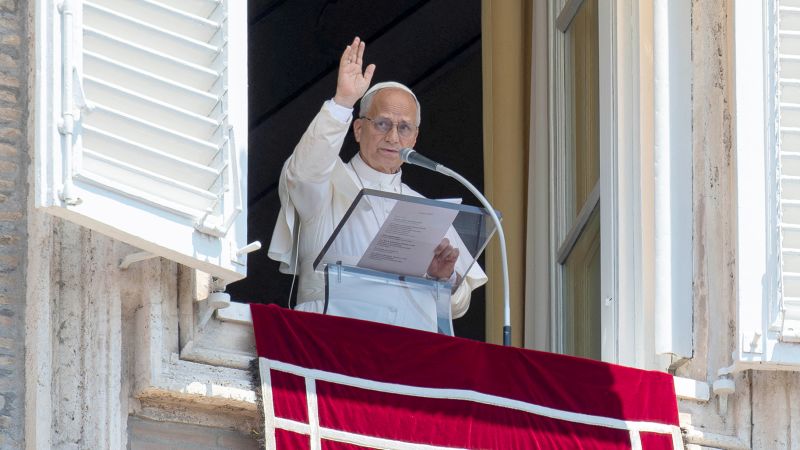
Pope Leo XIV Confronts Breakaway Catholic Group in Historic Ordination Move
Sandego.net – In a bold act that has sparked widespread attention, a faction of traditionalist Catholics has proceeded with the ordination of four new bishops without the consent of Pope Leo XIV, marking the first significant challenge to his papal authority. The ceremony, held in Écône, Switzerland, drew thousands of participants and was broadcast live in six languages on the group’s website. This move by the Society of Saint Pius X (SSPX) has raised concerns about the integrity of church leadership and the potential for further division within the Catholic community.
The Ordination as a Statement of Rebellion
The Society of Saint Pius X, a breakaway movement that has long opposed modernization within the Catholic Church, conducted the ordinations on Wednesday. The event, which took place under a white marquee, symbolized the group’s determination to uphold its vision of traditional practices. According to Vatican News, the gathering attracted approximately 15,000 attendees, highlighting the group’s continued influence despite its estrangement from the mainstream church.
Under Catholic canon law, the newly ordained bishops and their administrators are automatically excommunicated, severing their ties to the sacraments and the hierarchical structure of the Church. The pope had previously warned the SSPX that the ordinations would constitute a “schismatic” act, describing it as a “sin of extreme gravity.” His remarks came just days before the event, underscoring the urgency of the situation.
“Despite what has happened today, I hope dialogue can resume,” said Cardinal Pietro Parolin, the Vatican’s secretary of state, who expressed “deep sorrow” over the decision. He emphasized that the ordinations “break the unity of the Church and incur very specific sanctions—fundamentally, excommunication.”
A Legacy of Rebellion and Rejection
The SSPX traces its origins to 1970, when Archbishop Marcel Lefebvre founded the group in Switzerland. Lefebvre, a French prelate, sought to preserve pre-Vatican II traditions and resisted the reforms introduced during the Second Vatican Council. The group was formally suppressed by the Bishop of Fribourg in 1975, but it endured as a separate entity, advocating for a return to what it considers authentic Catholic teachings.
The SSPX’s most notable act of defiance occurred in 1988, when it ordained four bishops without papal approval. This event led to their excommunication and marked a turning point in the group’s relationship with the Vatican. Although Pope Benedict XVI later lifted the sanctions in 2009, one of the bishops, Richard Williamson, faced scrutiny for his controversial Holocaust-related statements. He was eventually expelled from the SSPX after being convicted of false claims about Nazi gas chambers.
Theological Divide and the Pope’s Priority
At the core of the SSPX’s opposition to the Vatican Council lies a rejection of key modern reforms, including the council’s emphasis on religious freedom, ecumenism, and the adaptation of Catholic worship. The group views these changes as compromises that have diluted the Church’s traditional teachings. They argue that the Catholic Church is in a “state of emergency,” necessitating the swift ordination of bishops to safeguard the faith.
Pope Leo XIV has made fostering unity a central goal of his papacy. However, the SSPX’s decision to proceed with the ordinations without papal consent threatens this objective. Cardinal Blase Cupich, a trusted ally of the pope, warned that the group’s actions risk creating a parallel structure within the Church’s hierarchy. “They are a small group, yet they misuse the rites of the Church when it comes to the ordination of bishops,” he stated, highlighting the pope’s resolve to address the issue through multiple interventions.
“While I remain open to dialogue, I am aware of the limits regarding these planned ordinations,” the pope said on June 16. “If they make that choice, I am sorry, but we must move forward.”
The Path to Excommunication and Future Implications
The excommunication of the four bishops represents a critical step in the Vatican’s effort to reaffirm its authority. Church law mandates that bishops in communion with the pope are essential to maintaining unity, a principle the SSPX has long contested. Their latest ordination is seen as an escalation of their defiance, with the potential to deepen the schism and challenge the papacy’s central role in the Church’s governance.
Despite its relatively modest size—comprising around 700 priests and 600,000 followers globally—the SSPX remains a formidable force. Its presence in the United States, including a headquarters in Missouri and a seminary in Dillwyn, Virginia, underscores its ability to mobilize adherents across continents. One of the newly ordained bishops, Father Michael Goldade, leads the seminary in Virginia, further intertwining the group’s activities with the American Catholic community.
The SSPX’s recent actions have also been accompanied by an effort to reinforce its ideological stance. A 28-page “profession of Catholic faith” was released to “enlighten souls in the face of modern errors,” aiming to articulate the group’s vision for the Church. Additionally, the group’s website detailed four days of events surrounding the ordinations, including the sale of a 75 Swiss Franc souvenir box containing four bottles of wine—a gesture meant to commemorate the ceremony and engage supporters.
A Test of Papal Resolve
The ordination of bishops without papal approval is not a new tactic for the SSPX, but its timing and scale have intensified the conflict. For decades, successive popes have attempted to reconcile with the group, recognizing its significance in the Catholic world. However, Pope Leo XIV’s firm stance suggests a shift toward stricter enforcement of church discipline.
Cardinal Cupich noted that the pope had extended numerous invitations to the SSPX to reconsider its approach, indicating a desire for dialogue even as the group pressed forward. The cardinal’s remarks highlight the tension between the Vatican’s efforts to maintain unity and the SSPX’s commitment to its own vision of Catholicism. This conflict may set a precedent for future disputes, with far-reaching consequences for the Church’s structure and doctrine.
As the situation unfolds, the broader Catholic community watches closely. The SSPX’s actions challenge the papacy’s authority while also testing its ability to navigate internal divisions. With the Church’s global membership numbering over 1.4 billion and its clergy exceeding 400,000, the threat posed by the SSPX may seem small in scale but carries significant symbolic weight. For Pope Leo XIV, this crisis represents a pivotal moment in his tenure, one that could shape the Church’s future direction for years to come.