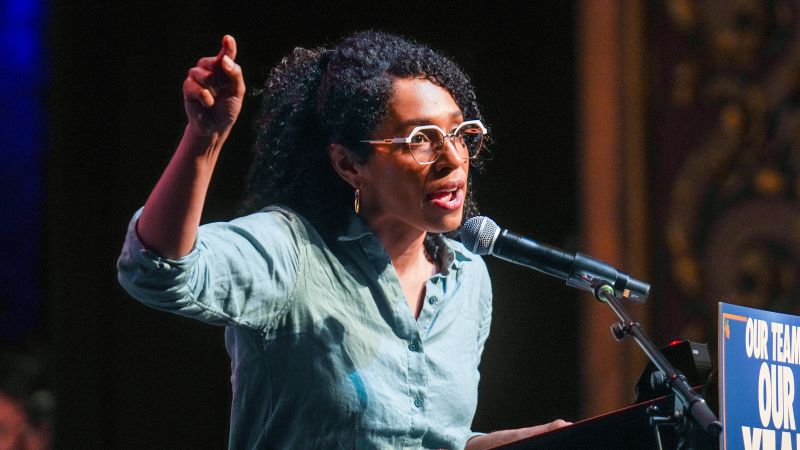
Darializa Avila’s Deleted Tweets Favorably Reference Communist Leaders and Marxism
Sandego.net – Recent analysis of deleted tweets from Darializa Avila’s account has revealed references to communist leaders and Marxist ideology, raising questions about her political stance. Darializa Avila, a 29-year-old sociology PhD candidate and Democratic congressional nominee backed by New York City Mayor Zohran Mamdani, gained attention after her primary election victory, which ousted incumbent Representative Adriano Espaillat. Her social media history, including content from a now-defunct Twitter account, showcases her advocacy for Marxist principles and favorable mentions of figures like Vladimir Lenin and other Soviet leaders. These tweets, removed from public view, have become a focal point for discussions about her alignment with leftist ideologies.
Political Journey and Academic Roots
Darializa Avila’s engagement with Marxist thought began during her undergraduate studies at Columbia University, where she was involved with Students for Justice in Palestine. Her activism intensified post-graduation, particularly in response to Israel’s actions in Gaza. By 2023, she had participated in a prominent rally in Times Square shortly after Hamas’ attack on Israel, where speeches emphasized revolutionary rhetoric and solidarity with Palestinian communities. This moment highlighted her growing embrace of political philosophies that challenge capitalist structures and prioritize systemic change.
Her deleted tweets reflect a consistent theme of critique against capitalism. Phrases such as “seize the means of production” and calls to dismantle institutions like police forces and prisons appeared frequently. One controversial tweet compared Black and Arab men to “fetishizing ugly colonizer women,” drawing criticism for its tone. Another post depicted her wiping “dirty hands” on the American flag, symbolizing a rejection of national symbols tied to capitalist values. These posts underscore her ideological commitment to Marxist principles.
Consumer Critique and Cultural Commentary
Archived tweets from 2020 to 2022 show a deliberate blend of political theory and everyday life. In April 2020, she critiqued the idea that people would reject communism due to a lack of soup varieties, humorously arguing that capitalism’s failures were evident in the “perfect illustration” of its shortcomings. This metaphor became a recurring element in her discourse, linking personal experiences to broader economic critiques. She also targeted popular culture, labeling the film “Anastasia” as an “explicitly anti-USSR kid’s movie” and mocking a viral claim that Disney had removed it due to its anti-Russian bias.
“I just cannot get over the fact that the universe has foisted upon us the perfect illustration of literally every failing of capitalism and people are still like we can’t be communists cuz there won’t be enough types of soup,”
the post read, illustrating her ability to blend humor with ideological messaging. Her commentary extended to music, with a reference to Sheryl Crow’s “Soak Up the Sun” as “bootstrap capitalist propaganda” after noticing its opening lyric, “my friend the communist.” These tweets reveal a strategic approach to weaving Marxist ideas into relatable contexts, enhancing their resonance with broader audiences.
Engagement with Revolutionary Leaders
Avila’s deleted tweets also highlighted her admiration for revolutionary figures. She frequently cited Assata Shakur, a former Black Liberation Army member, and praised leaders like Ho Chi Minh and Fidel Castro for their “revolutionary struggle” contributions. This emphasis on global communist icons positioned her within a movement that celebrates diverse leftist leaders, contrasting with her critiques of Marx and Lenin. Her alignment with these figures underscores a deeper ideological connection to Marxist theory and its historical applications.
Her online activity included a playful dismissal of what she saw as capitalist distractions, such as the “banned books” displays in public libraries. By 2023, she had also become a lightning rod for debate within the Democratic Party, with her tweets sparking discussions about the role of Marxism in modern politics. While some viewed her content as a bold expression of progressive values, others questioned its impact on her political credibility. The continued relevance of her deleted tweets speaks to the enduring nature of ideological discourse in contemporary public life.