
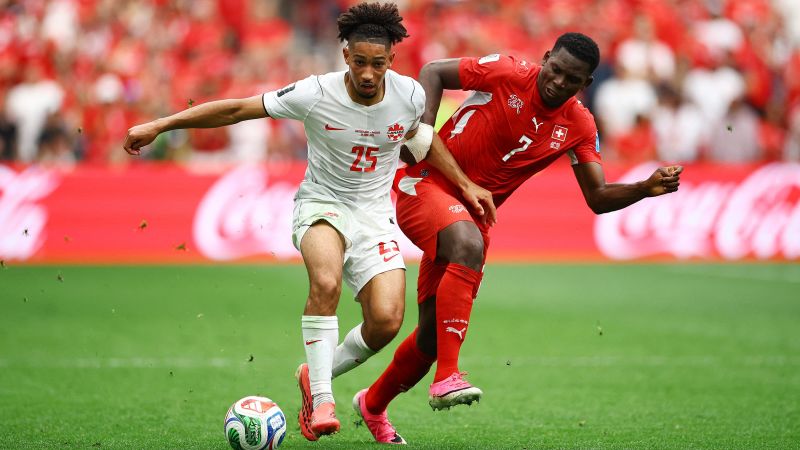
Canada faces an unprecedented World Cup situation as the knockout rounds begin
Sandego.net – The 2026 World Cup has taken an unexpected turn, with Canada now navigating a rare scenario as the tournament shifts to its high-stakes knockout stage. For the first time in World Cup history, a co-host nation will play a critical round-of-32 match outside its own country, setting the stage for a moment that could redefine the tournament’s dynamics. The stakes are higher than ever, as the Canadians aim to secure their place in the next round against South Africa, a team that has long struggled to reach this point in the competition. This development marks a pivotal moment for both nations, with fans and analysts alike questioning whether the World Cup’s logistical challenges have outpaced its strategic planning.
The group stage, which has dominated the early weeks of the tournament, is often remembered for its unpredictability and the emotional rollercoaster it provides. From underdog triumphs to dramatic upsets, these matches have become a celebration of global soccer’s diversity. However, as the calendar flips to the knockout rounds, the atmosphere changes. This week’s single match, Canada versus South Africa at SoFi Stadium in Los Angeles, symbolizes a shift toward intensity and high pressure. While the group phase is filled with excitement, the knockout stage demands precision, resilience, and a clear path to victory.
Canada’s journey to this point has been anything but straightforward. After being eliminated from the group stages in 1986 and 2022, the team’s success in 2026 feels like a long-awaited breakthrough. Their 2-1 defeat to Switzerland in the final group game left them in second place of Group B, forcing a departure from Canadian soil for their next challenge. The decision to host the Round of 32 in Los Angeles has sparked debate, with many questioning whether FIFA’s planning overlooked the emotional weight of playing on home turf. For a nation that had never advanced beyond the group stage in a World Cup before, this arrangement feels like an anomaly rather than a calculated move.
South Africa, on the other hand, has endured a different kind of journey. The team’s absence from the knockout rounds in 1998, 2002, and 2010 has made their current qualification feel like a redemption arc. Their narrow 1-0 win over South Korea in the final group match—coupled with a last-minute penalty against the Czech Republic—secured their spot in the Round of 32. This achievement, while hard-earned, has come at a cost, as the team now faces a daunting challenge in the U.S. The question remains: Can the Bafana Bafana squad replicate their group-stage resilience under unfamiliar conditions?
“
This is a match of firsts for several reasons. For starters, it’s the first knockout game of the 2026 tournament. But more notably, it’s the first time both teams will compete in the knockout stages of a men’s World Cup. Canada’s third attempt at this stage feels like a triumph in itself, while South Africa’s journey has been a lesson in perseverance.
”
The World Cup’s structure has always been a balancing act between tradition and innovation. Hosting nations like Canada, the U.S., and Mexico have brought fresh energy to the event, but the logistical demands of spreading matches across multiple countries have created unique challenges. Critics argue that FIFA’s decision to place Canada’s knockout game in Los Angeles was a misstep, especially given the team’s historical struggles. The lack of guaranteed advancement for the Group B winners further complicated the situation, as Canada’s fate hinged on a single match that now requires them to travel south of the border.
As the tournament progresses, the 2030 World Cup is expected to amplify these trends. Marking its 100th anniversary, the event will be co-hosted by South America, Europe, and North Africa, with matches set in Montevideo, Buenos Aires, and Asunción. This sprawling format will test the adaptability of teams and fans alike, as the World Cup becomes a global spectacle rather than a regional one. The Canadian experience in 2026 may serve as a blueprint for future tournaments, where host nations might face similar hurdles in securing their own knockout matches.
The emotional toll of this setup cannot be ignored. For Canadian fans, the thought of a critical match being played in Los Angeles, rather than Toronto or Vancouver, has sparked a mix of pride and frustration. The team’s previous World Cup exits are now overshadowed by the opportunity to prove themselves on the international stage. Meanwhile, South Africa’s players must channel the same determination that carried them through the group stages, even as they prepare for a new chapter. The pressure is immense, but the potential for history is undeniable.
The matchup itself is a testament to the World Cup’s unpredictable nature. Canada’s recent form suggests they are capable of challenging strong opponents, while South Africa’s late surge in the group phase highlights their fighting spirit. The 3 p.m. ET kick-off at SoFi Stadium will be more than a game—it will be a test of will, a clash of narratives, and a moment that could reshape the tournament’s legacy. Whether the Canadians can secure a victory or if South Africa’s underdog story continues, the outcome will ripple through the global soccer community.
As the World Cup continues to evolve, the balance between home advantage and international exposure will remain a central theme. The 2026 edition has already demonstrated that the tournament is not without its quirks, and future iterations will likely face similar dilemmas. For now, Canada and South Africa stand at the intersection of history and ambition, their paths determined by a combination of skill, strategy, and the ever-changing landscape of global football. The next chapter of this story will unfold in the U.S., where the hopes of a nation are on the line.
With the group stage behind them and the knockout rounds in full swing, the World Cup’s drama has only just begun. The decision to host this crucial match in Los Angeles reflects FIFA’s growing commitment to a worldwide footprint, but it also underscores the challenges of maintaining the essence of a host nation’s identity in a global event. As fans around the world prepare to witness the next round of action, the 2026 tournament reminds us that while the rules may change, the passion for the game remains constant.