Venezuelans Search for a Future Amid Earthquake Catastrophe
Sandego.net – As the nation grapples with the aftermath of two catastrophic earthquakes that struck on Wednesday, Venezuelans are left questioning whether their country can endure the combined weight of economic turmoil and natural disaster. The tremors, measuring 7.2 and 7.5 on the Richter scale, delivered a devastating blow to infrastructure and lives, compounding years of political instability and financial collapse. The death toll has surpassed 1,400, with thousands still unaccounted for, leaving communities in despair and prompting a frantic search for survivors.
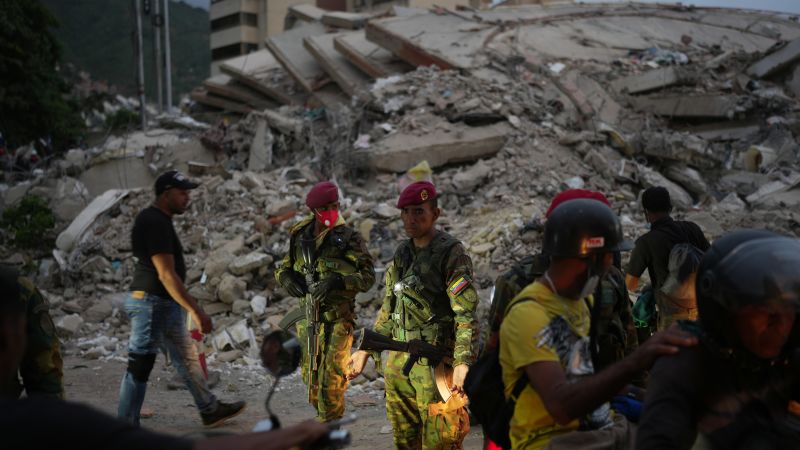
Rescue operations continue in the shadow of collapsed buildings, with neighbors and emergency workers combing through rubble to uncover the fate of those trapped beneath. For many, the dual shocks of the quakes have not only disrupted daily life but also amplified the sense of vulnerability that has defined Venezuela’s recent history. “This is a moment that will test our resilience,” said Neida Pernilla, a resident of Caracas, whose home was reduced to ruins. “But we have to believe that hope still exists.”
“I think we have to learn from everything we’re going through. That life is fleeting — just a moment. We have to thank God, the Virgin Mary, whatever we have faith in, for the fact that we’re alive, and we need to be more human, more cooperative, more humble.”
The earthquakes have struck indiscriminately, claiming victims from all walks of life. In the northern city of La Guaira, one of the hardest-hit areas, supplies of essential goods have dwindled as residents scramble to secure food and clean water. The city, located just 20 miles from the capital, now faces isolation due to collapsed roadways and damaged bridges, hindering the flow of aid and resources. “It’s been us, the families, trying to dig through debris to find our relatives,” said Mileidy Duque, 43, who narrowly escaped the destruction of her apartment. Her family, living in a government housing complex inaugurated by ousted President Nicolás Maduro in 2015, remains in limbo as the search for missing loved ones intensifies.
Decades of economic mismanagement have left the government struggling to respond effectively to the crisis. While acting President Delcy Rodríguez urged citizens to remain steadfast, the reality on the ground tells a different story. “We are not alone in this,” she declared, but many Venezuelans argue that the nation’s weakened infrastructure and limited resources make survival a daily battle. The twin quakes have exposed the fragility of a system already stretched thin by years of shortages and political upheaval.
For residents like Lindomar Milla, the trauma of the disaster echoes memories of a previous tragedy. In December 1999, La Guaira was devastated by massive landslides triggered by torrential rains, resulting in an estimated 15,000 fatalities. Though an official count was never released, researchers at the Central University of Venezuela noted the scale of the devastation. “This was much worse than the mudslides,” Milla said, sitting outside the Caracas morgue where his sister and brother-in-law’s remains were displayed. “So many people are still looking for their loved ones. There are people who traveled to La Guaira and found buildings that no longer exist.”
Human Stories Behind the Numbers
Amid the chaos, the human toll of the disaster becomes starkly clear. Susana Henríquez, standing near the remnants of the Petunia residential complex in the Palos Grandes neighborhood, described the emotional weight of the tragedy. “I have been feeling so much pain and uncertainty,” she said, her voice trembling. The Petunia complex, a symbol of middle-class stability, saw two towers collapse, leaving families to confront the loss of homes, livelihoods, and lives.
“We want to trust that our neighbors in the Petunia I will be rescued alive,” Henríquez told CNN. “I have so many friends there, and it’s hard to imagine them gone.”
The Petunia complex, once a beacon of hope for many, now stands as a testament to the fragility of Venezuela’s social fabric. Families in the area, accustomed to living with scarcity, face a new level of despair as they mourn the dead and await the fate of the missing. “It’s not just about the numbers,” Henríquez added, her tears mixing with the dust of the rubble. “It’s about the people — their names, their stories, their connections.”
The 72-hour window for rescue efforts has passed, but the search for survivors continues. Hundreds of aftershocks have kept the ground trembling, adding to the anxiety of those still trapped in the wreckage. “Every second feels like an eternity,” said a survivor from the Luisa Caceres de Arismendi building, where Neida Pernilla and her relatives survived. “The nerves are raw, and the hope is thin, but we keep going.”
As the days stretch on, the tropical heat and lingering smells of destruction have become an unrelenting presence. Many survivors now wear face masks to shield themselves from the stench of death and decay, a stark reminder of the scale of the loss. The resilience of Venezuelans, however, remains unbroken. In the face of calamity, communities have come together to share what little they have, forming makeshift support networks in the absence of government aid.
For those who have lost everything, the earthquake serves as both a physical and emotional reckoning. Neida Pernilla, who escaped unscathed, spoke of the need to find strength in unity. “We are more than the rubble we stand on,” she said. “We are the survivors, the families, the voices that refuse to be silenced.” Her words reflect a broader determination among Venezuelans to persevere, even as the path to recovery seems uncertain.
The twin quakes have not only deepened the crisis but also highlighted the vulnerabilities of a nation already teetering on the brink. With millions displaced and the economy in freefall, the question remains: will Venezuela’s people find a way to rebuild, or will the disaster mark the beginning of a new era of despair? As the search for survivors continues, the answer may emerge not from statistics, but from the enduring spirit of those who call this country home.