JD Vance’s Defense of Nixon’s Legacy Amid Corruption Allegations
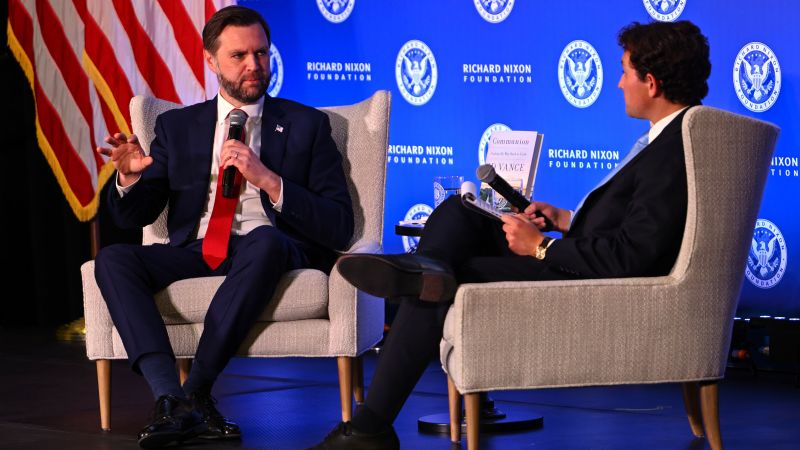
Sandego.net – JD Vance, the vice president and potential 2028 presidential candidate, recently drew attention for his defense of former President Richard Nixon, positioning him as a figure whose reputation has been unfairly tarnished. This move has sparked discussions about the strategic implications of aligning with Nixon’s narrative in the context of ongoing scrutiny of Donald Trump’s leadership. During a visit to the Nixon Presidential Library and Museum in California, Vance made pointed comparisons between Nixon’s political downfall and the current challenges facing Trump, suggesting that both leaders face similar pressures from entrenched institutions.
A Parallel Between Nixon and Trump?
Vance’s remarks, delivered during his appearance at the Nixon Library, highlighted a perceived similarity between the 1970s Watergate scandal and the controversies surrounding Trump’s first term. He argued that Nixon’s resignation was a result of a “deep state” conspiracy, a term often used to describe bureaucratic or media-driven efforts to undermine presidential authority. “If Watergate happened today, it would be like a 12-hour news story,” Vance joked, implying that the public’s reaction to corruption allegations has diminished since Nixon’s era.
“I think that his historical legacy is enjoying a bit of a renaissance — but I think deservedly so.”
This statement, while seemingly complimentary, has been interpreted as a calculated attempt to reshape perceptions of Nixon’s legacy. Vance also drew a parallel between his own political standing and Nixon’s, noting their shared status as vice presidents who were “hated by the media.” “I’ve always liked Richard Nixon,” he added with a smile, framing his admiration as a personal preference rather than a political maneuver.
However, the notion that Nixon’s legacy is experiencing a “renaissance” remains contentious. While some conservative figures have worked to rehabilitate his image in recent years, the broader public’s view of Nixon has not shifted significantly. A Gallup poll conducted in December 2024 revealed that 54% of Americans rated Nixon as “below average” or “poor,” with only 12% considering him “above average” or “outstanding.” These figures place Nixon among the least popular presidents in modern history, even within his own party.
Strategic Motives Behind the Comparison
Analysts suggest that Vance’s focus on Nixon may serve a dual purpose: to bolster his own political credibility and to indirectly defend Trump. By framing Nixon’s scandal as a product of the “deep state,” Vance appears to be distancing Trump from similar accusations. This tactic could be particularly effective as the 2028 election cycle approaches, when Trump’s potential vulnerabilities will be under intense scrutiny.
Vance’s comments also reflect a broader effort among conservative leaders to reframe historical narratives. In 2023, GOP presidential candidate Vivek Ramaswamy visited the Nixon Library and praised him as “the most underappreciated president of our modern history.” Such endorsements highlight a growing movement to portray Nixon not as a symbol of corruption, but as a misunderstood leader whose policies were unfairly criticized. However, these efforts have not yet translated into widespread public approval, as evidenced by the Gallup poll’s stark findings.
“By the way, if you look at the story of how the deep state took down Richard Nixon, it’s not all that different from what the same groups of people — the same institutions — tried to do to Donald Trump in the first Trump administration.”
Vance’s argument hinges on the idea that both Nixon and Trump have faced systemic challenges from powerful institutions. While this may be true, it also raises questions about the effectiveness of such comparisons in altering public opinion. Nixon’s resignation in 1974 was a defining moment in American politics, and its legacy continues to shape discussions about executive accountability. By downplaying Watergate’s significance, Vance may be attempting to weaken the narrative that corruption is a central issue in Trump’s tenure.
Public Perception and Political Strategy
Despite the efforts to revive Nixon’s reputation, his image remains largely negative in the eyes of many voters. The Gallup poll from 2024 underscores this trend, with nearly two-thirds of Americans holding Nixon in low regard. Even among Republicans, only 19% viewed him positively, compared to 39% who rated him negatively. These statistics suggest that while some conservative voices advocate for Nixon’s rehabilitation, the general populace has not fully embraced it.
Yet, there is evidence that Vance’s approach could resonate with certain audiences. By linking Nixon’s scandals to the “deep state,” he may be appealing to voters who perceive the media and federal agencies as politically biased. This strategy aligns with a larger trend of shifting blame from individual leaders to systemic forces, which has been a hallmark of right-wing rhetoric in recent years. Vance’s comments also echo the sentiment that Watergate, once a symbol of presidential misconduct, is now seen as an overblown event in a more politically polarized era.
The vice president’s emphasis on Nixon’s legacy could be part of a broader campaign to position Trump as a victim of unfair political attacks. By framing the Watergate scandal as a product of institutional bias rather than personal corruption, Vance may be aiming to create a narrative where Trump’s alleged misdeeds are viewed as similarly circumstantial. This could help shield Trump from the kind of sustained scrutiny that has plagued his presidency, especially as the Justice Department and congressional oversight face scrutiny themselves.
Implications for the 2028 Election
While Vance’s praise for Nixon may seem incongruous with the current political climate, it could serve as a valuable tool in shaping the 2028 race. The mention of the “deep state” resonates with a segment of the electorate that distrusts federal institutions and believes Trump’s critics are politically motivated. By highlighting this parallel, Vance may be positioning himself as a leader who understands the challenges of holding power accountable.
However, the long-term impact of his remarks depends on whether the public perceives Nixon’s legacy as genuinely deserving of revival or if it is merely a strategic ploy. Vance’s insistence on Nixon’s “renaissance” could be a sign of his broader approach to political messaging, where historical comparisons are used to frame contemporary events. This tactic has been employed by other politicians to align their agendas with the past, but its effectiveness will depend on how well it connects with voters’ current concerns.
As the midterms approach, the strategic importance of these comments becomes more apparent. If Democrats gain control of one or both legislative chambers, they will have the authority to launch investigations into Trump’s activities. Vance’s focus on Nixon’s downfall may be an attempt to prepare his audience for the possibility of similar scrutiny. By emphasizing the role of institutions in Nixon’s resignation, he may be suggesting that Trump’s political fate is similarly tied to the actions of a powerful, yet biased, establishment.
In the end, Vance’s remarks about Nixon are more than just a nostalgic nod to history. They are a carefully crafted narrative that seeks to redefine the meaning of corruption in the context of modern politics. Whether this strategy will succeed depends on how effectively it reshapes public perception — and how much the electorate is willing to overlook Nixon’s scandals in favor of Trump’s narrative.