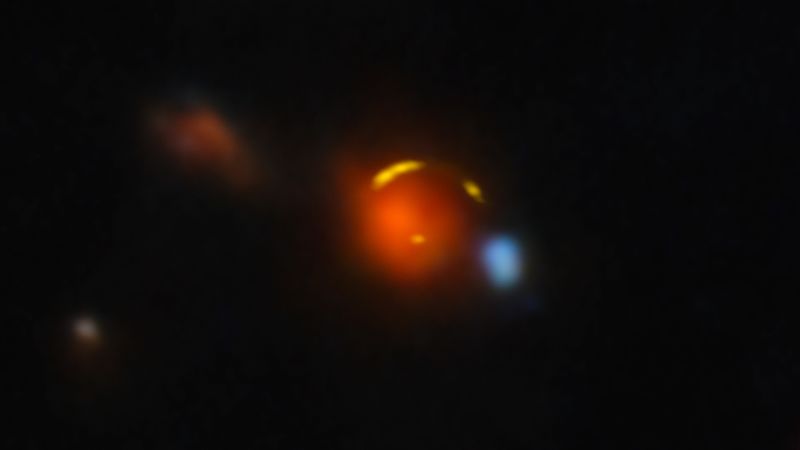
Astronomers Discover Neutrino Source in Distant Galaxy
Tracking the Elusive Cosmic Particle
Sandego.net – Scientists have made a significant breakthrough in identifying the source of high-energy neutrinos, a mysterious class of subatomic particles. A newly discovered galaxy, referred to as the “Shadow Blaster,” appears to be the origin of a neutrino detected on Earth. This finding, published on June 17 in *Nature Astronomy*, marks a major step forward in the quest to understand these elusive particles, which traverse the cosmos with minimal interaction. The discovery underscores the importance of combining neutrino detection with multi-wavelength observations to decode their cosmic origins.
Neutrinos, known for their ghostly nature, possess no electric charge and interact weakly with matter. This makes them incredibly difficult to trace, as they can pass through vast distances undetected. Their sources range from supernovae to stellar nuclear fusion and the decay of heavy particles. However, pinpointing specific origins has been a challenge, even with state-of-the-art facilities like the IceCube Neutrino Observatory. The recent study provides a new method for narrowing down these sources by linking neutrino data with other celestial observations.
A Cosmic Coincidence
A key moment in the research came when a high-energy neutrino detected in 2021 by IceCube coincided with an unexpected flare from the Shadow Blaster galaxy. The event, designated IC 210922A, occurred in the direction of the Eridanus constellation, sparking a flurry of activity among astronomers. By analyzing the galaxy’s activity across multiple light spectrums, the team uncovered a hidden star-forming region that could explain the neutrino’s origin.
“The neutrino’s path aligned with the galaxy’s infrared emission, suggesting it was produced in a dense stellar nursery,” explained Dr. Yuji Urata of MITOS Science Co. Ltd. in Taiwan. “This connection required both neutrino data and precise optical and infrared observations to confirm.”
Further analysis revealed that the Shadow Blaster galaxy was positioned behind a massive gravitational lens, which amplified its infrared light. This allowed researchers to detect its star-forming core, which emits intense radiation. The galaxy’s composition, rich in dust and gas, obscures it in optical wavelengths but shines through in infrared, making it a unique candidate for neutrino production.
Gravitational Lensing and Stellar Nurseries
Researchers used the Atacama Large Millimeter/submillimeter Array in Chile to confirm the gravitational lensing effect. This phenomenon, where the light from distant objects is bent by intervening mass, magnified the Shadow Blaster galaxy’s star-forming regions, making them detectable. The findings suggest that such dense stellar nurseries may be significant sources of high-energy neutrinos, challenging previous assumptions about their origins.
“Gravitational lenses act as natural telescopes, revealing details about distant galaxies that would otherwise remain hidden,” Urata noted. This discovery highlights the role of cosmic structures in shaping our understanding of astrophysical phenomena. The Shadow Blaster galaxy’s activity, now confirmed to be a potent neutrino emitter, offers insights into the mechanisms driving high-energy particle production in the universe.
Implications for Neutrino Research
The identification of the Shadow Blaster galaxy as a neutrino source opens new avenues for astrophysics. It demonstrates that multi-wavelength observations are essential for linking neutrino events to their cosmic origins. By integrating data from radio, infrared, and optical telescopes, scientists can now explore previously unseen regions of the universe for similar activity.
Future studies will focus on identifying more such galaxies to build a comprehensive map of neutrino sources. This could lead to advancements in understanding cosmic ray acceleration and the role of supermassive black holes in particle emission. The Shadow Blaster galaxy serves as a critical case study, bridging the gap between neutrino detection and visible celestial phenomena.