Mamdani Defends Criticism of AIPAC After Accusations of Antisemitism
Political Firefighting in New York
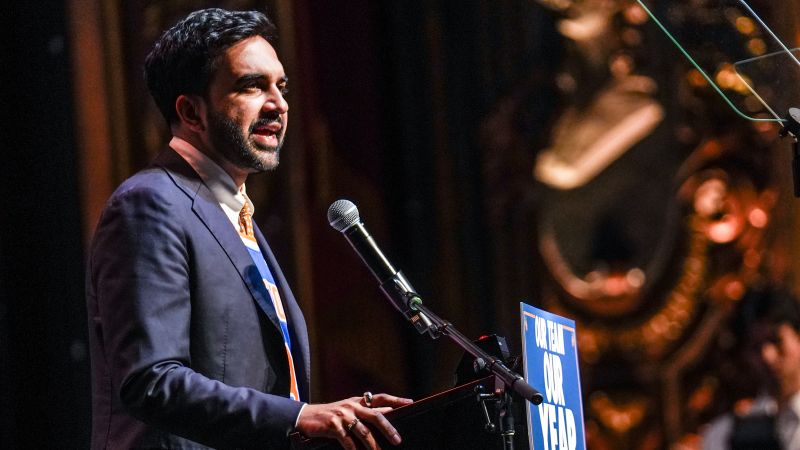
Sandego.net – On Monday, New York City Mayor Zohran Mamdani addressed mounting pressure from Jewish community leaders who accused him of spreading antisemitic rhetoric. The controversy emerged after his sharp critique of the American Israel Public Affairs Committee (AIPAC) sparked accusations of targeting Jewish identity. Mamdani, a vocal opponent of Israel’s policies, defended his comments during a press conference at City Hall, emphasizing his focus on organizational actions rather than personal attacks.
“When I speak about AIPAC, I’m highlighting an entity that has consistently upheld the status quo, obstructing efforts to achieve safety for people—not only in Palestine but across the broader Middle East region. It’s a system built on immorality,” Mamdani stated, linking the group’s influence to Israeli military operations in Gaza.
Mamdani’s remarks came amid a heated political battle in New York’s 13th Congressional District. The mayor, who has endorsed a slate of progressive candidates, argued that AIPAC’s spending in the New York House primary was part of a larger strategy to divide voters. “They channel millions of dollars through dark money to maintain their power, ensuring we turn on each other instead of uniting behind necessary moral reforms,” he added, criticizing the group’s tactics in the campaign.
Context of the Accusations
The backlash against Mamdani intensified after Jewish leaders claimed his comments equated the entire pro-Israel lobby with antisemitism. Ted Deutch, CEO of the Anti-Defamation League, condemned the mayor’s use of the term “monsters” to describe AIPAC donors, warning of the broader implications. “Calling fellow New Yorkers ‘monsters’ is not just harsh—it’s dangerous,” Deutch wrote on X, noting that the city’s Jewish population exceeds one million.
“Swap ‘AIPAC’ for ‘Jews’ and you’re looking at the classic antisemitic conspiracy theory. This isn’t criticism—it’s using the mayor’s platform to mask antisemitism,” Democratic Rep. Josh Gottheimer, a Jewish New Jersey lawmaker, tweeted.
Gottheimer, who has also criticized AIPAC’s influence, pointed to the group’s role in funding candidates aligned with Israeli interests. Federal Election Commission records show that AIPAC’s super PAC, United Democracy Project, contributed over $600,000 to BOLD America last month. This support helped fund television ads promoting Rep. Adriano Espaillat, a candidate Mamdani’s endorsed challenger, Darializa Avila Chevalier, is contesting in the district.
Mamdani’s Justification
In response to the accusations, Mamdani clarified his use of the term “monsters” was not personal but ideological. “I’m quoting Antonio Gramsci, the founder of the Italian Communist Party, to describe those who hinder the creation of a new world order,” he explained. “These are the same individuals who flood airwaves with deceptive ads to undermine our progressive candidates.”
“I used the word ‘monsters’ to label the political system that has long asked working people to lower their expectations. It’s about sustaining a status quo that leaves communities starving for resources, all in the name of preserving power,” the mayor said.
Mamdani’s critique extended beyond AIPAC, targeting super PACs like United Democracy Project. He cited examples of deceptive advertising against candidates such as Brad Lander and Claire Valdez, arguing that these tactics reflect a broader pattern of influence in New York’s elections. “This isn’t just about one organization—it’s a systemic issue that affects multiple races,” he stated, underscoring his stance on campaign finance reform.
The Gaza Ceasefire and Moral Accountability
Mamdani also linked his criticism to the ongoing humanitarian crisis in Gaza. Referring to the Palestinian Ministry of Health’s report, he highlighted the over 1,000 lives lost since the fragile ceasefire took effect in October. “We must ask how such destruction occurs overseas, and who enables it,” he said. “It’s time to hold those who profit from this system accountable.”
His remarks reflect a growing tension between progressive voices and pro-Israel advocates in New York. While AIPAC has historically been a key player in supporting candidates aligned with Israeli interests, Mamdani’s campaign has positioned itself as a counterforce. The mayor’s alliance with progressive challengers has drawn criticism from Jewish leaders, who fear his language could deepen the divide between communities.
Reactions and the Path Forward
AIPAC, which has spent millions to bolster pro-Israel candidates in congressional primaries this year, faced scrutiny for its role in funding misleading ads. The group’s strategy has often focused on domestic issues to sway public opinion, a tactic Mamdani labeled as part of a broader effort to stoke division. “They use the airwaves to paint us as enemies, when the real battle is for justice and equity,” he argued.
Despite the criticism, Mamdani remains steadfast. He pointed to the increasing death toll in Gaza as evidence of the system’s failure. “Even with a ceasefire, the violence continues. That’s a sign of the status quo’s immorality,” he said. The mayor’s defense hinges on framing AIPAC as an obstacle to progress rather than a representative of Jewish interests.
AIPAC’s Response and the Political Landscape
CNN contacted AIPAC for comment, seeking clarification on their spending practices and the mayor’s allegations. While the group has not yet issued a formal response, the controversy underscores the stakes of the upcoming New York House primary. Mamdani’s allies argue that the fight against AIPAC’s influence is critical to advancing progressive agendas, while opponents warn of the risks of conflating the entire lobby with antisemitism.
As the political battle intensifies, the debate over AIPAC’s role in New York’s elections highlights the complex interplay between ideology and influence. Mamdani’s use of charged language has sparked a broader discussion about how to balance criticism of political entities with respect for Jewish identity. For now, the mayor’s stance remains a focal point in the city’s political discourse, with the outcome of the primary likely to shape the conversation in the coming weeks.
The situation also raises questions about the effectiveness of campaign finance reforms. With AIPAC and other super PACs pouring millions into elections, Mamdani’s critique of their tactics could resonate with voters seeking transparency. However, the challenge lies in ensuring that criticism doesn’t inadvertently marginalize Jewish communities, a concern voiced by leaders like Deutch and Gottheimer.
As the dust settles, the intersection of politics and identity remains a contentious issue. Mamdani’s defense of his statements and the accusations from Jewish leaders illustrate the high-stakes nature of the debate. Whether his approach strengthens his campaign or alienates key allies will depend on how the public perceives the balance between ideological critique and personal attack.