
How Ukraine Broke Through Russia’s Air Defenses
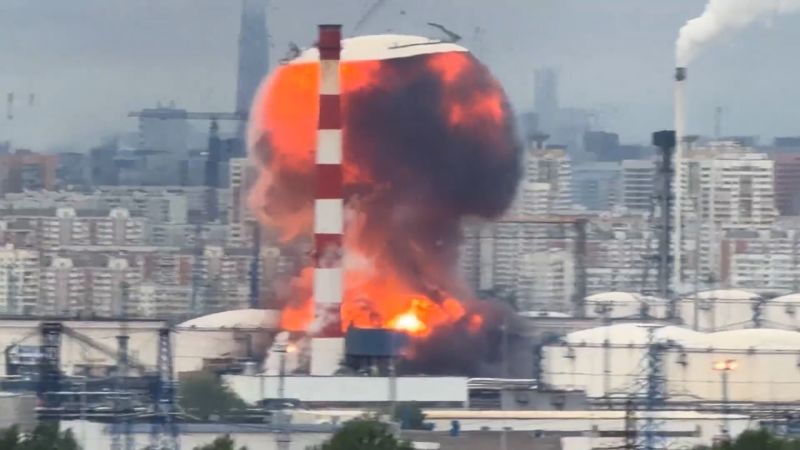
Sandego.net – On Thursday, a swarm of Ukrainian drones targeted Moscow, igniting a chaotic reaction from Russian forces. The attack, which marked the largest strike on the Russian capital since the full-scale war began, exposed vulnerabilities in Moscow’s air defense network. Footage shared by CNN and analyzed by military experts revealed a disorganized response, with soldiers hastily deploying portable air-defense systems on a bustling highway while civilians scrambled for shelter. The videos captured a moment of unpreparedness, as a drone, possibly neutralized by Russian defenses, crashed into a building within a crowded market square. In another clip, a Russian missile appeared to miss its intended target, striking an oil storage facility on the outskirts of the city and creating a visible plume of smoke.
Experts Call the Response “Unprofessional”
“The video showing soldiers firing man-portable air defense systems (MANPADS) on a busy highway is indicative of a hasty, ad-hoc, and frankly unprofessional response to the attack,” remarked Stu Ray, a senior analyst at McKenzie Intelligence Services. He highlighted the lack of coordination, noting that military equipment was dangerously close to civilian vehicles and pedestrians. “This underscores the strain on Russia’s defense capabilities as they are forced to react rather than plan,” Ray added.
The incident reflected a broader trend in the conflict, where Ukraine has systematically challenged Russia’s air defense infrastructure. Since 2024, Kyiv has intensified its long-range strikes against Russian oil refineries and military installations, extending the war’s reach beyond the frontlines. The recent breakthroughs in St. Petersburg and repeated attacks on Moscow have brought the fighting closer to Russia’s heartland, according to Ukrainian military sources. “This is a shift in tactics,” said one official, emphasizing the strategic focus on dismantling Russia’s defensive capabilities.
Strategic Shifts and Targeting of Key Systems
Initially, Russia concentrated its air defense systems along the border with Ukraine and the frontline, leaving urban centers and infrastructure relatively unprotected. However, Kyiv’s evolving strategy has forced Moscow to disperse these defenses, stretching resources thin. Over the years, Ukrainian forces have targeted not only enemy aircraft but also radar detection systems and launchers, aiming to degrade Russia’s ability to monitor and intercept incoming threats.
According to Ukraine’s Armed Forces, the country has destroyed 166 “anti-air elements” this year alone, with over 1,432 such systems neutralized since the full-scale invasion began in 2022. This cumulative effort has weakened Russia’s capacity to mount a unified defense. “We’ve been methodically eroding their infrastructure, making it harder for them to respond effectively,” explained a defense analyst. The attack on Moscow was a culmination of this strategy, demonstrating how drone technology has become a game-changer in modern warfare.
Design Flaws in Russian Air Defense Systems
“Russia’s air defenses were never intended to handle drone attacks,” said Thomas Withington, a military sciences fellow at the Royal United Services Institute. “They’re built for conventional aircraft, ballistic missiles, and cruise missiles, not the swarms of small, fast-moving drones Ukraine has deployed.” Withington pointed out that the system’s design limits its ability to track and engage the rapid, unpredictable movement of drone swarms, leaving significant gaps in coverage.
Moreover, international sanctions have constrained Russia’s access to advanced technology needed to modernize its air defense systems. Withington noted that even if Moscow could increase production, the current systems are not suited for the evolving battlefield. “They’re just building more of the same, which isn’t solving the problem,” he said. The result is a defense network that struggles to keep pace with Ukrainian innovations.
Impact on Russian Operations and Morale
The drone threat has disrupted Russian military operations and heightened domestic tensions. Last month, the Kremlin scaled back its Victory Day parade in Red Square, omitting military hardware due to the “current operational situation” described by the Russian Defense Ministry. The event, traditionally a symbol of military strength, was reduced to a ceremonial display, signaling the growing pressure on Moscow’s forces.
Despite the challenges, experts acknowledge that Russia’s air defenses are still managing to intercept a large share of Ukrainian drones. On Friday, the Russian military reported downing 216 Ukrainian drones nationwide, a testament to the system’s residual effectiveness. However, Ukraine’s commander of Unmanned Systems Forces, Robert Brovdi, noted that Moscow’s defenses remain extensive, with over 100 air-launchers and more than 50 “Pantsir” systems still operational. The Pantsir, a Russian mobile anti-aircraft platform, is a key component of their defensive network, though its performance against drones has been inconsistent.
Analysts suggest that Ukraine’s use of drones has forced Russia into a reactive posture, undermining its ability to maintain a proactive defense. “This is a textbook example of how asymmetric warfare can outmaneuver traditional military power,” said a defense strategist. The attacks have not only damaged infrastructure but also demoralized Russian forces, as their once-reliable systems now face frequent failures.
As the conflict continues, the balance of power is shifting. Ukraine’s relentless drone campaigns have exposed the limitations of Russia’s air defense technology, while Moscow’s efforts to adapt are proving slow and fragmented. The recent strikes on Moscow highlight the growing capability of Kyiv’s forces and the increasing risk to Russian cities. “This isn’t just about military assets,” Withington observed. “It’s about creating a sense of vulnerability that can fuel internal dissent.”
With each successful drone strike, the war is becoming more personal for Russians. The attacks on St. Petersburg and Moscow have shown that the conflict is no longer confined to the eastern front, and the psychological impact of these strikes is as significant as their physical toll. As Ukraine refines its tactics, the question remains: how long can Russia sustain its defensive efforts without a major overhaul of its systems? The answer may determine the future of the war in the region.