Dan Osborn’s Union Role and ICE Allegations Highlight Immigration Dilemma in Nebraska Senate Race
Sandego.net – As the Democratic Party–endorsed independent vying for the Nebraska Senate seat, Dan Osborn has positioned himself as a champion of working-class interests, emphasizing the importance of immigrant labor to the state’s economic vitality. His campaign has focused on appealing to voters who are wary of the Trump administration’s strict immigration policies, portraying him as a bridge between economic populism and progressive values. However, recent revelations about his actions during a labor dispute five years ago have cast a shadow over this narrative, revealing a complex relationship between his union leadership and federal immigration enforcement.
Strikes and Allegations: A Tense Standoff
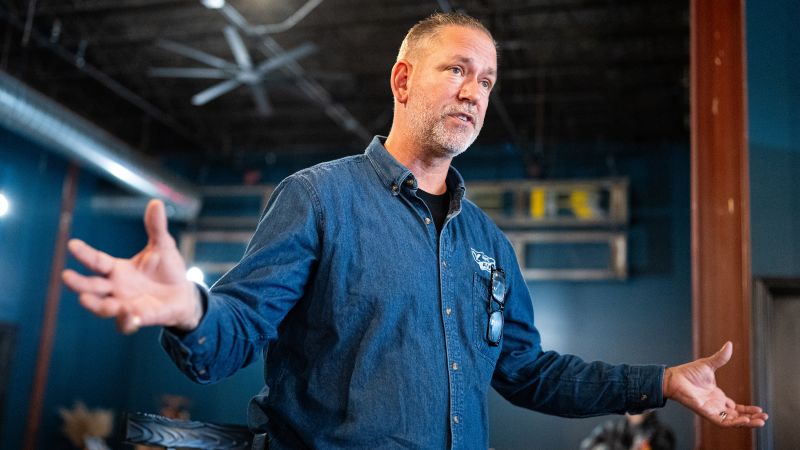
In late 2021, Osborn found himself at the center of a labor conflict at an Omaha Kellogg’s plant, where over 1,400 workers across four U.S. facilities walked off the job to demand better wages, improved benefits, and a more equitable treatment of their employment conditions. As a union leader, he took an active role in the dispute, which escalated into a bitter confrontation with the company. During this time, Osborn and his union team reportedly sought to inform federal immigration authorities about claims that Kellogg’s had replaced striking workers with undocumented immigrants. This move, while aimed at supporting labor rights, introduced a potential contradiction in his political messaging.
“Kellogg’s bringing in replacement workers, we have reliable information indicating that they’re replacing us with a significant number of undocumented workers,” Osborn stated in a December 2021 interview on a pro-union podcast. He added, “We have been in contact with Homeland Security and ICE. We’ve made our claims. I hope they do the right thing and investigate our claims.”
Despite these assertions, Osborn provided no concrete evidence to back up the allegations, and CNN’s subsequent investigation found no documented proof of the claim. The company, Kellogg’s, has not publicly confirmed or denied the allegations, leaving the issue open to interpretation. This ambiguity has raised questions about the motivations behind Osborn’s outreach to immigration authorities and whether it was a strategic move to bolster his image as a defender of labor or an attempt to address genuine concerns about workforce exploitation.
Revised Narrative: A Shift in Campaign Strategy
In the wake of the strike, Osborn’s campaign has since clarified that he did not personally contact ICE or Homeland Security. Instead, they claim he reached out to the local sheriff’s department to determine the best way to report the allegations, then shared that guidance with his team. According to the campaign, other individuals within his network independently contacted federal authorities “in their individual capacity” during the dispute. This revision suggests a calculated effort to align his actions with his current campaign platform, which emphasizes a balance between tough border enforcement and support for immigrant workers.
While this reframe may help mitigate criticism, it has not erased the controversy. The incident underscores the challenge Osborn faces in maintaining credibility as a political figure who oscillates between advocating for immigrant labor and engaging with immigration enforcement agencies. His comments from 2021, in particular, could complicate efforts to unify his diverse coalition, which includes both Trump voters and Democrats. The latter group, according to recent polls, has grown increasingly hostile toward ICE, with 78% expressing unfavorable views in a 2025 Pew Research Center survey.
A Political Tightrope: Bridging Opposing Visions
Osborn’s campaign has since framed his actions as a middle-ground approach to immigration policy, seeking to appeal to both economic conservatives and social liberals. He has argued that while federal raids on factories and restaurants disrupt businesses, they also fail to reflect the humanity of immigrant workers. “I mentioned that it’s hurting businesses, but it’s also not humanly decent,” he said on The Bulwark podcast in August 2025. “We’re seeing factories, get raided, meat cutters get raided. We’re seeing people not showing up to work at restaurants. We are seeing business owners get hurt by this immigration policy. So the economic conservative side of me is extremely worried about that.”
His position aligns with a broader debate in American politics over the role of immigration enforcement. While many Republicans view agencies like ICE as essential to maintaining border security, Democrats have increasingly criticized their methods, citing the impact on families and communities. Osborn’s attempt to occupy the political middle is evident in his advocacy for a path to citizenship for long-term undocumented residents, while also supporting a border wall as a prerequisite for immigration reform. This duality has become a defining feature of his candidacy, particularly in a state where Nebraska’s economic landscape is heavily reliant on immigrant labor.
Despite the polarizing nature of immigration policy, Osborn’s campaign has framed the issue as a unifying force. By emphasizing the economic contributions of immigrant workers, he aims to attract a coalition that includes both rural voters and urban Democrats. Yet, the 2021 incident has left his campaign grappling with the perception that his past actions may have leaned more toward enforcing immigration rules than protecting workers. The tension between his current messaging and historical ties to ICE remains a focal point for critics and supporters alike.
The resolution of the Kellogg’s strike in late 2021, just weeks after Osborn’s podcast appearance, highlights the rapid shifts in labor dynamics and political strategies. Workers ratified a new contract, ending the 77-day standoff. This outcome may have allowed Osborn to pivot his narrative, but it has not erased the scrutiny surrounding his earlier involvement. As the Senate race intensifies, the question of whether his union past compromises his pro-labor image will continue to shape the debate. His ability to reconcile these perspectives may ultimately determine his success in a political landscape defined by stark divisions over immigration.