This City Had a Flooding Problem. So It Turned to an Animal That Had Been Extinct There for 400 Years
Sandego.net – Deep in the heart of West London, within a short walk of a fast-food restaurant and a row of commercial buildings, a quiet revolution is taking place. A once-overlooked stretch of land in Ealing is being transformed by a group of furry architects: beavers. These industrious creatures, long absent from the region, are now working to address the area’s recurring issue of flooding, a challenge that has plagued the community for decades.
From Neglect to Renewal
For years, the Ealing area has struggled with heavy rainfall, which would turn nearby streets into rivers and flood the Greenford tube station, a key hub in the London Underground. Traditional solutions, such as constructing reservoirs with concrete and machinery, had been considered but met with limited success. Enter the Ealing Beaver Project, a bold initiative led by Sean McCormack, a veterinarian and conservationist, who proposed a radical alternative: rewilding with beavers.
“Why don’t we try a nature-based solution?” McCormack said. “Why don’t we bring back beavers?”
In 2023, the project successfully relocated a family of five beavers to Paradise Fields, a 24-acre plot that had long been neglected. “It was kind of a forgotten space,” McCormack recalled. “But now, it’s becoming a hub for biodiversity and resilience.” The transformation has already begun, with the beavers constructing dams and canals that are altering the local hydrology. As climate change intensifies the frequency and severity of storms, such projects are gaining traction as a sustainable way to combat environmental challenges.
The Natural Engineers
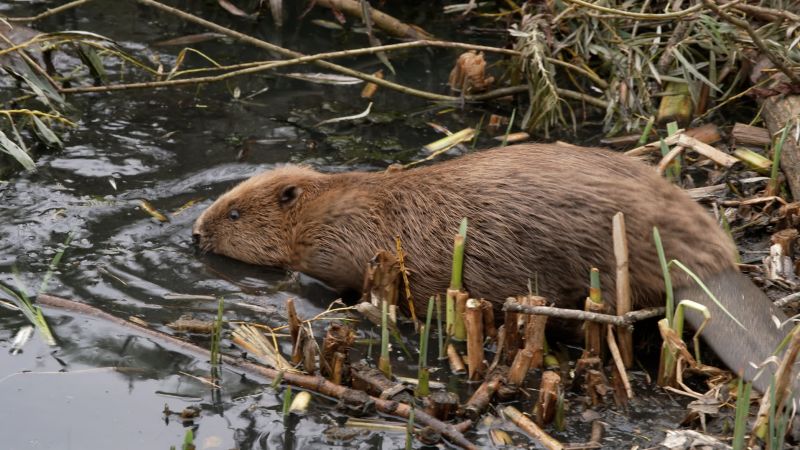
Beavers, often called the “keystone species” of wetland ecosystems, have a remarkable ability to shape their surroundings. Their teeth, reinforced with iron and displaying a vivid orange hue, are capable of felling trees and gnawing through branches, which they use to build intricate dams. These structures create pools that serve as natural reservoirs, slowing the flow of water and reducing the risk of downstream flooding. Additionally, the canals they dig form a network of micro-streams, spreading floodwater across a broader area and mitigating its impact.
Emily Fairfax, a geography professor at the University of Minnesota, described this process as “a spiderweb of water” that enhances the landscape’s capacity to absorb excess rain. “The beavers’ work is like a living sponge,” she told CNN. “It helps the land retain water during storms and even supports ecosystems during droughts.” The wetlands they create can also act as a buffer against wildfires, as the moisture retained in the environment reduces the likelihood of flames spreading rapidly.
“There’s a joke in the beaver science community that if you’ve got a problem, there’s a beaver for that,” Fairfax said. “It’s an oversimplification, but beavers really do provide a staggering number of ecosystem services.”
While beavers are celebrated for their engineering prowess, their reintroduction is not without complexities. In the UK, the species vanished around 400 years ago due to human activities, including hunting for their fur, meat, and scent glands. These glands, which produce a musky, vanilla-like fragrance, were historically used in perfumes and food flavoring. The Ealing project, however, represents a careful, planned effort to reintegrate them into the environment, ensuring they coexist with human infrastructure.
Success and Sustainability
The Ealing initiative has already shown promising results. By the beavers’ second winter at Paradise Fields, the area experienced no flooding for the first time in a decade, according to McCormack. The dams and canals have not only stabilized water flow but also created a diverse mosaic of habitats. Birds, butterflies, bats, and even freshwater fish have begun to return, drawn by the renewed ecosystem.
Currently, eight beavers inhabit the site, and a new generation of kits, or baby beavers, was born in the spring. The exact number of kits will be revealed when they emerge from their lodge, a process McCormack expects to occur by the end of the month. This natural regeneration is a testament to the project’s success, but it also highlights the importance of ongoing monitoring and adaptation.
Challenges and Considerations
Despite the positive outcomes, beaver reintroductions require careful planning. George Holmes, a conservation professor at the University of Leeds, noted that not all communities embrace the idea. “When beavers are introduced without proper coordination, it can lead to conflicts,” he said. One such tactic, known as “beaver bombing,” involves releasing animals into areas where they may disrupt farming operations or create unforeseen challenges.
Beavers’ tunneling can trap cattle or machinery in riverbanks, and their activity might encroach on human settlements if not managed. To prevent this, the Ealing project has engaged local residents, ensuring they are aware of the beavers’ impact and prepared to address any potential issues. “A community needs a contingency plan,” Holmes emphasized. “Otherwise, the benefits of rewilding can be overshadowed by local resistance.”
While the UK project has been a model of cooperation, similar initiatives in the United States face their own set of hurdles. Beaver rewilding is particularly popular in the West, where the animals are helping restore ecosystems in states like Washington and Oregon. Yet, even there, success depends on factors such as food availability, water sources, and space for the beavers to construct their homes. The Ealing experience underscores the importance of these considerations in any rewilding effort.
As climate change continues to reshape weather patterns, the role of beavers as natural engineers is becoming increasingly vital. Their ability to create resilient landscapes offers a unique solution to modern environmental challenges. The Ealing project, with its blend of historical insight and ecological innovation, serves as a blueprint for cities worldwide. By reintroducing beavers, communities are not only addressing immediate issues like flooding but also fostering long-term biodiversity and ecosystem health. This approach highlights a growing recognition of nature’s power to adapt and thrive, even in the face of human-driven disruptions.
The story of Ealing’s beavers is more than a tale of ecological restoration—it is a reminder of how ancient species can offer solutions to contemporary crises. As the project progresses, it will continue to demonstrate the potential of rewilding to build a more sustainable and adaptable future. For now, the wetlands are thriving, and the beavers are proving that sometimes, the best way to solve a problem is to let nature take the lead.