Putin’s War Reality Shaken
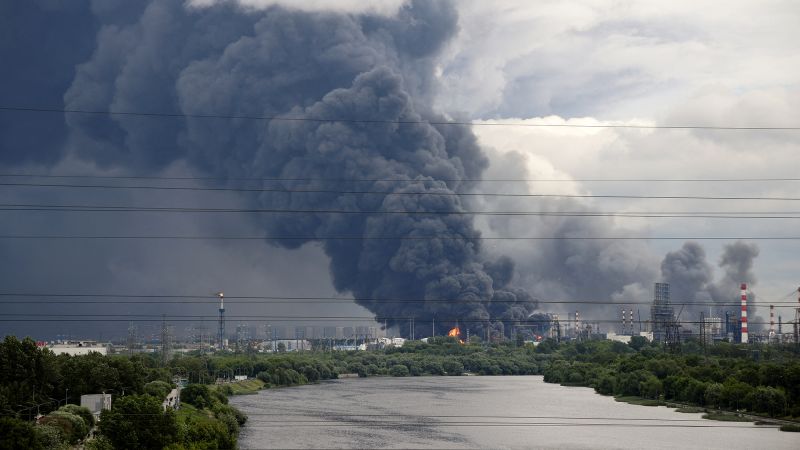
Sandego.net – On a day that left Moscow’s skyline in disarray, a series of powerful explosions shattered the illusion of invincibility that Russian President Vladimir Putin had long cultivated. The attacks, which targeted refineries just 10 miles from the Kremlin, sent thick black smoke billowing across the capital’s skyline—a stark reminder of the escalating consequences of the war in Ukraine. For weeks, Putin had maintained a facade of control, retreating into secure bunkers to avoid the chaos of frontline battles. Yet the devastation unfolding in his backyard has begun to erode even the strongest layers of his defensive strategy.
Drones as a New Threat
Russian authorities have struggled to contain the fallout, as social media videos reveal a narrative of vulnerability. These clips, shared widely despite government attempts to limit their spread, depict drones penetrating Moscow’s air defenses—once thought impenetrable. The same drones that Ukraine once endured in its early days of conflict now serve as a weapon of retaliation, striking with precision and frequency. A refinery’s roof blown off, multiple fires raging, and the environmental toll of the strikes have created a crisis that transcends military strategy. The attacks not only disrupt fuel supplies but also challenge the Kremlin’s ability to sustain its war effort, prompting concerns of long lines at gas stations in a city the regime has fought to protect.
These incidents mark a turning point in the war’s trajectory, forcing Putin to confront the limits of his influence. The images of destruction have sparked a ripple effect of uncertainty, both among the Russian public and international observers. While the government has tried to downplay the damage, the undeniable footage has exposed cracks in its narrative of dominance. The strikes, though localized, carry symbolic weight, signaling that Ukraine’s airpower is no longer confined to the eastern front.
Zelensky’s Strategic Gambit
Ukrainian President Volodymyr Zelensky has framed the attacks as a calculated response to Russia’s relentless nightly bombardments. Last week’s strikes on Kyiv’s oldest and holiest church complex were just one example of Moscow’s aggressive tactics, which have kept the conflict simmering. Yet Zelensky’s latest moves suggest a shift in his approach. After the G7 meeting in Evian, where President Trump’s mixed signals provided both support and skepticism for Ukraine, Zelensky appears to have tempered his ambitions. His focus has now turned to securing tangible military advantages, particularly the ability to mass-produce advanced air defense systems and missiles under license. This strategy, as Zelensky himself noted, reflects a pragmatic understanding of the war’s evolving dynamics.
“Last week’s attacks on Kyiv’s historic sites were a direct consequence of Russia’s unrelenting aggression. But now, we are not just reacting—we are adapting,” Zelensky stated in a recent address, emphasizing Ukraine’s growing capacity to manufacture critical weapons.
The implications of this shift are profound. By leveraging U.S. and European technology, Ukraine aims to close the gap in its military capabilities, a move that could pressure Russia into a more defensive posture. However, the success of this strategy hinges on the willingness of Western allies to provide the necessary resources and expertise. The G7 summit, while offering some hope, also highlighted the complexity of maintaining international unity in the face of geopolitical tensions.
The Cost of War
As the war drags on, the human and economic toll on Russia has become impossible to ignore. Western intelligence estimates that over half a million Russian citizens have been killed, a staggering figure that underscores the war’s toll on the population. For Putin, the struggle to defend Russian airspace and territory has grown increasingly burdensome. Even the capture of the Donbas, a goal he once viewed as achievable within months, has proven elusive. The “meatgrinder” assaults of 2023-2024 have left Russia grappling with recruitment challenges and a mounting casualty count, further straining its resources.
Despite these setbacks, Putin has not abandoned his vision of victory. Recent remarks hint at a potential reevaluation of his approach, though the specifics remain opaque. He has suggested that a ceasefire and the capture of Donbas are not mutually exclusive, a statement that has been met with cautious optimism. However, his public pronouncements often mask deeper uncertainties, particularly as the war’s economic and social costs mount. The blackened rain falling on Moscow’s streets serves as a poignant image of the war’s reach, a reminder that the conflict is no longer confined to Ukraine’s borders.
European Hope and the Path Forward
Amid the chaos, European nations have remained cautiously hopeful. Italy’s Prime Minister Giorgia Meloni, referring to Russia as a “middle power,” has hinted at the possibility of renewed diplomacy. The UK, France, and Germany recently issued a joint statement reaffirming their commitment to a ceasefire as a key component of any peace deal. This stance, though long-standing, has gained renewed relevance as the war’s stalemate deepens.
But the road to peace is fraught with challenges. Putin’s insistence on territorial gains and his reluctance to acknowledge strategic losses have kept negotiations at an impasse. His recent suggestion to welcome former German Chancellor Gerhard Schroeder as a mediator signals an openness to dialogue, yet it remains unclear whether this is a genuine pivot or a tactical maneuver. The decision to seek a ceasefire, if it comes, will likely depend on the balance of power shifting in Ukraine’s favor, a scenario that could see the conflict’s trajectory change dramatically.
For now, the war continues to unfold in a way that forces Putin to reckon with its realities. The damage to Moscow’s infrastructure and the growing dissent within the country have created a pressure cooker environment. While the Kremlin maintains its grip on power, the cracks are widening. The question remains: will Putin choose diplomacy, or will he cling to a strategy that has left his nation in ruins? As the world watches, the answer may shape the future of the conflict for years to come.
Unseen Struggles and Unfinished Battles
Behind the scenes, the war’s impact on Russia’s internal politics is becoming more apparent. The repeated strikes on Moscow have not only raised public morale but also tested the regime’s ability to manage crises. With social media as a conduit for dissent, the government’s message control has faltered, revealing a populace increasingly aware of the war’s costs. This growing unrest could have lasting consequences, potentially undermining Putin’s authority in the long run.
Even as the war rages on, the global community continues to assess its implications. The European Union, with its emphasis on sanctions and support for Ukraine, remains a key player in shaping the conflict’s direction. Meanwhile, the U.S. and its allies grapple with the challenge of maintaining momentum in the face of economic strain and political fatigue. The role of former leaders like Schroeder, who may bridge the gap between Russia and Europe, could prove decisive in the coming months.
In the end, the war’s outcome hinges on the decisions of its architect, Vladimir Putin. The blasts in Moscow have forced him to confront the fact that his campaign, once seen as unstoppable, now faces an uncertain future. Whether he will pivot toward diplomacy or double down on his current strategy remains to be seen. But one thing is clear: the war has become a test of both his resilience and the world’s patience. As the smoke from the refineries clears, the path to resolution grows more complex, and the stakes have never been higher.