Exiled Russian Artist Known for Anti-Putin Cartoons Shot Dead in Poland
Sandego.net – On Tuesday, Polish prosecutors announced the death of Semyon Skrepetsky, a Russian artist renowned for his satirical and critical depictions of President Vladimir Putin. The artist, whose real name was Robert Kuzovkov, was reportedly killed in a suspected execution earlier that day in Biała Podlaska, a town bordering Belarus. The incident occurred in a parking lot near his residence, and the two Belarusian men arrested in connection with the crime are currently under investigation.
A Fugitive from Russia’s Grip
Skrepetsky, 44, had fled Russia in 2021, fearing repercussions for his activism. His work often targeted the Russian government, and he became a prominent figure in the exile community for his bold visual critiques. The Polish Prosecutor’s District Office in Lublin released a statement detailing the circumstances of the shooting. According to Marcin Kozak, a spokesman for the office, the artist was approached by an unidentified individual in the early hours of Monday. The attacker fired two shots with a handgun, striking Skrepetsky in the head and chest. After the victim collapsed, the assailant returned to fire three additional rounds before vanishing from the scene.
The manhunt that followed led authorities to detain two Belarusian citizens, aged 37 and 33, near the Belarusian Consulate in Biała Podlaska. Kozak stated that their involvement in the incident is still under examination. The arrests have raised questions about cross-border cooperation and the potential role of Belarus in the attack, given its close ties to Russia. While no official motive has been disclosed, the nature of the shooting suggests a targeted act, likely linked to Skrepetsky’s political affiliations.
Art as a Weapon of Dissent
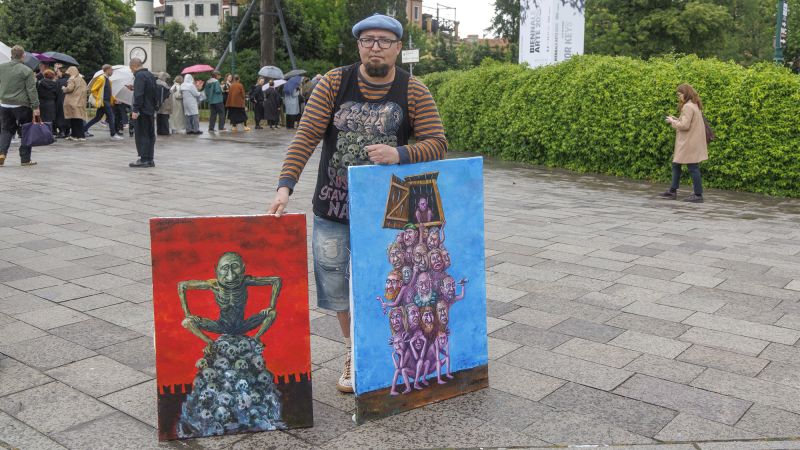
Skrepetsky’s artistic style was a blend of psychedelic elements and traditional Russian Orthodox iconography, a unique approach that often highlighted his satirical perspective. His works frequently featured Putin with exaggerated physical traits, such as a bovine nose or hugging pigs, which became symbolic of his critique of the leader’s policies. The artist also painted Putin alongside figures like US President Donald Trump, Chinese President Xi Jinping, Chechen leader Ramzan Kadyrov, and even tech mogul Elon Musk, using these collaborations to underscore themes of power and influence.
“His art wasn’t just a reflection of his views—it was a direct challenge to the status quo,” said one of his former collaborators. “He used humor and symbolism to make his point, which made his work both accessible and incisive.” The artist’s pieces often critiqued the Russian regime’s authoritarian tendencies, and his sharp imagery resonated with those disillusioned by the government’s actions. This creative approach made him a target for those who sought to silence dissenting voices.
A Shift in Political Allegiances
Skrepetsky’s journey from a pro-Ukrainian stance to a more nuanced critique of Ukrainian leadership has sparked discussion. In 2022, he publicly burned his Russian passport after Russia launched its full-scale invasion of Ukraine, a gesture that aligned him with the war effort. However, over time, his views evolved. He began questioning the leadership in Kyiv, particularly their strategies and rhetoric, which some interpret as a reflection of his growing complexity as a critic.
“He was once a fierce advocate for Ukraine, but his art and statements revealed a deeper layer of analysis,” noted a fellow artist. “It was as if he was exploring the contradictions within the conflict itself.” This shift highlights how even those who support a cause can develop critical perspectives as the situation evolves. Skrepetsky’s work now included a broader spectrum of political commentary, addressing not only Russia’s actions but also the dynamics between various factions within the international arena.
Critical of the Russian Opposition
Beyond his anti-Putin stance, Skrepetsky was also known for his criticism of certain segments of the Russian opposition. He openly accused the late activist Alexei Navalny of “destroying the entire Russian opposition,” a statement that underscores his complex relationship with the movement. While Navalny’s anti-corruption efforts were widely celebrated, Skrepetsky believed they lacked a cohesive vision or broader appeal. This critique positioned him as both an ally and a critic of the opposition, reflecting his multifaceted perspective on Russia’s political landscape.
“He wasn’t afraid to call out anyone, even those he considered allies,” a friend of the artist recalled. “It was his way of pushing for more radical change.” His work often blended humor with sharp political commentary, making him a controversial but influential figure. The attack on Skrepetsky may be seen as a culmination of this outspoken nature, targeting him for his unrelenting criticism of both Putin and the opposition.
Implications for Exile Communities
The killing of Skrepetsky has sent ripples through the Russian diaspora in Poland and beyond. Exiled artists and activists now face heightened risks, as the incident demonstrates the reach of political violence even in neighboring countries. The involvement of Belarusian suspects has drawn attention to the geopolitical tensions between Russia and its neighboring states, with Belarus often serving as a conduit for Russian operations.
“This is a clear warning to anyone who dares to challenge the Kremlin’s narrative,” said an analyst specializing in Eastern European politics. “It shows that the threat extends beyond Russia’s borders.” The case also raises questions about the safety of artists in regions like Poland, where Russia’s influence is significant. Despite the artist’s exile, his work remained a powerful tool for political expression, and his death has intensified debates about the role of art in times of conflict.
A Legacy of Bold Expression
Skrepetsky’s death marks the end of a prolific career that combined creativity with political courage. His unique style and fearless approach to satire made him a standout figure in the Russian exile community. Even as his views evolved, his work continued to provoke thought and challenge the status quo. The incident has left a void in the art world, with many mourning the loss of a voice that used imagery to critique power.
“He brought a new level of artistry to political cartoons, making them both entertaining and deeply critical,” said a museum curator who showcased his work. “His legacy will live on, even as the circumstances of his death remind us of the dangers faced by those who speak out.” As investigations into the shooting continue, the case remains a symbol of the ongoing struggle between freedom of expression and political repression in the region.
“According to current information, the 44-year-old was approached by an unidentified man who fired two shots at him with a handgun. After the victim fell to the ground, the perpetrator approached, fired three more shots, and then quickly fled the scene,” Marcin Kozak, the prosecutors’ office spokesman said.
The killing of Semyon Skrepetsky has sparked international reactions, with some calling it a tragic loss for free speech and others viewing it as a strategic move by Russian forces to eliminate dissent. As the investigation unfolds, the case may shed light on the broader network of political operatives working across borders to suppress opposition. For now, the artist’s work remains a testament to the power of creativity in shaping political discourse.