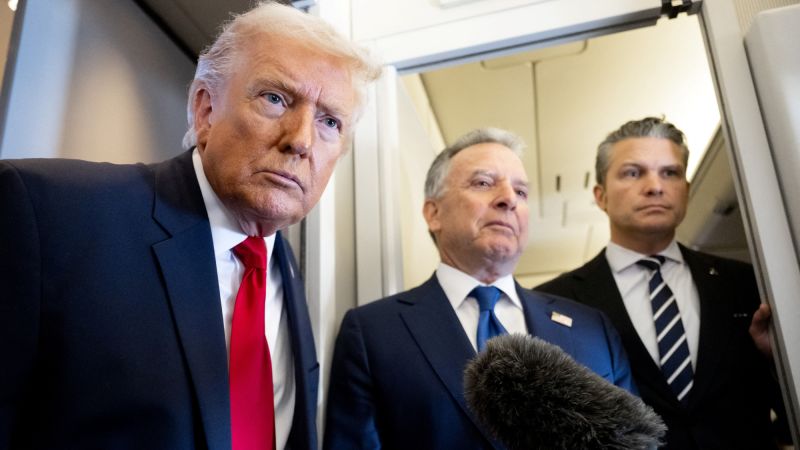
‘An awkward family gathering’: Trump and G7 leaders convene in France amid geopolitical divergences
The Summit’s Uncertain Atmosphere
Sandego.net – As the G7 summit approaches in Évian-les-Bains, France, President Donald Trump has been preoccupied with the stakes of the gathering. The event, which brings together leaders from the world’s most developed economies, is expected to highlight tensions in international relations. Trump’s team, including key advisors, has been cautious in assessing the outcome, given the fragile state of the Middle East conflict that has dominated global headlines. The president’s strategy hinges on a recently announced agreement with Iran, which aims to halt hostilities and restore the Strait of Hormuz to full operation. However, the path to this resolution has been fraught with challenges, leaving the summit’s participants with questions about its durability.
The Middle East war, now in a precarious stalemate, has tested the patience of Trump’s allies. The president’s arrival in France is anticipated with a mix of hope and skepticism, as he seeks to solidify his position among G7 leaders. For months, Trump has criticized his counterparts for their hesitance to commit to patrolling the Strait of Hormuz, a critical waterway for global oil trade. This tension has created an uneasy backdrop for the summit, where discussions are expected to be intense and scrutinized. Despite the agreement, sources indicate that the specifics of the deal remain under debate, and the commitment of each nation to uphold its terms is still uncertain.
The Iran Agreement: A Fragile Victory
Trump’s decision to finalize an accord with Iran has been met with mixed reactions. While the deal promises to stabilize the region, its effectiveness depends on the willingness of all parties to adhere to its terms. According to officials, the agreement’s success may be contingent on the cooperation of France and Britain, both of which have expressed interest in forming a coalition to secure the strait. This initiative would involve clearing mines placed by Iran during the conflict, a task that requires sustained international effort.
Meanwhile, the inclusion of Arab states in the summit has added another layer of complexity. Egypt, Qatar, and the United Arab Emirates are set to join the discussions, invited by French President Emmanuel Macron to address regional issues. The leaders of these nations are expected to engage with Trump individually, offering insights into the dynamics of the Middle East. Macron’s decision to bring Zelensky into the fold underscores the desire to unify efforts on multiple fronts, from resolving the Iran conflict to supporting Ukraine’s war efforts.
“It’s all really just a big photo op,” said a senior White House official. “It’s not like big things get done there. It’s more about the meetings that come after.”
This quote encapsulates the administration’s perspective on the summit’s primary function. While the event itself may not yield major breakthroughs, it is seen as a platform for setting the stage for future negotiations. Trump’s aides have emphasized that the focus will shift to investment partnerships, framing the summit as an opportunity to explore economic collaboration that benefits both developing and developed nations. This approach reflects a broader agenda that includes supply chain resilience and artificial intelligence, topics that have gained traction in recent months.
Trump’s Past G7 Struggles
For Trump, the G7 summit is not just another international meeting—it’s a recurring challenge. During his first term, he often questioned the necessity of attending such gatherings, arguing that the absence of Russia and China left the talks incomplete. His skepticism was not unfounded; the G7 has historically been a forum where consensus is difficult to achieve, and Trump’s confrontational style has made the process even more contentious.
Trump’s tenure at past summits has been marked by abrupt exits and unmet expectations. In 2017, his first G7 in Quebec, he left early, claiming that the meetings were not productive. Last year, he cut his stay short in Alberta, citing the need to focus on other priorities. These actions have left a legacy of unpredictability, with G7 leaders often bracing for unexpected moves. This year’s summit is no different, as the president navigates a delicate balance between showcasing progress and addressing lingering doubts.
A Multifaceted Agenda
The summit’s agenda extends beyond the Iran conflict, touching on a range of global issues. While energy prices remain a pressing concern, other topics such as China’s growing influence, the Ebola outbreak in Africa, and digital safety are also on the table. European officials have noted that the discussions will be shaped by the need to coordinate efforts on multiple fronts, including the Strait of Hormuz and Ukraine’s war. This multifaceted approach highlights the summit’s role as a microcosm of the complex challenges facing the international community.
Officials from other G7 nations have shared similar priorities, with a focus on economic growth and supply chain resilience. However, the addition of new issues like the Ebola crisis and digital safety signals a broader scope for the conversations. One US official hinted at the president’s plan to “reframe” the summit’s narrative, positioning it as a catalyst for investment partnerships. This strategy is intended to shift the emphasis from short-term agreements to long-term economic collaboration, a move that aligns with Trump’s broader vision for international trade.
Despite these ambitions, the administration admits that no grand announcements are expected. The summit is seen as a preparatory step, with the real negotiations likely to take place in the weeks and months ahead. European officials, however, remain optimistic, viewing the event as a precursor to the NATO summit in Turkey. They anticipate that the discussions in Évian could influence the outcome of that meeting, which is expected to be a high-stakes encounter given the ongoing conflict in Ukraine.
As the leaders gather, the atmosphere in Évian-les-Bains is charged with anticipation. The president’s presence, though contentious in the past, is now a focal point for both supporters and critics. The G7’s ability to forge a unified response will be critical in determining the summit’s success. With the Strait of Hormuz at the center of the talks, the question remains: can this fragile agreement hold, or will the summit reveal deeper divisions among the world’s most powerful nations?
The meeting in France marks a pivotal moment in Trump’s foreign policy, as he attempts to reconcile his domestic agenda with international obligations. While the Iran deal may provide temporary relief, the long-term implications of the agreement will depend on the commitments of all parties involved. The G7 leaders, ever the watchful critics, will be scrutinizing every detail, ensuring that the outcome reflects a genuine effort to stabilize the region. As the summit unfolds, the stage is set for a series of intense negotiations that could reshape the geopolitical landscape for years to come.