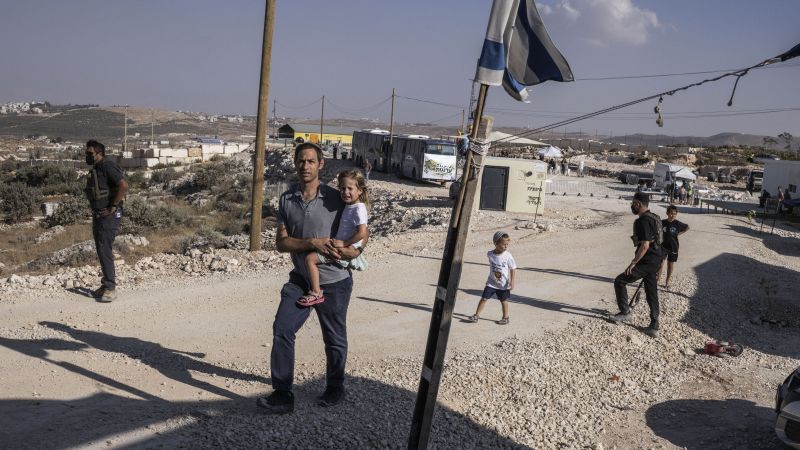
London Moves to Penalize West Bank Settlement Output, Signaling a Sharp Break With Jerusalem
Sandego.net – Britain is preparing to impose trade sanctions on goods produced in Israeli settlements across the occupied West Bank, a step that will land on Tuesday and represent the most consequential rupture in decades between London and its longtime Western ally. The measures, framed by the government as a direct response to the accelerated settlement build-out under Prime Minister Benjamin Netanyahu’s administration, are designed to pressure Israel into halting what officials describe as the systematic dismantling of the two-state framework.
The announcement arrives at a moment when international frustration with Israeli policy in the territories has reached a fever pitch. Settler attacks on Palestinian residents have escalated sharply in zones that most of the global community still regards as the geographic core of any future Palestinian state. For Britain, which has historically occupied a privileged diplomatic position relative to Israel, the decision to formalize economic penalties marks a departure from a posture of quiet encouragement.
The E1 Corridor and the Geography of Division
At the heart of the dispute lies the E1 settlement project, a strip of planned construction running between East Jerusalem and the northern West Bank. Critics argue that completing E1 would sever the territory into two disconnected halves, rendering a contiguous Palestinian state functionally unachievable. The corridor also physically detaches East Jerusalem — the city Palestinians designate as their prospective capital — from the remainder of the West Bank.
In late August, Israel’s Housing Ministry opened tenders for the construction of more than 1,200 residential units within the E1 zone. The stated objective is to forge an unbroken chain of Jewish settlements stretching from East Jerusalem deep into the West Bank interior. Far-right Finance Minister Bezalel Smotrich, who has long positioned himself as the architect of settlement expansion, framed the project’s final approval in uncompromising terms:
“The Palestinian state is being erased from the table not with slogans but with actions.”
Smotrich and his National Security counterpart, Itamar Ben-Gvir, were themselves placed under UK sanctions last year for what London characterized as “repeatedly inciting violence against Palestinians.” The current round of measures thus extends a pattern of targeted economic pressure already established by the British government.
Trade Stakes and Economic Exposure
Annual bilateral commerce between Britain and Israel stands at roughly $8 billion. Only a marginal slice of that flow originates in the West Bank, meaning the sanctions’ direct commercial bite will be modest. According to the UK Department for Business and Trade, the largest British export category to Israel comprises medicinal and pharmaceutical products, while the principal import stream consists of fruits and vegetables. Still, the symbolic weight of the move far exceeds its narrow economic footprint, and Israeli officials have signaled they intend to make the point felt.
Jerusalem’s Response
President Isaac Herzog reacted sharply, speaking at a ceremony commemorating thirty years of research-and-innovation cooperation between Israel and the European Union. He dismissed the sanctions as counterproductive:
“Sanctions are not a solution. Dialogue is.”
He went further, labeling the British decision a “serious error in judgment and choosing the wrong side of history.” Foreign Minister Gideon Sa’ar was more combative, telling domestic media last week that retaliation would follow automatically:
“If Britain acts against the State of Israel, the State of Israel will act against Britain. We have the tools.”
“The period is over when people act against the State of Israel and the State of Israel doesn’t respond.”
Washington Watches
The sanctions also carry the potential to unsettle the transatlantic alignment on Middle East policy. US Ambassador Mike Huckabee, who has publicly defended Israel’s settlement activities in the West Bank, told BBC News on Tuesday that a reaction from the Trump administration was virtually certain:
“I think without a doubt there will be (a reaction).”
He cautioned that any such response could carry a “huge impact on British businesses,” underscoring the diplomatic and commercial ripple effects that extend well beyond the narrow settlement trade.
London’s Stated Rationale
Foreign Secretary Ed Miliband laid out the government’s reasoning in remarks to British lawmakers on Monday, previewing what he called a “comprehensive set of measure in the coming weeks.” Earlier in the month, he had summoned Israel’s Chargé d’Affaires in London to demand the “immediate reversal” of the E1 plan, which he branded an “unacceptable and destructive act” crossing a “red line.”
“The impact of settler violence and terrorism has been catastrophic for Palestinian communities,” Miliband said.
He warned that continued settlement growth “threaten(s) peace, security and the prospects for a viable Palestinian state.” In May, Britain joined several European partners — with backing from Canada, Australia, and New Zealand — in issuing a formal advisory urging multinational firms to weigh legal and reputational exposure before participating in E1 construction. That joint statement described the West Bank situation as having “deteriorated significantly,” with settler violence reaching “unprecedented levels.”
“Britain will not stand back and accept the destruction of the Two-State Solution,”
Miliband added, invoking the long-standing peace architecture that envisions an independent Palestinian state existing alongside Israel.
Historical and Legal Backdrop
Israel seized East Jerusalem and the West Bank during the 1967 war. Under prevailing interpretations of international law, both areas remain occupied territories, and the construction of settlements within them is widely regarded as contrary to the Fourth Geneva Convention. The UK’s decision to attach economic consequences to settlement activity therefore rests on a legal consensus that has been broadly maintained across the United Nations, the International Court of Justice, and most Western governments — even as political will to enforce that consensus has varied considerably over the decades since 1967.
For British policymakers, the sanctions represent an attempt to convert that long-standing legal position into tangible economic cost, betting that the pressure will alter settlement trajectories before the two-state architecture collapses entirely. Whether the measure will achieve that outcome, or instead accelerate a broader realignment of alliances in the region, remains the central question as Tuesday’s announcement approaches.
Related Reading
Frequently Asked Questions
What is UK set to sanction Israeli settlements?
UK set to sanction Israeli settlements is the main topic of this guide. The article explains the context, practical details, and next steps readers should understand.
Why does UK set to sanction Israeli settlements matter?
UK set to sanction Israeli settlements matters because readers are looking for a useful answer, not just a short summary. Good content should match search intent and help them decide what to do next.