The Most Controversial Fossil Site in Human Evolution Just Got Even More Puzzling
Sandego.net – The Rising Star cave system in South Africa has long been a focal point of debate in the study of human origins. Over the past decade, excavations there have uncovered a wealth of hominin fossils, challenging existing theories about the evolutionary tree. Now, new research on the sex of these remains has deepened the enigma, suggesting that Homo naledi—once considered a remarkable species—may have practiced rituals that distinguished individuals by gender. This revelation has left scientists grappling with questions about the species’ behavior and the implications for understanding early human societies.
Unearthing a Puzzling Species
Discovered in 2015, Homo naledi was initially hailed as one of the most unusual hominin species ever found. The Dinaledi Chamber, where the fossils were recovered, contained an exceptionally rich assemblage of remains, offering unprecedented insights into the anatomy and possible behaviors of this ancient relative. Despite its relatively small brain size—comparable to that of a chimpanzee—Homo naledi exhibited traits that hinted at complex cognitive abilities. Among the most intriguing was the suggestion that the species deliberately buried its dead, a practice previously thought to be uniquely human.
Scientists speculated that this intentional burial was not random but part of a ritualistic behavior. The consistent presence of remains in the cave, despite its remote and challenging location, supported the idea of a deliberate act. Moreover, the discovery of possible engraved markings on rock surfaces raised the possibility that Homo naledi engaged in symbolic communication, further blurring the lines between human and non-human ancestors.
Proteins in Prehistoric Teeth Reveal a Surprising Gender Pattern
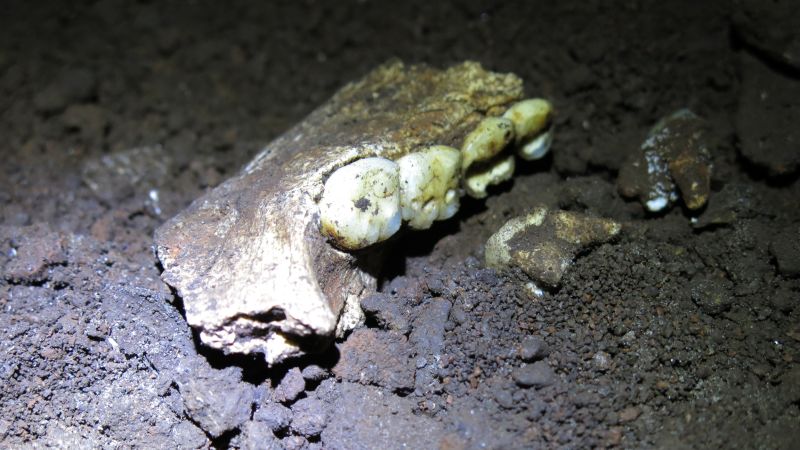
A recent study has added a new layer of mystery to the Homo naledi story. By analyzing ancient proteins preserved in the teeth of 20 individuals found at the site, researchers determined that all the remains belonged to females. This finding has sparked controversy, as it challenges the assumption that the site was a dumping ground for a mixed population. “When these results came out, there were a lot of quite nervous scientists. This was not what we expected,” recalled Lee Berger, a paleoanthropologist and National Geographic explorer in residence. Berger, who led the excavations and coauthored the study, emphasized the thoroughness of the analysis. “Two labs ran this data,” he said. “We ran it through twice because we didn’t want it to be an internal error,” he added.
Molecular scientist Palesa Madupe, now a postdoctoral researcher at the Max Planck Institute for Evolutionary Anthropology, spearheaded the investigation. Working at the Globe Institute in Copenhagen, Madupe examined 23 tooth enamel samples, but two were inconclusive. Two others belonged to the same individual, leaving 20 valid samples. The absence of male-specific proteins in all the teeth suggests a possible sex bias in the site’s occupation. However, the study also raises questions about genetic factors, such as mutations or deletions that might have affected the presence of these markers.
Sexual Dimorphism and the Enigma of the Fossils
Sexual dimorphism, the physical differences between males and females in a species, is a common feature among hominins. Yet, the Homo naledi fossils displayed minimal variation in size and shape, leading researchers to describe them as the least sexually dimorphic species ever documented. Berger, who first analyzed the remains in 2015, noted that this lack of distinction was striking. “When we described those hominins in 2015, we said they’re the least sexually dimorphic species of ancient hominid ever found,” he said. This uniformity could imply a range of possibilities, from a species with minimal physical differences to one that practiced selective burial based on gender.
The study published in the Cell journal on Wednesday highlights this dilemma. While the absence of male markers in the proteins is perplexing, the researchers caution that it could be explained by genetic anomalies. Enrico Cappellini, a senior author of the study and paleoproteomics professor at the Globe Institute, pointed out that the amelogenin-Y gene—responsible for male-specific proteins—has been observed to mutate or even disappear in some living humans and Neanderthals. “It would be very unlikely for the gene to have been deleted among even half of the 20 individuals we studied or for an entire population,” he said in a news release. This raises the question: was the site a male-free zone, or did the genetic makeup of Homo naledi differ significantly from other species?
Implications for Mortuary Practices and Evolutionary Behavior
Berger’s interpretation of the findings suggests that Homo naledi may have engaged in ritualistic behavior that separated individuals by sex. “Either scenario, namely the absence of Homo naledi males in the Rising Star cave system or a systematic deletion of the amelogenin-Y gene, offers intriguing possibilities,” he said. If the species consistently buried its females, it could indicate a cultural practice rooted in social organization. This would align with the theory that Homo naledi’s burial behavior was not just a byproduct of environmental conditions but a deliberate act, reflecting an advanced understanding of death and the community.
The age of the Homo naledi remains—dated between 335,000 and 241,000 years ago—places them in the Middle Pleistocene era. This timeframe overlaps with the existence of other hominin species, such as Homo erectus and Homo sapiens, suggesting that Homo naledi may have coexisted with them. The discovery of these fossils has already reshaped discussions about human evolution, but the new sex-related findings could further redefine the narrative. For instance, if only females were buried in the Dinaledi Chamber, it might imply that males were excluded from the ritual, or that the cave served a specific function for the species.
Revisiting the Evidence: A New Perspective
Berger expressed surprise at the revelation that all the fossils were female, acknowledging that he should have recognized the pattern earlier. “In hindsight, I should have spotted sooner that the fossils appeared to be female,” he said. The consistent size and morphology of the remains, he argued, support the idea of a species with minimal physical differences. This could mean that Homo naledi’s behavior was not influenced by sexual dimorphism but by other factors, such as social roles or environmental pressures.
Madupe’s research also underscores the potential of paleoproteomics as a tool for studying ancient life. While this technique has been applied to various fossils, including a 2-million-year-old human relative, the Homo naledi case highlights its limitations. The absence of male markers could be due to factors like degradation of proteins over time, or the possibility of genetic mutations affecting the Y chromosome. These findings encourage scientists to consider both biological and cultural explanations when interpreting fossil records.
As the debate continues, the Rising Star site remains a treasure trove of enigmatic clues. The combination of its unique geological features, the diversity of its fossils, and the latest insights into their sex may ultimately provide a more complete picture of Homo naledi’s place in human evolution. For now, however, the question of why only females were found there—and what this reveals about their society—remains as intriguing as ever.