The Largest Scorpion to Walk the Earth Was the Size of a Baseball Bat
Sandego.net – Scientists have uncovered new insights into the ancient world by revisiting fossils that have resided in London’s Natural History Museum for over a century. Among these relics, a newly analyzed specimen has revealed the existence of the largest scorpion ever to roam the planet, a creature estimated to have reached lengths of nearly 1 meter—approximately 3 feet. This discovery challenges previous assumptions about the evolution of arthropods and their transition from aquatic to terrestrial environments, offering a glimpse into a time when Earth’s ecosystems were vastly different.
A Revised Classification
Initially identified in the 1870s, the species Praearcturus gigas was thought to be a crustacean, similar to lobsters and other shellfish. However, a team of researchers has now reclassified it as a scorpion, a finding that has reshaped our understanding of prehistoric life. This reevaluation was sparked by a closer examination of eight fossils excavated from three distinct sites, combined with advanced imaging techniques that allowed for a more detailed analysis of the specimens’ anatomical features.
“How we think about extinction and evolutionary biology comes from the ability of scientists to work over the same ground, by repetition,” said Elizabeth Dowding, a paleoenvironmental analyst at Friedrich-Alexander University of Erlangen-Nuremberg in Germany. “It’s just amazing that this story itself is one of revision and consistent curiosity over the same set of rocks. … It’s demonstrative of the way science works.”
The breakthrough came when the researchers compared their findings with a 2015 study of a Canadian scorpion, Eramoscorpius brucensis, which had previously been classified as a different type of arthropod. A critical similarity between the two species was their sternum—a triangular plate on the underside of the scorpion’s body, situated between the legs. This feature, shared by both Praearcturus gigas and Eramoscorpius brucensis, provided the decisive evidence linking them as closely related creatures.
Reconstructing a Prehistoric Giant
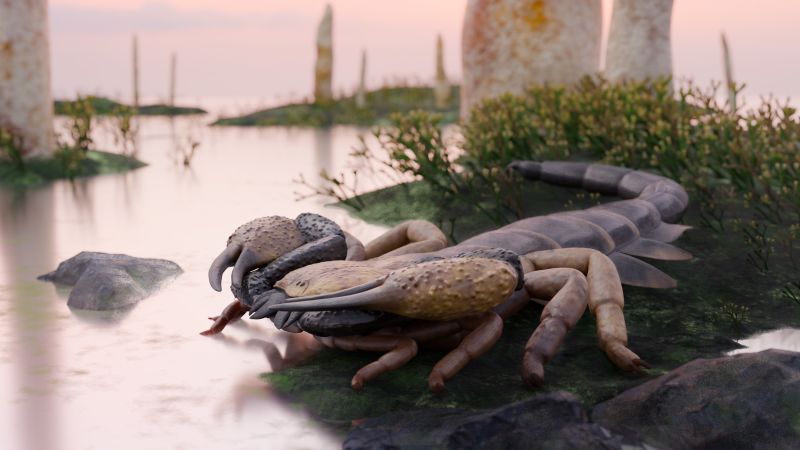
To visualize this ancient predator, the study team collaborated with an artist to create detailed renderings of what Praearcturus gigas might have looked like in its natural habitat. These reconstructions suggest a creature that moved with purpose across mossy landscapes and around towering, tree-like structures before retreating to water sources. Its robust, segmented body and formidable claws would have made it a dominant force in its ecosystem, capable of overpowering smaller prey.
“That is a chonky-looking organism,” remarked Russell Bicknell, a paleobiologist at Flinders University in Adelaide, Australia. “You would not want to run into this thing in a dark alley. It would be an absolute beast.”
While the fossils do not preserve eye structures, researchers believe Praearcturus gigas possessed eyes on its head, much like modern scorpions. These eyes, likely adapted for detecting movement in low-light conditions, would have been essential for hunting in the dimly lit environments of the early Devonian Period. The scorpion’s body was also marked by a series of rough bumps on its legs, claws, and head, a characteristic feature that aligns with known scorpion anatomy.
The Devonian Enigma
Living around 415 million years ago, Praearcturus gigas existed during a time when Earth’s landmasses were still largely dominated by aquatic life. The presence of such a large arthropod in this era is considered unusual, as oxygen levels were lower than they are today. This scarcity of oxygen blurred the boundaries between sea-dwelling and land-based organisms, making it difficult to determine whether Praearcturus gigas was fully terrestrial or still reliant on water for survival.
Richard Howard, the lead author of the study and curator of fossil arthropods at the Natural History Museum, emphasized the significance of the discovery. “That’s much older than we would expect to find giant arthropods,” he noted. “The lines between what is a land-living animal and what is an aquatic animal are much more blurred.” This observation highlights the dynamic nature of early evolutionary transitions, where the adaptability of arthropods allowed them to thrive in diverse environments despite environmental constraints.
A Legacy of Scientific Curiosity
The reclassification of Praearcturus gigas underscores the value of revisionary science—a process where old data is re-examined with fresh perspectives and modern tools. By integrating CT scans and comparative analysis, the researchers were able to piece together a more accurate representation of this ancient creature. The findings also suggest that the Devonian Period, often referred to as the “Age of Fishes,” may have been a more complex time for terrestrial life than previously thought.
While the giant scorpions of later periods, such as those that lived during the late Devonian, are better understood, Praearcturus gigas represents a pivotal moment in the timeline of arthropod evolution. Its existence challenges the notion that large land-based animals only emerged after significant changes in atmospheric composition and oxygen availability. Instead, it hints at the possibility that early arthropods may have already begun adapting to life on land, even in environments with limited resources.
The study’s implications extend beyond the scorpion itself. It serves as a reminder that scientific understanding is not static but evolves through persistent inquiry and technological advancements. As Howard explained, “The way we interpret ancient life depends on how we approach the evidence. This discovery shows that even well-preserved fossils can reveal new secrets when examined with updated methods.”
Comparisons to Modern Giants
Though Praearcturus gigas was far larger than its modern counterparts, its physical traits align with those of today’s scorpions. The creature’s pincers, estimated to have measured around 6 inches (16 centimeters), would have been comparable in length to a dollar bill. This immense size, combined with its formidable claws, suggests that it was a top predator in its environment, capable of hunting larger prey than previously imagined.
The team’s work also raises questions about the ecological roles of such giants. If Praearcturus gigas was indeed a land-dwelling creature, it would have competed with early vertebrates and other arthropods for resources. However, its aquatic adaptations may have allowed it to exploit both environments, a duality that reflects the transitional nature of life during the Devonian Period.
As researchers continue to analyze these fossils, they hope to uncover more about the evolutionary pathways that led to today’s diverse arthropod species. The discovery of Praearcturus gigas not only adds to our understanding of prehistoric ecosystems but also highlights the importance of revisiting old specimens with new tools and theories. In doing so, science continues to rewrite the story of life on Earth, one fossil at a time.