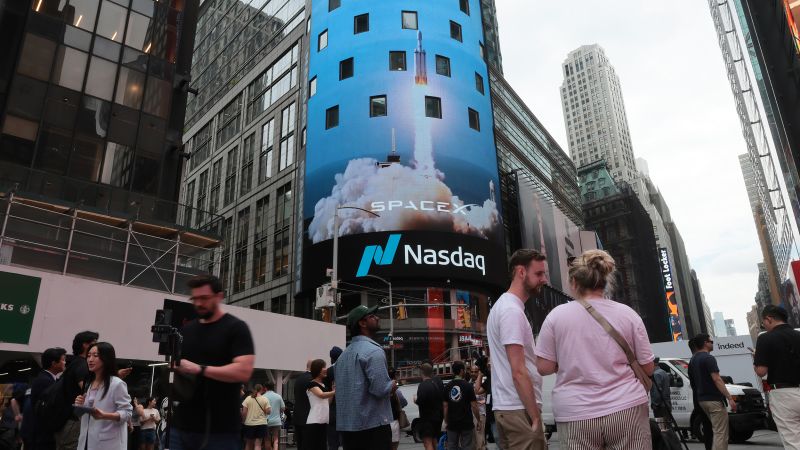
SpaceX’s Public Debut: Rising High Amid Identity Crisis
Sandego.net – SpaceX is flying high off its public debut, yet the company is facing a significant identity dilemma. The historic IPO has placed Elon Musk’s space venture in the spotlight, but as it transitions from a private mission to a publicly traded entity, questions linger about its core purpose. Once a bold startup with a singular goal of Mars colonization, SpaceX now operates in a broader landscape of space and tech innovation, raising concerns about whether its original vision will remain central to its trajectory.
Musk’s 2013 Caution: A Warning for the Market
More than a decade before the IPO, Musk had already warned about the risks of public ownership. In a 2013 email, he expressed doubts that becoming a publicly traded company might divert attention from its primary mission. “The fundamental goal of SpaceX is to create the technology for life on Mars,” he wrote. “If being a public company reduces the chance of achieving this, we should delay until Mars is secure.” This foresight now echoes as the company balances investor expectations with its ambitious Martian aspirations.
From Niche Rocketry to Global Leadership
SpaceX has grown from a niche player to a space industry powerhouse. Its achievements—restoring American crewed spaceflight, launching the first private mission to the International Space Station, and deploying Starlink satellites—have cemented its status as a multibillion-dollar enterprise. However, the shift to public ownership has introduced new dynamics, with investors now scrutinizing its long-term viability against the backdrop of rapid diversification into AI and other cutting-edge technologies.
“Musk’s vision has always been the engine of SpaceX,” said Jay Ritter, a finance professor at the University of Florida. “But the public debut brings a different kind of pressure—one that could either refine its mission or dilute it.”
With a valuation exceeding $85 billion, the IPO has positioned SpaceX as a financial milestone. Yet, the inclusion of the Mars quote in its S-1 filing has sparked debate. While some see it as a creative touch, others question if it’s a strategic move to maintain investor enthusiasm. This tension reflects a broader conversation about the balance between innovation and tradition in the space sector.
AI Integration: A New Chapter or a Divergence?
Just months before its public offering, SpaceX made a strategic leap into artificial intelligence. Acquiring xAI, the developer of the Grok chatbot, and integrating Cursor into its operations signals a shift toward leveraging AI in space exploration. These steps have expanded its capabilities, but they also highlight a growing divergence from its original mission. Critics argue that the company’s expansion into AI could overshadow its Martian ambitions, while supporters see it as a necessary evolution to sustain growth and relevance in a competitive market.
“SpaceX is flying high off its public debut, but the question is whether it’s still focused on its founding principles,” noted Chad Anderson, founder of Space Capital. “The Mars mission is the heartbeat of the company, yet its financial strategies now demand more immediate returns.” This sentiment underscores the challenge of maintaining a visionary purpose in the face of market demands.
Mars as a Financial Guarantee: The S-1 Prospectus
The S-1 prospectus reveals a bold alignment of Musk’s pay package with the company’s long-term goals. He will only receive his full $7.5 trillion compensation if SpaceX achieves a permanent human colony on Mars with at least one million inhabitants. While this clause is unconventional, it reflects the company’s attempt to marry its grand vision with financial accountability. For some, it’s a testament to Musk’s commitment, while for others, it raises doubts about whether the Mars mission is a genuine priority or a marketing tool.
As SpaceX navigates this pivotal moment, the company must reconcile its role as a public entity with its mission to revolutionize space travel. The identity crisis isn’t just about public perception—it’s a test of whether its core purpose can adapt to a new era of shareholder expectations and technological expansion.