After 286 Days at Sea, USS Abraham Lincoln Returns to Port Covered in Rust
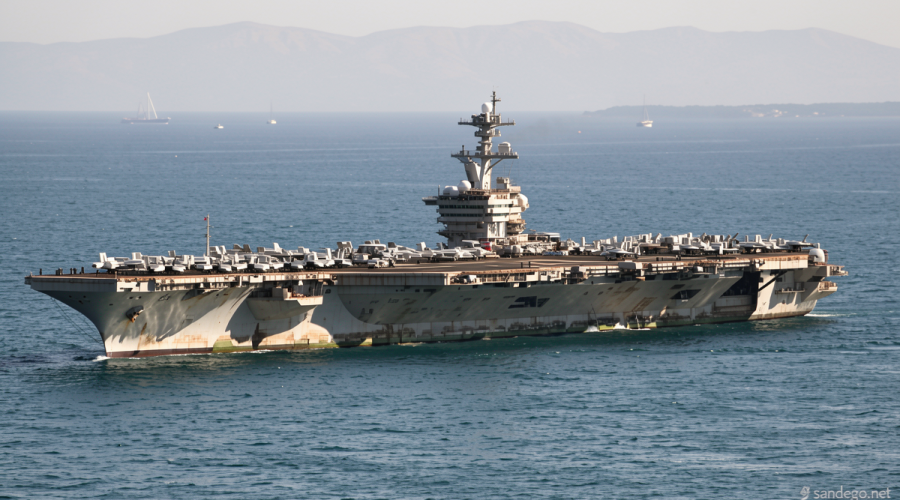
Sandego.net – The nearly 1,100-foot Nimitz-class aircraft carrier USS Abraham Lincoln slid into the port of Laem Chabang on the Gulf of Thailand, south of Bangkok, on Wednesday — and the sight that greeted dockside observers was far from the gleaming warship of recruitment posters. From bow to stern, the hull bore a heavy patina of oxidation, the unmistakable signature of months spent in saltwater without the benefit of dry-dock maintenance.
The visit, expected to last roughly seven days, marks the crew’s first full rest-and-relaxation port call since the ship departed its homeport of San Diego last November. In between those two dates, the Lincoln logged what the Navy describes as 286 consecutive days at sea, including sustained combat and blockade operations directed against Iran in the Middle East. The rust, in short, is the visible scar of that operational tempo.
Why the Waterline Turns Brown
Carl Schuster, a retired US Navy captain who completed three tours aboard Nimitz-class carriers of the same class as the Lincoln, told reporters that the degree of corrosion seen along the waterline is entirely predictable given the ship’s time on station.
“Rust along the waterline is not unusual on a ship that has spent 60 days or more of operations continuously at sea.”
The practical problem, Schuster explained, is that meaningful remediation cannot be performed while a carrier is underway — and certainly not during active combat operations. Proper restoration requires crews to be lowered alongside the hull down to the waterline, where they sand away the oxidized metal, apply two coats of rust-preventative primer, and finish with two coats of standard naval gray paint.
“Based on what I am seeing, you are looking at about 30 days of preservation work to remove all the rust.”
During the Thailand stop, only the highest-priority sections will receive attention. Schuster noted that the bow and forward hull areas take the greatest mechanical and chemical punishment when a ship is under way, absorbing corrosive spray and wave impact in choppy seas. Those zones will be addressed first. Upper-deck corrosion, by contrast, can be treated while the vessel is still moving, provided it is stationary enough to work safely. Waterline repairs, however, demand the ship be at rest and free from wave action.
Rust as a Structural Threat
The corrosion is not merely cosmetic. Schuster compared it to a contagious disease that spreads laterally through steel, progressively weakening decks, walkways, and lifelines until components fail.
“Rust is like a contagious disease. It spreads. So, it is better to deal with it early to contain it or deal with a much larger problem later. It weakens any steel structure it attacks. So, you have to remove it before it has a decisive impact on your components.”
Left unchecked, the oxidation compromises the very structures sailors rely on for safe movement across the flight deck and superstructure — a concern that grows with each additional month a carrier remains in continuous operation.
A Broader Pattern of Extended Deployments
The Lincoln’s condition is not an isolated incident. Under President Donald Trump’s second administration, US warships have been facing longer and more frequent deployments, stretching maintenance cycles beyond their design parameters. The Lincoln’s extended tour has also been accompanied by reports of morale difficulties amid supply shortages and at least one crew member going overboard.
Trump himself has dismissed concerns about the ship’s condition. Speaking before the carrier reached Thai waters, he characterized the deployment as
“not nearly long enough.”
No further comment on the Lincoln’s physical state has come from the White House since the ship docked. Yet the president has repeatedly pressed the Navy to improve the outward appearance of its fleet. Last year, then-Navy Secretary John Phelan recounted that Trump would telephone him in the middle of the night to press the rust issue.
“He has stated to me many times: ‘Shipbuilding, shipbuilding, shipbuilding. Get those ships out of maintenance yards. Fix the damn rust.’ He does not like it, and I don’t like getting calls in the middle of the night.”
The tension is clear: operational demand keeps carriers at sea for months at a stretch, while the very steel that makes them seaworthy degrades without periodic dry-dock intervention. Each additional week of continuous operation deepens the corrosion and narrows the window for safe, effective repair.
The Sailor’s Perspective
For the men and women who live aboard, the rust problem carries a distinctly unglamorous daily reality. Schuster, recalling his own years as a junior officer, offered a blunt assessment of how sailors feel about the endless cycle of sanding, priming, and repainting.
“Fighting rust is one of the two most unpopular naval activities. The other being anything to do with plumbing. Hated both as a junior officer on a ship.”
As the Lincoln’s crew takes its first genuine shore leave in nearly a year, the question facing the Navy is not whether the rust will be addressed — it will — but how quickly, how thoroughly, and at what operational cost. Thirty days of preservation work, by Schuster’s estimate, is a substantial commitment of shipyard time and labor in a fleet already stretched thin by the tempo of current operations. The brown streaks along the Lincoln’s hull are, in effect, a ledger of every day the ship spent doing its job without pause. Whether the next deployment cycle shortens that ledger remains to be seen.
Related Reading
Frequently Asked Questions
What is Rusty state of USS Abraham Lincoln?
Rusty state of USS Abraham Lincoln is the main topic of this guide. The article explains the context, practical details, and next steps readers should understand.
Why does Rusty state of USS Abraham Lincoln matter?
Rusty state of USS Abraham Lincoln matters because readers are looking for a useful answer, not just a short summary. Good content should match search intent and help them decide what to do next.