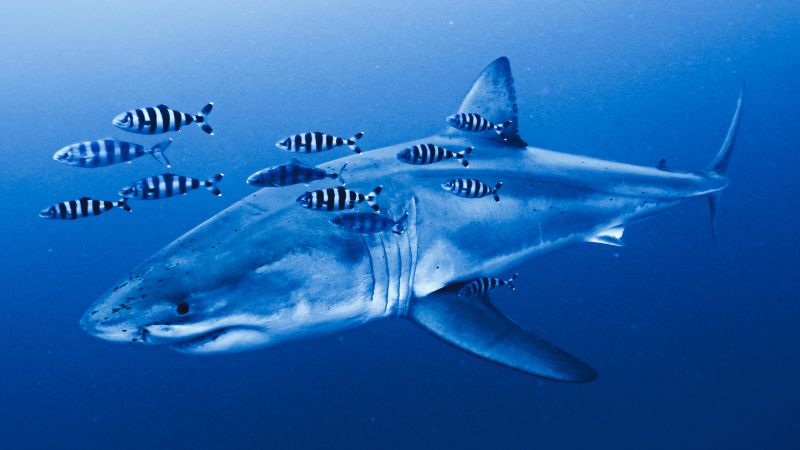
Rare footage of Mediterranean great white shark captured by ghost diver
Sandego.net – In a groundbreaking moment for marine conservation, a diver named Derk Remmers encountered a great white shark while retrieving abandoned fishing nets from a shipwreck in the Mediterranean Sea. The footage, recorded more than 132 feet beneath the ocean’s surface, marks a significant discovery as it may represent the first underwater video of an adult great white in the region. This rare encounter took place near the shores of Sicily and Tunisia, where the waters are known for their rich biodiversity. Remmers, a volunteer with the Ghost Diving Foundation, described the experience as both thrilling and surreal.
Unexpected encounter in deep waters
Remmers was part of a team engaged in removing ghost nets from a shipwreck when he unexpectedly spotted a great white shark. “I wasn’t afraid at all, but it’s not true,” he admitted in a Monday interview with CNN. “My mind told me humans aren’t typically on a white shark’s menu, but another part of me hoped the shark understood that too.” The diver’s composure was put to the test as he activated the camera, which he had initially intended to use only at the dive’s conclusion. “I needed to capture the footage because no one would believe we had seen a white shark without proof,” he explained.
“Scientists say that around 3 to 10% of all fishing gear is lost in any given year, in the oceans of the world,” Remmers told CNN. “And if you could imagine how many fishing boats come out of any harbor, this is a huge amount.”
Remmers and his diving partner were working in an area where no land was visible, emphasizing the remote and deep nature of the location. The mission, organized by Healthy Seas, aimed to clear ghost nets from shipwrecks that serve as critical habitats for marine life. “What makes this encounter so powerful is not only the shark itself, but the context in which it happened,” said Veronika Mikos, director of Healthy Seas, in a press release. “We were there to remove ghost nets trapping marine life on a shipwreck ecosystem that is a hotspot for biodiversity.”
Conservation efforts and biodiversity at risk
Healthy Seas, a foundation dedicated to marine litter removal and ocean life protection, has been instrumental in such missions. The team’s work focuses on both cleaning up debris and monitoring the health of underwater ecosystems. Mikos highlighted that the presence of a great white shark in these waters underscores the importance of preserving habitats threatened by human activity. “Moments like this remind us how much life can still exist in offshore Mediterranean waters and how vital it is to shield it from preventable dangers like abandoned fishing gear or overfishing,” she added.
For Remmers, the encounter was a testament to the fragility of marine ecosystems. “To my knowledge, no one has ever captured footage of a Mediterranean great white,” he said. “The last sighting was over 40 years ago.” This rarity highlights the challenges faced by these apex predators in their shrinking habitats. The Mediterranean, once a thriving environment for sharks, now bears the scars of decades of fishing and environmental degradation.
Human impact on great white populations
Despite their fearsome reputation, great white sharks are not immune to human threats. According to the International Union for Conservation of Nature (IUCN), white sharks are classified as vulnerable to extinction, with their populations estimated to have declined by 30-49% over the past three generations. This decline is attributed to overfishing, climate change, and the entanglement of sharks in fishing nets. “Sharks often become bycatch,” said Paul Cox, CEO of Shark Trust, a British organization specializing in shark and stingray conservation since 1997. “They are caught in nets not meant for them, left helpless, and face certain death.”
The situation is even more dire for Mediterranean white sharks. The IUCN has labeled them critically endangered, citing an extreme population drop caused by coastal and industrial fishing. These sharks, which can grow up to six meters in length and weigh over two tons, have become increasingly scarce in the region. Their presence in shipwrecks suggests that these underwater structures are now critical refuges for the species, as natural habitats are dwindling.
Global and local conservation challenges
Shark Trust, based in Plymouth, England, has been advocating for the protection of sharks and rays for over two decades. Their Mediterranean Programme was established in response to the alarming rates of extinction among the region’s nearly 80 species of sharks and rays. Cox emphasized that effective conservation requires coordinated efforts across fishing nations. “A range of measures are needed for sharks in the region,” he said. “The survival of marine life depends on all countries adhering to clear and enforced fishing regulations.”
The footage captured by Remmers is more than just a rare moment—it’s a call to action. Healthy Seas and other organizations stress that ghost nets are not only a menace to marine life but also a silent contributor to the decline of shark populations. These nets, discarded into the ocean, can trap and suffocate creatures for years, creating a web of threats that extends beyond immediate danger. “The Mediterranean is a biodiversity hotspot, but it’s also under immense pressure,” Mikos noted. “Every effort to remove debris is a step toward preserving the delicate balance of life here.”
While the encounter with the great white shark is a rare success, it underscores the broader challenges facing marine ecosystems. The Mediterranean, with its unique mix of warm and cold currents, supports a diverse range of species, but pollution, habitat destruction, and overfishing are eroding this diversity. Remmers’ video serves as a reminder that even in remote waters, the impact of human activity is evident. “This footage shows that the ocean still holds wonders, but we have to work harder to protect them,” he said.
As the team continues its efforts to clean up shipwrecks and monitor marine biodiversity, the discovery of the great white shark offers hope. It highlights the importance of conservation initiatives and the role of individuals in making a difference. The footage, combined with ongoing research, could help raise awareness about the plight of these majestic creatures and the urgent need for action. “It’s a powerful symbol of what we can achieve if we keep pushing forward,” Mikos concluded. “Every net removed, every species observed, and every story shared brings us closer to a healthier ocean.”
With the Mediterranean’s ecosystems under threat, the work of divers like Remmers and organizations like Healthy Seas is more critical than ever. Their efforts not only help protect marine life but also provide valuable data on the health of the ocean. As the footage of the great white shark spreads, it may inspire new commitments to conservation and remind the world of the importance of safeguarding the planet’s underwater wonders. “This encounter is a reminder that even in the deepest, darkest parts of the sea, life persists,” Remmers said. “And it’s up to us to ensure it continues.”