Crimea’s Emergency Declaration Amid Intensified Ukrainian Strikes
Sandego.net – Crimea’s leadership, under Russian control, activated an emergency status on Friday as escalating Ukrainian attacks disrupted power grids and fuel supplies. The move comes amid growing pressure on Russia, with Kyiv’s military campaign targeting the peninsula intensifying over the past months. Residents of Sevastopol, the main city of the Russian-occupied region, have reported frequent blackouts and dwindling fuel reserves, forcing daily life to adapt to new challenges.
Power Grid Crises and Ukrainian Drone Strikes
Sevastopol, a critical hub for Russia’s Black Sea Fleet, has been under constant threat from Ukrainian drone activity. The Kremlin-appointed governor, Mikhail Razvozhayev, announced that electricity repairs would be delayed due to air raid alerts, leaving the city in darkness. According to Ukraine’s drone commander, Robert Brovdi, Kyiv’s forces struck the city’s primary power substation seven times in the early hours of Wednesday, cutting off energy to thousands of households.
“The air raid warnings have become a routine part of life here,” said a Sevastopol resident who spoke to CNN. “Drones now fly over the city regularly, and intercepts happen above the streets instead of the Black Sea. It’s more dangerous than ever.”
Historical Context of Crimea’s Annexation
Crimea’s annexation by Russia in 2014 marked a pivotal moment in the region’s history. The decision followed the Maidan protests, which ousted pro-Kremlin President Viktor Yanukovych and sparked a shift in Ukraine’s political direction. The peninsula, historically a strategic asset for Russia, had been a popular vacation spot for both Russians and Ukrainians long before its occupation. During World War II, Yalta became a key venue for Allied leaders, while the Soviet era saw a darker chapter: the forced deportation of Crimean Tatars under Stalin’s orders.
Ukrainian Efforts to Reclaim the Peninsula
Since the 2014 annexation, Ukraine has pursued a multi-faceted strategy to reclaim Crimea. President Volodymyr Zelensky, who pledged to restore control of the region during his 2019 election, has emphasized the importance of the peninsula in his broader campaign against Russia. The recent military escalation reflects this commitment, with Ukrainian forces intensifying strikes on infrastructure to weaken Russian hold. These actions have disrupted the region’s energy and supply chains, creating a domino effect on civilian life.
Disruption of Daily Life and Economic Strain
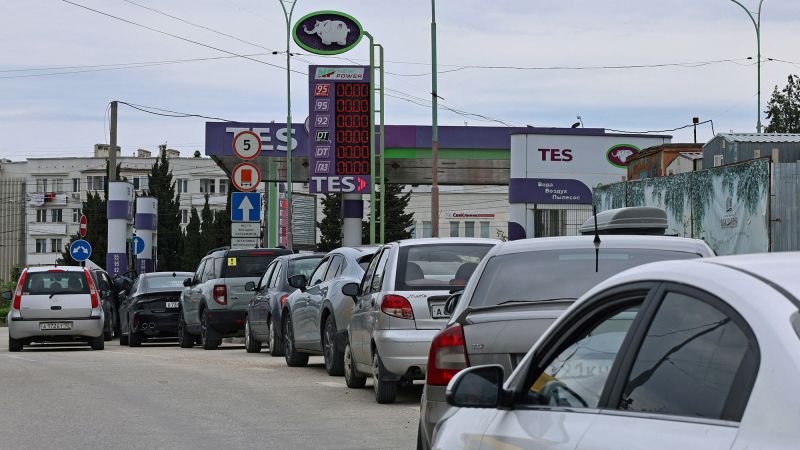
Crimea’s residents now face shortages of fuel and electricity, with gas sales to households banned to prioritize military needs. Public transport continues to operate, but fuel stations stand empty, and prices have soared. A local woman recounted how she had to queue for hours to secure fuel before it was no longer available. “We wanted to grab something to eat but there’s nothing. The shelves are empty,” said another resident in a video shared online.
“There is only one car. There is nothing else out there, emptiness,” a woman described in a Tuesday video, capturing the eerie quiet that has settled over Simferopol, Crimea’s second-largest city.
Logistical Challenges and Cross-Border Struggles
The Kerch Strait crossing, a vital link between Crimea and Russia, has seen massive congestion since Wednesday. Thousands of vehicles line up daily to pass through the manually inspected bridge, with the queue peaking at 2,800 cars on Friday morning after an overnight drone attack temporarily closed the route. Despite the disruption, the flow of goods and people remains uneven, with more vehicles attempting to exit the peninsula than enter.
Summer Camps Suspended and Educational Impact
As part of the emergency measures, the Russian-installed authorities have halted all children’s summer camps until September 1. This decision affects thousands of families, particularly those with young children. A video filmed in Simferopol shows empty roads and public spaces, contrasting sharply with the bustling atmosphere of Crimea’s resorts. The suspension of these programs highlights the broader disruption to education and leisure in the region.
Resilience and Uncertainty in the Region
Despite the hardships, Crimeans have shown resilience. A guesthouse owner in the resort town of Noviy Svet shared that visitors are still coming, though the experience has changed dramatically. “The city feels like it’s inside some sort of apocalypse,” said a resident in a Tuesday video, emphasizing the sense of isolation and instability. Meanwhile, the Russian government continues to invest in Crimea’s development, aiming to transform it into a thriving tourist destination. However, ongoing power outages and fuel shortages threaten these plans.
Strategic Importance of Crimea
Crimea’s strategic value lies not only in its natural beauty but also in its military infrastructure. The Black Sea Fleet, based in Sevastopol, plays a key role in Russia’s naval operations. The Ukrainian strikes targeting this fleet have intensified since 2022, as Kyiv seeks to pressure Putin’s regime. The region’s economic development under Russian rule has seen billions in investment, yet the current crisis has exposed vulnerabilities in this infrastructure.
International Reactions and Long-Term Implications
The annexation of Crimea in 2014 was widely criticized by the international community, but Russia has continued to assert control over the peninsula. The recent measures—power restrictions, fuel bans, and camp suspensions—underscore the growing tension between Kyiv and Moscow. While Crimeans adapt to these changes, the long-term impact on their quality of life remains a concern. The combination of military action and economic hardship has created a new reality for the region, one that challenges its role as both a strategic asset and a vacation destination.
As the conflict persists, the people of Crimea find themselves caught in the crossfire of a war that began in 2014 but has only intensified since 2022. The state of emergency reflects a broader strategy by Ukraine to erode Russia’s foothold in the south, leveraging both military and economic tactics. For now, the peninsula remains a symbol of the ongoing struggle between the two nations, with its future hanging in the balance as the situation continues to evolve.