Planet Found Orbiting a Dead Star Could Preview What Will Happen to Our Solar System
Unraveling the Mystery of a Distant Exoplanet
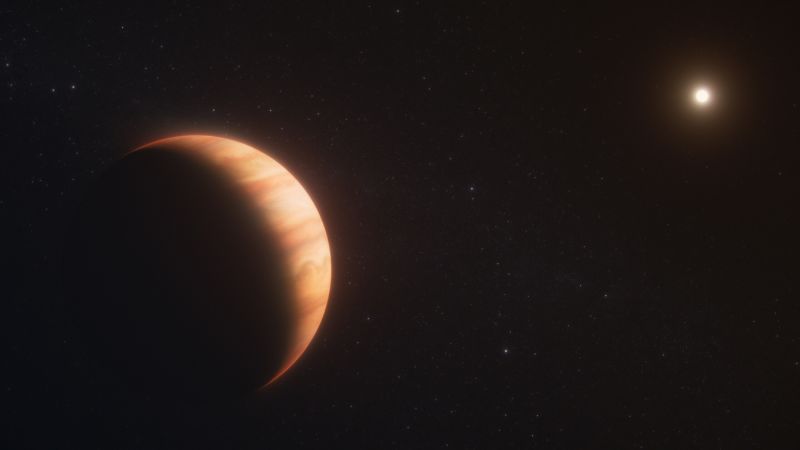
Sandego.net – Recent observations have shed new light on a peculiar exoplanet that orbits a white dwarf star, offering insights into how such a massive world could endure the violent transformation of its host. The discovery, detailed in a study published in the journal *Nature*, suggests that the planet’s survival may provide a glimpse into the potential future of our own solar system as the sun ages. Located a mere 80 light-years from Earth, the exoplanet—named WD 1856 b—has sparked intrigue among astronomers due to its unusual proximity to its star and its size, which is seven times greater than the white dwarf it now circles.
WD 1856 b’s orbit is so tight that it completes a full revolution around its host every 34 hours, making it one of the closest planets to a dead star ever recorded. This extreme closeness raises questions about its origins. When a sun-like star exhausts its hydrogen fuel, it expands into a red giant, engulfing nearby planets before collapsing into a dense, ember-like white dwarf. Yet, WD 1856 b exists in a space where it should have been destroyed, prompting researchers to investigate how it managed to survive this cosmic upheaval.
Observing the Bizarre Dance of a Planet and a Star
The study, led by Dr. Christopher O’Connor, a postdoctoral fellow at Northwestern University’s Center for Interdisciplinary Exploration and Research in Astrophysics, challenges existing models of planetary survival. O’Connor and his team used the James Webb Space Telescope to capture detailed data about the planet’s atmosphere, mass, and temperature, revealing unexpected findings that suggest the planet’s journey was anything but ordinary. “This is one of the most bizarre planetary systems we know of,” O’Connor noted in an email, highlighting the anomaly of a giant exoplanet thriving so near to a stellar remnant.
The challenges of studying WD 1856 b were significant. Unlike the bright stars that typically host planets, white dwarfs emit far less light, making their transits difficult to detect. Victoria Boehm, a graduate student in astronomy at Cornell University and coauthor of the study, explained that “dead white dwarfs are much dimmer than the planet-hosting stars normally observed with Webb.” This dimness, combined with the planet’s brief transit—lasting just 8 minutes—meant the team had to work quickly to capture the fleeting moment when the planet passed in front of its star, allowing them to analyze the starlight filtered through its atmosphere.
Unexpected Discoveries About the Planet’s Origins
Analysis of the data revealed that WD 1856 b has a mass between four and 11 times that of Jupiter, a finding that defies previous assumptions. Infrared measurements indicated the planet’s surface temperature is approximately 260 degrees Fahrenheit (127 degrees Celsius), which is 240 degrees higher than expected if it were solely warmed by the white dwarf. This thermal anomaly suggests the planet may have absorbed heat from a different source during its migration, a possibility that has only emerged through the study’s innovative approach.
By combining these new measurements with models of how gas giants like Jupiter and Saturn lose heat over time, the researchers uncovered a plausible explanation. The planet likely began its life orbiting at a safer distance from its host star before migrating inward as the star evolved. This inward journey could have been driven by gravitational forces, or it may have involved a dramatic survival event where the planet endured the star’s expansion and collapse. “That was really what started us on the track of figuring out the planet’s history from our data,” O’Connor stated, emphasizing the importance of this thermal signature in understanding the planet’s past.
Competing Theories for the Planet’s Fate
Two theories have emerged to explain how WD 1856 b ended up in its current orbit. The first, known as the “engulfment model,” proposes that the planet was partially consumed by its host star during its red giant phase but survived due to its massive size. “In the first scenario, we would expect the migration and heating process to leave a distinct imprint on the planet’s internal structure,” O’Connor explained. The second theory, the “gravitational interaction model,” suggests the planet avoided being destroyed but was nudged closer to the white dwarf by the gravitational pull of other celestial bodies in the system.
Both scenarios highlight the dynamic and unpredictable nature of planetary evolution. The engulfment model implies that the planet may have been torn apart or stripped of its outer layers during the star’s death throes, while the gravitational interaction model points to a more chaotic dance of gravitational forces. These possibilities not only reshape our understanding of exoplanet survival but also raise questions about the stability of planetary systems in their later stages. “For a theoretical astrophysicist, finding a strange object located where it ‘shouldn’t be’ feels a bit like an invitation from the universe to get creative in search of an explanation,” O’Connor wrote in an email, underscoring the study’s significance.
Implications for Our Solar System’s Future
The discovery of WD 1856 b has broader implications for the future of our own solar system. In approximately 5 billion years, the sun will expand into a red giant, potentially swallowing the inner planets, including Earth. However, Jupiter and Saturn—our largest gas giants—may have a better chance of surviving this phase. The study’s findings suggest that even planets as massive as Jupiter could migrate inward, retaining heat and avoiding complete destruction. This could mean that, in the distant future, the outer planets might orbit the sun’s remnant—a white dwarf—in a way that resembles WD 1856 b’s current state.
While the exact mechanism behind WD 1856 b’s survival remains unclear, the data from the James Webb Space Telescope has opened new avenues for research. The telescope’s ability to capture subtle changes in starlight has been crucial in studying such a dim and fleeting event. “Capturing enough light to see WD 1856 b’s spectrum, while also doing so quickly enough to not miss the transit, is something only Webb can do,” Boehm emphasized in a statement. This capability allows scientists to explore the planet’s atmospheric composition and temperature, which may hold clues about its history and the conditions that allowed it to persist.
As researchers continue to analyze the data, they hope to uncover more about the processes that shape planetary systems over time. WD 1856 b’s existence challenges existing models and invites new questions about the resilience of planets in the face of stellar evolution. Whether the planet’s journey was a result of gravitational interactions, thermal retention, or an improbable survival during the star’s collapse, its story is a testament to the complexity of cosmic phenomena. The study not only deepens our understanding of exoplanets but also serves as a reminder of the unpredictable paths that celestial bodies can take in the vastness of space.
The findings also highlight the importance of advanced telescopes in exploring the universe’s most extreme environments. Instruments like the James Webb Space Telescope enable scientists to observe events that would otherwise be invisible, such as the brief transits of planets around white dwarfs. As our understanding of stellar and planetary dynamics grows, so too does the possibility of discovering similar systems elsewhere. These discoveries could one day help predict the fate of our own planets, offering a cosmic preview of what lies ahead for the solar system billions of years from now.