Peter Thiel in Aspen: The Pope Accused of ‘Working for the Chinese Communists’
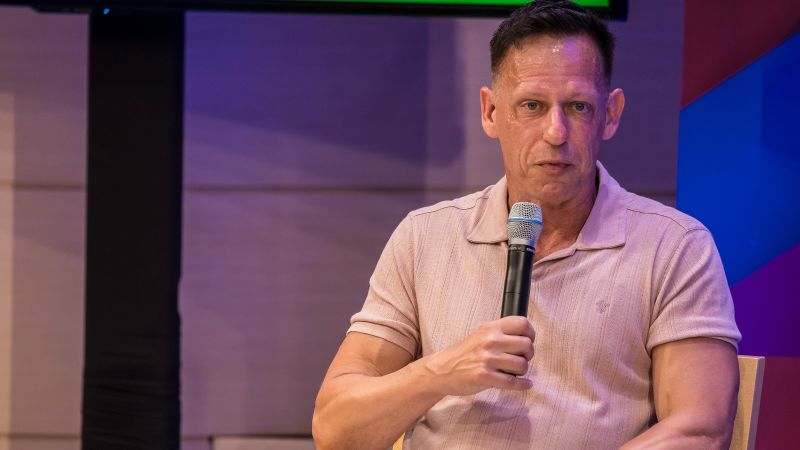
Sandego.net – Billionaire investor and tech entrepreneur Peter Thiel ignited controversy at the Aspen Ideas Festival on Tuesday, delivering sharp criticisms of both artificial intelligence and Western political systems. During his remarks, he took a pointed shot at Pope Leo XIV, asserting that the pontiff’s advocacy for AI regulation inadvertently aligned him with Chinese interests. This claim, however, was not merely a passing remark; it framed the pope as a “Chinese communist agent” in a broader debate about the future of global power dynamics and technological progress.
Thiel’s Bold Claims at Aspen Ideas Festival
Speaking alongside political scientist Francis Fukuyama, Thiel highlighted the pope’s role in shaping international AI policies. He argued that Leo XIV’s recent encyclical, “Magnifica Humanitas,” pushed for stricter oversight of artificial intelligence, which he believed could hinder the United States’ competitive edge against China. “The race between the US and China to advance AI is being slowed by only one side,” Thiel said, suggesting the encyclical might not resonate with Chinese leaders but could influence American public opinion.
“The weird ways that politics has gone haywire is telling me something very deep.”
The Aspen audience responded with a mix of amusement and intrigue, as Thiel’s characterization of the pope as a covert Chinese agent sparked discussion. While the Vatican did not immediately address the remarks, the incident underscored a growing tension between religious institutions and Silicon Valley’s ideological shifts. Thiel, a co-founder of Palantir and PayPal, has long been known for his skepticism of democratic systems, a stance that has drawn both praise and criticism from political observers.
Pope’s Encyclical and AI Regulation
Pope Leo XIV, the first leader of the Catholic Church to be born in the United States, issued his encyclical in May, urging global cooperation to regulate artificial intelligence. The document emphasized the need for AI to be “disarmed,” a metaphor that has fueled debate about the technology’s role in shaping society. Thiel contended that this call for international oversight, while well-intentioned, risked tipping the balance in favor of Chinese governance. “Working for the Chinese Communists” became a central accusation, implying that the pope’s efforts could be seen as supporting a rival power in the global race for technological dominance.
Thiel’s critique extended beyond AI to broader political concerns. He warned of a “democratic-socialist takeover” of the Democratic Party, suggesting that its policies were increasingly influenced by far-left ideologies. This vision of political realignment echoed his earlier support for Donald Trump, a stance that placed him at odds with progressive factions within the party. “When the Democratic Party goes, this country is over,” he declared, painting a dire picture of Western democracy’s future.
Fukuyama’s Response and Thiel’s Criticisms
In contrast to Thiel’s alarmist tone, Francis Fukuyama, a renowned political theorist, framed the discussion as a reflection of evolving global systems. The panel, titled “Humanity at the End of History,” marked a departure from their previous debate in 2012, which focused on economic stagnation and the challenges of liberal democracy. While Fukuyama argued that democratic institutions remain vital to sustaining political stability, Thiel countered that they had become sources of stagnation and instability themselves.
“I think there’s going to be a democratic-socialist takeover of the Democratic Party.”
Thiel accused the Democratic Party of drifting toward a more centralized form of governance, favoring elite decision-making over grassroots participation. He cited recent elections, including the 2024 selection of New York City Mayor Zohran Mamdani as a notable example of this shift. “The Republican Party doesn’t matter that much. It’s the less important one,” he said, implying that the Democratic Party’s transformation could have more profound consequences for the nation’s direction.
The debate also touched on the concept of the “End of History,” a theory Fukuyama once popularized, which posited that liberal democracy represents the culmination of human political evolution. Thiel, however, challenged this idea, suggesting that the current era of technological advancement might lead to a new form of governance. His remarks about the Antichrist, a theme he explored in a March lecture in Rome, hinted at a broader existential threat to Western values. “The Antichrist could manifest not as an individual but as a world government,” he said, envisioning a system that prioritizes efficiency over democratic ideals.
Broader Political Context and Future Outlook
Thiel’s remarks at Aspen were part of a larger narrative about the erosion of traditional political structures. He argued that democratic-socialists, with their emphasis on centralized control and collective action, were gaining momentum within the Democratic Party. This trend, he claimed, could lead to a new era of governance where technology and environmental concerns overshadow individual freedoms. “The race between the US and China” was framed as a critical juncture, with Thiel asserting that the pope’s policies could play a pivotal role in determining the outcome.
While some analysts praised Thiel’s provocative approach for stimulating dialogue, others criticized it as a form of “techno-authoritarianism.” They pointed to his history of championing elite-led solutions, from his early support for Trump to his influence on JD Vance’s political rise. Thiel’s partnership with Mithril Capital, a venture firm he co-founded, helped shape Vance’s career, illustrating the deep ties between Silicon Valley and political movements in the United States.
The tension between Thiel and the Vatican is not new. In March, he hosted an exclusive lecture in Rome on the Antichrist, just steps from the Holy See, which reportedly unsettled Catholic scholars. Two Catholic universities later distanced themselves from the event, highlighting concerns about its ideological implications. This friction, Thiel suggested, reflected a deeper conflict between religious traditions and modern technological paradigms.
As the debate unfolded, Thiel’s vision of the future emphasized the urgency of action against existential threats. Whether through AI, climate change, or political extremism, he believed that the West’s survival depended on adopting new strategies that embraced technological progress. “The greatest danger is abandoning institutions that have sustained democracy,” Fukuyama noted, but Thiel insisted that those same institutions were now complicit in stagnation. The clash of ideas at Aspen underscored a critical moment in the conversation about the role of technology, politics, and global power in shaping the 21st century.