Presidential Helicopter and Commercial Jet Nearly Collide at Reagan National Airport
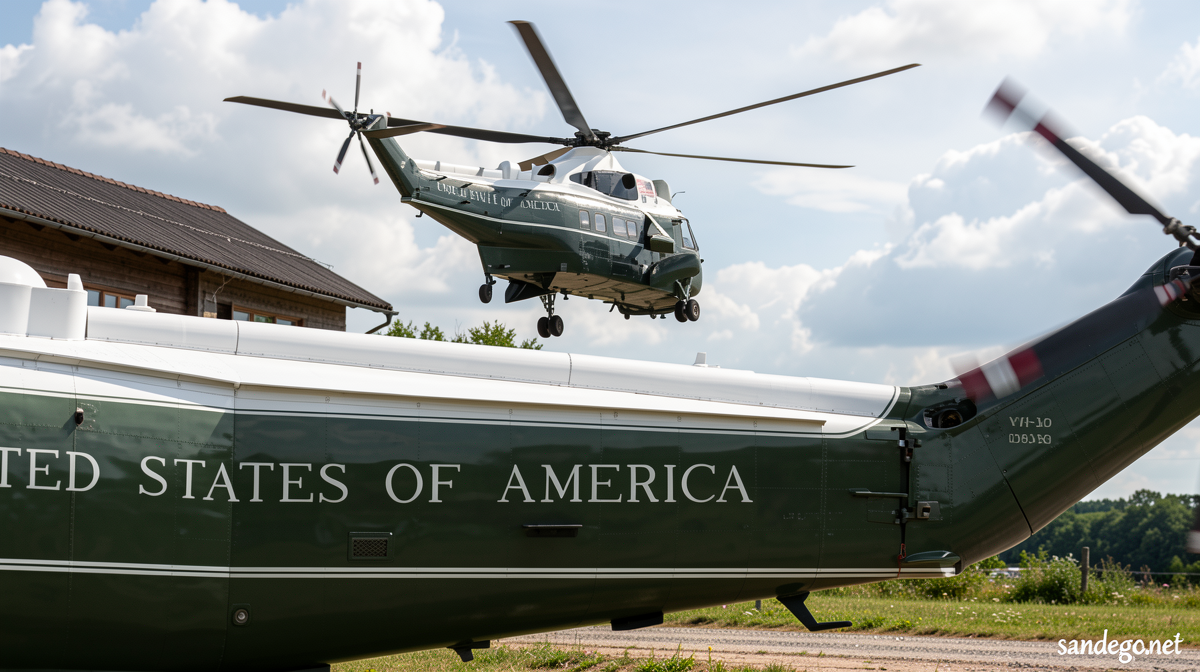
Sandego.net – Federal aviation authorities have launched a joint investigation after a passenger aircraft operating near Ronald Reagan Washington National Airport came dangerously close to the Marine One helicopter transporting President Donald Trump. The incident occurred on Tuesday afternoon when air traffic at the busy airport continued despite the presidential helicopter’s departure from the Ellipse, located just south of the White House.
Timeline of the Near-Miss
According to air traffic control audio obtained by CNN, the situation unfolded with concerning precision. Marine One pilots attempted to communicate with the Reagan National tower controller at least three times while preparing for takeoff. At 2:31 p.m., one pilot transmitted: “Tower, do you copy. Marine One, three minutes to lift.” The controller’s response indicated technical difficulties, describing the transmission as “broken and unreadable.” Marine One officially lifted off from the White House Ellipse around 2:33 p.m., according to a pool report. Approximately one minute later, at 2:34 p.m., American Airlines flight 3742—an E170 regional jet operated by Envoy Air, a wholly owned subsidiary of American Airlines—departed Reagan National Airport en route to Pensacola, Florida.
Distance and Safety Assessment
Tracking data from Flightradar24 indicates the commercial jet passed within 1.5 miles of the Ellipse during the critical moment. Both aircraft ultimately landed without incident. Video footage captured by independent journalist Dave Statter shows the plane ascending while the helicopter moved past the Washington skyline in the opposite direction. The Federal Aviation Administration issued a statement confirming the preliminary findings: “Based on our preliminary safety review, there was momentary loss of separation after which the aircraft continued to move away from one another.” The agency emphasized that ongoing reviews would determine whether corrective actions are necessary.
NTSB Investigation Launched
The National Transportation Safety Board announced Wednesday that it would open a formal investigation into the incident. This scrutiny comes amid heightened attention on Reagan National Airport’s airspace following a tragic collision last year between a US Army Blackhawk helicopter and an American Airlines regional jet. That accident claimed the lives of all 67 people aboard both aircraft. In response to the 2025 crash, the FAA implemented stringent restrictions on helicopter operations in the vicinity of Reagan National Airport. Despite these measures, the recent incident suggests potential gaps in communication protocols or procedural adherence.
Communication Breakdown
Audio analysis reveals that Marine One pilots maintained persistent contact attempts with the tower. After the initial “broken and unreadable” response, the pilots continued their transmissions. Minutes later, one pilot confirmed: “Uh … Marine One, you said you are proceeding as briefed?” The controller then issued a warning about the regional jet already departing. The pilots acknowledged the warning, held their position briefly, and then proceeded to Joint Base Andrews in Maryland. President Trump subsequently boarded an Air Force One flight bound for Los Angeles.
Official Responses and Context
A US Marine Corps spokesperson characterized the flight as routine, stating: “Marine One’s flight on Aug. 4 was routine. Washington National Tower did not delay the helicopter crew, ask them to hold, or otherwise alter their flight profile.” White House spokesperson Kush Desai emphasized to the Wall Street Journal that “Marine One flights are piloted by some of the best aviators in the world, and at no point was the President in harm’s way.” The FAA further clarified that the air traffic controller maintained contact with both the commercial pilot and Marine One pilot throughout the separation incident.
Broader Implications
Reagan National Airport, situated approximately three miles from the White House, operates in one of the most congested airspace environments in the United States. The airport’s proximity to the nation’s capital necessitates complex coordination between military and civilian air traffic control systems. President Trump brings particular relevance to this incident given his extensive aviation background. He has previously designed his own Air Force One aircraft, demonstrating a personal interest in presidential aviation operations. The investigation will examine whether the controller’s failure to acknowledge Marine One’s transmissions constituted a procedural violation or a technical malfunction. Both possibilities carry different implications for future presidential movements through the Washington airspace. CNN has contacted Envoy Air, American Airlines, and the White House for additional commentary. The investigation’s findings could result in revised protocols for coordinating presidential helicopter departures with commercial air traffic at Reagan National Airport.
Related Reading
Frequently Asked Questions
What is Passenger plane taking off got too close?
Passenger plane taking off got too close is the main topic of this guide. The article explains the context, practical details, and next steps readers should understand.
Why does Passenger plane taking off got too close matter?
Passenger plane taking off got too close matters because readers are looking for a useful answer, not just a short summary. Good content should match search intent and help them decide what to do next.