No Fuel, No Weapons: Ukraine’s Drone Strategy Hitting Russian Logistics Hard
Sandego.net – As the conflict in Ukraine enters its fifth year, a novel approach involving mid-range drones is proving to be a critical weapon in Kyiv’s arsenal. These unmanned aerial systems are now significantly hampering the Russian military’s ability to maintain supply lines, particularly in the southern front, by targeting infrastructure such as bridges, trains, and fuel transport vehicles. The strategy has not only created a barrier for Moscow’s planned summer offensive but also weakened the logistical backbone that sustains its operations in the region.
Tracking the Impact of Drone Strikes
Recent analyses by French open-source researcher Clément Molin and the volunteer-driven OSINT group Geoconfirmed, alongside CNN’s investigative team, have documented over 150 instances of drone attacks on Russian fuel tankers and trucks. Geolocated video and imagery provide evidence of these strikes, though experts suggest the actual number could be even higher, with many incidents going unnoticed. The surge in attacks has accelerated since mid-May, expanding to include targets like port facilities and maritime vessels, further complicating Russian logistics.
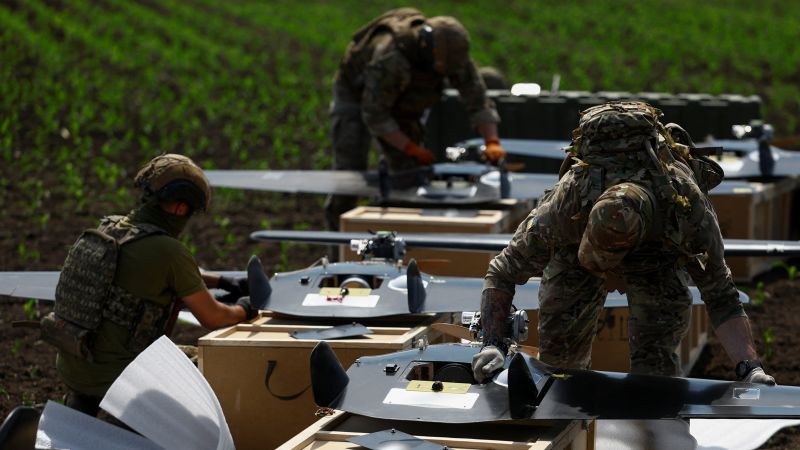
The drones, all developed within Ukraine, are engineered to operate within a range of 50 to 300 kilometers. This capability allows them to strike at critical points along supply routes, adding a new layer to Ukraine’s military strategy. By disrupting the flow of resources, these drones are not only slowing down Russian advances but also creating strategic opportunities for Kyiv to gain the upper hand in the war.
Strategic Shift and Operational Scale
Among the newly deployed systems are the FP-2 and Behemoth models. The Behemoth, notable for its speed of 180 km/h (110 mph), can carry a 70-kilogram warhead, making it highly effective for striking larger targets. According to Molin, these drones have given Ukraine the ability to launch large-scale operations that target Crimea’s main supply routes and disrupt logistics across the frontline. “The Ukrainians have obtained the means to start a large-scale drone campaign to cut Crimea from its main supply roads and complicate Russia’s logistical situation throughout the frontline,” he told CNN.
Ukraine’s Unmanned Systems Forces, the military unit responsible for drone operations, reported that the number of mid-range strike missions has increased 28 times over the past year. This escalation is part of a broader plan to weaken Russia’s offensive capabilities, create supply bottlenecks for enemy forces, and dismantle key air defense systems in occupied areas. The goal is to open “corridors” for longer-range drones, allowing them to strike deeper into Russian territory with greater precision.
Disrupted Supply Routes and Fuel Shortages
The impact of these strikes has made several vital routes between Russia and occupied Ukraine too hazardous for regular use. This has led to a shortage of fuel and munitions for Russian forces stationed in southern regions, directly affecting their ability to sustain operations. In Crimea, a region under Russian control since the war’s early stages, persistent fuel shortages are now a reality, as critical transport links are repeatedly targeted.
Analyst Mick Ryan, a former senior officer in the Australian army, highlights the success of this strategy in securing aerial dominance over three coastal highways connecting Crimea to the mainland. Geolocated footage from May shows Ukrainian drones striking at least 35 trucks and other vehicles near these highways, underscoring the scale of disruption. One notable example is the Chonhar bridge, a key artery linking Crimea with occupied Ukraine. The bridge, located near a village of the same name, has been repeatedly attacked, leaving large craters in its road surface and rendering it impassable for much of the time.
Russian-backed authorities in the Kherson region have acknowledged the damage to the Chonhar bridge and others, with traffic frequently halted and temporary pontoon bridges constructed to replace the damaged ones. Despite these efforts, the bridge’s freight traffic has dropped by 71% in just two weeks, according to Robert Brovdi, commander of Ukraine’s drone forces. This decline reflects the effectiveness of the drone campaign, forcing Russia to rely on less efficient alternatives.
Challenges for Russian Air Defenses
Russian air defenses, which have been a cornerstone of their logistical operations, are struggling to keep up with the frequency and precision of Ukrainian drone strikes. Analysts note that the Russian military has been unable to fully neutralize the threat, allowing drones to operate with relative impunity. This has created a scenario where enemy forces face not only ground disruptions but also constant aerial harassment.
“The enemy will no longer feel safe, even at a considerable distance from the line of contact,” said Ukrainian Defense Minister Mykhailo Fedorov, who described the strategy as a “logistical lockdown.” Fedorov emphasized that these strikes are systematically destroying Russian capabilities far from the front lines, depriving them of the resources needed to conduct active assaults. The cumulative effect of these attacks is a profound disruption to the flow of supplies, fuel, and reinforcements, all of which are essential for sustaining the Russian military’s operations.
Geolocated data from the Institute for the Study of War further supports the notion that Ukraine’s drone strategy is evolving. The group reports that Ukrainian forces have been targeting at least 35 trucks and vehicles near highways in Crimea and other southern regions, with the most significant impact seen on fuel transport. This trend has been consistent since January 2026, with over 20 trains attacked, many of them fuel-laden, along the entire front. The coordinated effort to disrupt rail networks has compounded the challenges faced by Russian logistics, making it harder to move supplies efficiently.
Long-Term Implications for the War
Molin’s research suggests that this strategy is not just effective but also transformative. By extending the “kill zone” deep into Russian territory, Ukraine has redefined the depth of its operational reach. These drones, operating as roving munitions, are flying over key routes to target logistics, especially military equipment and fuel trucks. This precision targeting has made it increasingly difficult for Russia to maintain its supply chain, forcing them to divert resources and adapt their tactics.
The ongoing drone campaign is a testament to Ukraine’s growing technological and strategic capabilities. It marks a shift from earlier tactics, where drone strikes were primarily used for tactical disruption, to a more systematic approach that targets the core of Russian logistics. This has not only altered the battlefield dynamics but also forced Russia to reconsider its supply routes and operational plans. As the war continues, the effectiveness of Ukraine’s drone strategy may determine the outcome of future offensives, particularly in the southern front.