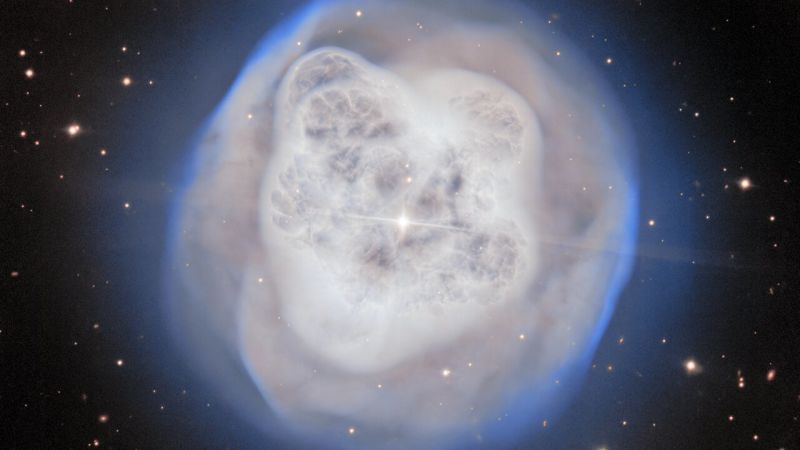
New Image of the Crystal Ball Nebula Captures Dying Star’s Cosmic Drama
Sandego.net – A stunning new image of the Crystal Ball Nebula has been released, offering a breathtaking view of a star in its final cosmic act. Captured by the Gemini Multi-Object Spectrograph on the Gemini North telescope, this photograph highlights the intricate dance of a binary star system as it sheds its outer layers, forming a luminous cloud of gas and dust. The nebula, located in the Taurus constellation, is approximately 1,500 light-years away—an expanse that means the light we see today was emitted over a thousand years ago, preserving a moment frozen in time.
Artistry in the Universe
While the image serves as a scientific tool, its visual appeal has made it a standout in the field of astronomy. “This image was chosen not just for its scientific value, but for its striking beauty,” said Travis Rector, an astronomer at the NOIRLab. “It’s a reminder of how extraordinary the cosmos can be.” The NOIRLab, supported by the National Science Foundation, uses advanced instruments like the Gemini telescope to explore such phenomena, blending discovery with artistry.
“The Crystal Ball Nebula’s symmetry and brilliance make it a unique subject for study.”
The Binary System’s Cosmic Influence
The Crystal Ball Nebula is not a solitary star but a binary system, where two stars have evolved in tandem and now orbit each other. This interaction has shaped the nebula’s distinctive appearance, creating layered structures that resemble a crystal ball. “Such systems are common in our galaxy,” Rector noted. “The gravitational pull between the stars influences how material is expelled, resulting in complex, radiant patterns.”
The slower orbital cycle—nine years for one star to complete a full rotation around the other—creates a prolonged interaction, allowing the expelled gas to form intricate, multi-tiered layers. This process mirrors the way spinning cotton candy machines generate fluffy, symmetrical clouds, resulting in a celestial object that is both scientifically significant and visually captivating. The nebula’s structure challenges current models of stellar evolution, revealing new insights into how stars transition to their final phases.
Colors Reveal Stellar Secrets
The vibrant colors in the new image of the Crystal Ball Nebula are a direct result of its chemical composition. Spectrographic analysis isolates specific wavelengths of light, exposing gases like hydrogen and oxygen that dominate the scene. Reddish tones originate from ionized hydrogen, while brilliant blue hues highlight oxygen-rich regions—elements produced in abundance during a star’s late life. “The colors are a window into the nebula’s physics,” Rector explained, “offering clues about the gases and their interactions.”
Such details are vital for understanding the life cycles of stars. While planetary nebulae often appear as glowing disks through small telescopes, their complexity is only fully revealed with advanced imaging tools. The new image of the Crystal Ball Nebula showcases these layered formations, demonstrating how light and material interact in space. These observations help astronomers refine theories about star death and the birth of new celestial bodies.
A Legacy of Scientific Discovery
William Herschel, the German-British astronomer who first classified such objects as “planetary nebulae,” observed this one in 1790. Though he could not have anticipated the technology that would later dissect its secrets, his early work laid the foundation for modern studies. The Crystal Ball Nebula remains a popular subject for researchers, even as new tools like the James Webb Space Telescope continue to unveil unexpected details.
“When viewed through the James Webb Space Telescope, the same object looks entirely different,” said Jan Cami, a physics and astronomy professor at Western University. Cami, who was not involved in the latest imaging, pointed out that multi-wavelength studies are essential for uncovering the full story of such phenomena. The new image of the Crystal Ball Nebula, combined with data from other instruments, paints a more complete picture of its evolution and the universe’s hidden wonders.