Murder or Self-Defense? Texas Jury Set to Decide Fate of Karmelo Anthony in Track Meet Stabbing Case
The Incident That Sparked a Trial
Sandego.net – A tragic event unfolded at a high school track meet in Frisco, Texas, on April 2, 2025, when 17-year-old Austin Metcalf was fatally stabbed by Karmelo Anthony, a fellow student. The confrontation, which occurred under the tent of Frisco Memorial High School, has drawn national attention as both parties present conflicting narratives. Anthony, who is Black, and Metcalf, who is White, were both attending the event as members of their respective schools. The incident has become a focal point for discussions about race, provocation, and the use of weapons in school settings.
Trials of Perception and Proportion
The trial has ignited a heated debate over whether Anthony’s actions were premeditated murder or a justified act of self-defense. Prosecutors argue that Anthony initiated the conflict, taunting Metcalf and using a knife to stab him without reason. Defense attorneys, however, claim that Anthony was merely defending himself after being shoved by Metcalf. The case has also raised questions about the broader societal implications of such incidents, with some activists framing it as a reflection of systemic racial disparities.
Public Support and Racial Tensions
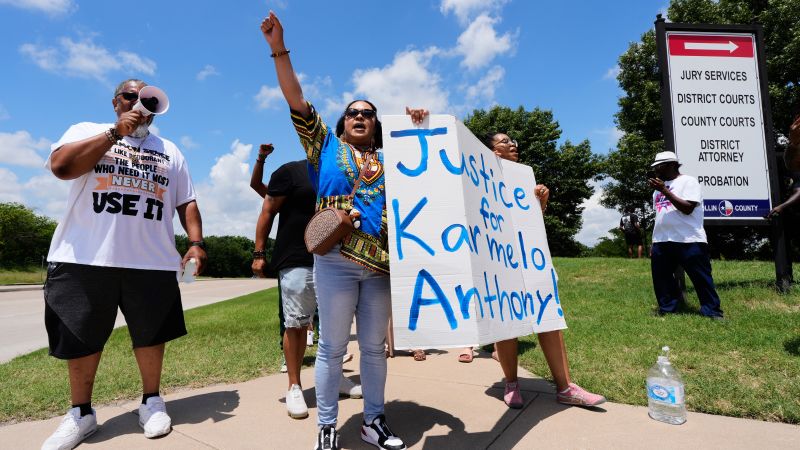
Amid the legal battle, public opinion has been divided. A fundraising campaign for Anthony’s family, organized through GiveSendGo, has amassed over $625,000 in donations, while Metcalf’s family received nearly $600,000 via GoFundMe. This disparity highlights the polarizing nature of the case. The Next Generation Action Network, a social justice group backing Anthony, has drawn parallels to Kyle Rittenhouse, the Wisconsin teenager acquitted of murder charges in 2021 for shooting two people during protests. “Rights are either for everyone or they are for no one,” the group stated in a recent statement, emphasizing their belief in Anthony’s right to self-defense.
Jury Selection and Trial Logistics
Jury selection for the trial took place last week, revealing a notable absence of Black jurors. This has sparked discussions about potential biases in the selection process, given Anthony’s race. The trial’s proceedings are further constrained by limited public access to the courtroom, with cameras restricted to ensure a focused environment for deliberation. The prosecution concluded its case late last week, and the defense wrapped up its arguments on Monday, leaving the jury to weigh the evidence and determine the verdict.
Prosecution’s Narrative of Provocation
“This case has nothing to do with race. This case has nothing to do with self-defense,” asserted Bill Wirskye, a prosecutor in the case, according to CNN affiliate WTVT. He described the altercation as a deliberate act of violence, emphasizing Anthony’s role in provoking Metcalf before the stabbing. Wirskye argued that Anthony’s actions were unprovoked, resulting in a senseless murder that reflects broader patterns of aggression in school settings.
Defense’s Claim of Necessity
Mike Howard, Anthony’s defense attorney, presented a contrasting account. He maintained that Anthony sought shelter under the Memorial High tent to escape the rain and was subsequently attacked by Metcalf. According to Howard, Anthony used the knife in response to the shove, acting out of immediate fear rather than malice. “He was defending himself,” Howard told CNN affiliate WFAA, framing the incident as a spontaneous reaction to perceived threat.
Witness Testimony and Conflicting Accounts
A critical witness recounted the events to police, stating that Metcalf had approached Anthony and instructed him to move out from under the tent. Anthony, according to the witness, retrieved a knife from his bag and warned, “Try to touch me, and you’ll see what happens.” When Metcalf complied, Anthony stabbed him once in the chest and fled the scene. The witness’s account aligns with the prosecution’s claim of premeditated violence, though the defense argues the sequence of events was reversed.
Legal Consequences and Defense Strategies
If convicted of murder, Anthony faces a sentence of five to 99 years in prison. However, he may attempt to argue that the killing was committed in “sudden passion,” a legal defense that could reduce the charge to second-degree felony. This would result in a maximum sentence of two to 20 years. The choice of defense strategy underscores the gravity of the case and the potential for differing outcomes based on how the jury interprets the sequence of events.
Aftermath and Family Impact
Metcalf’s twin brother, Hunter, rushed to the scene after the stabbing and tried to aid his sibling. Despite the efforts of first responders, Metcalf succumbed to his injuries at the stadium. The tragedy has left his family grappling with grief and the need for justice. Meanwhile, Anthony’s family has relied on public support to navigate the emotional and financial toll of the trial, with their fundraiser reflecting the community’s solidarity.
Societal Reflections and Ongoing Debate
Collin County District Attorney Greg Willis highlighted the national significance of the case, stating in a previous statement, “When something like this happens at a school event, it shakes people to the core.” His remarks echo the broader sentiment that such incidents resonate deeply, particularly in communities where racial tensions are already palpable. The trial is not only about determining guilt but also about setting a precedent in how society views acts of violence and self-defense in diverse contexts.