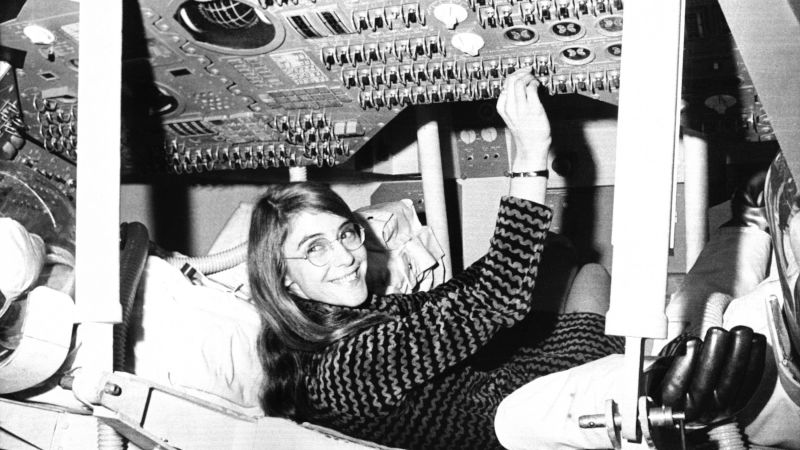
Margaret Hamilton, Apollo Software Pioneer, Dies at 90
Sandego.net – Margaret Hamilton, the computer scientist whose work helped guide NASA’s Apollo astronauts to the moon, has died at age 90. Her career reshaped the way software was designed, tested and trusted at a moment when human spaceflight depended on computers performing flawlessly under extraordinary pressure.
The Massachusetts Institute of Technology confirmed Hamilton’s death through its Department of Aeronautics and Astronautics. No cause of death was made public.
Hamilton’s legacy reaches far beyond a single lunar mission. She is widely recognized as a foundational figure in software engineering, helping turn programming from an emerging technical craft into a disciplined professional field. The phrase “software engineering” is credited to Hamilton, who used it to emphasize that building dependable code required the same rigor, planning and accountability applied to other major engineering projects.
Leading software work for Apollo
Hamilton joined MIT in 1959 and remained there until the middle of the 1970s. During that period, she led the Software Engineering Division at the MIT Instrumentation Laboratory, an organization that would become central to the Apollo program’s navigation and guidance work.
In 1961, the division received a NASA contract connected to Apollo. Hamilton eventually directed a team of 100 engineers responsible for creating software used to steer and guide the missions. Their work supported an undertaking of exceptional complexity: sending crews beyond Earth, navigating to the moon, landing on its surface and bringing astronauts safely home.
The Apollo program became one of the defining scientific and technological efforts of the 20th century. Its success required not only rockets, spacecraft and astronauts, but also reliable onboard computing at a time when digital systems were far less powerful than the devices now found in ordinary homes. Software had to make effective use of limited computing resources while responding correctly to changing conditions during flight.
Hamilton’s team worked in that demanding environment, developing code for systems whose failure could endanger crews and jeopardize the mission. The achievement demonstrated that software was not a secondary component of space exploration; it was essential infrastructure for making the mission possible.
A discipline built through rigor
Hamilton helped establish a model for software development rooted in careful design, testing and reliability. That approach was especially important in aerospace, where a programming error could have immediate and severe consequences. Her work gave greater visibility to the idea that software deserved engineering standards of its own.
At the time, computing was still a young field. The profession did not yet carry the broad recognition it has today, and many of the methods now associated with dependable software were still being developed. Hamilton’s leadership showed how teams could organize complex codebases and build systems intended to operate in high-stakes circumstances.
Her contribution is often remembered through the Apollo moon landings, particularly the first landing in 1969, but its influence extends to the larger evolution of modern computing. Industries ranging from transportation and medicine to communications and finance now rely on software systems that must be built with precision and resilience. Hamilton’s insistence on treating software as engineering helped lay intellectual groundwork for that reality.
“To say Margaret Hamilton was a pioneer — to say she was ahead of her time — would be a dramatic understatement,” said Olivier de Weck, the Apollo Program Professor and interim head of the MIT Department Aeronautics and Astronautics.
“She was a software engineer at a time when that field was in its infancy, and she not only developed advanced code herself but also led a team in using that nascent technology to develop one of the most complex systems humanity had ever achieved.”
Recognition for a lasting achievement
Hamilton received the Presidential Medal of Freedom in 2016 from President Barack Obama. The honor recognized her contributions to science and space exploration and placed her among Americans celebrated for exceptional impact on public life.
Her career also remains an important example of the people behind landmark achievements that are often described primarily through spacecraft, launch vehicles or famous astronauts. Apollo’s lunar missions were the work of extensive teams of scientists, technicians, engineers and support staff. Hamilton represented the crucial role played by software specialists in transforming ambitious goals into functioning systems.
The moon landings changed what many people believed technology could accomplish. Hamilton’s work helped make that change possible by ensuring that the computers aboard Apollo could contribute to the decisions and guidance required during the journey. It was a defining contribution to the space race and to the development of a profession that now shapes nearly every part of daily life.
Hamilton leaves behind a legacy tied to one of humanity’s most celebrated explorations, as well as to the continuing expectation that critical software must be designed with care. Her work showed that code could be as consequential as any physical component of a spacecraft—and that the people who create it could help carry human ambitions all the way to the moon.
Related Reading
Frequently Asked Questions
What is Margaret Hamilton whose software helped land?
Margaret Hamilton whose software helped land is the main topic of this guide. The article explains the context, practical details, and next steps readers should understand.
Why does Margaret Hamilton whose software helped land matter?
Margaret Hamilton whose software helped land matters because readers are looking for a useful answer, not just a short summary. Good content should match search intent and help them decide what to do next.