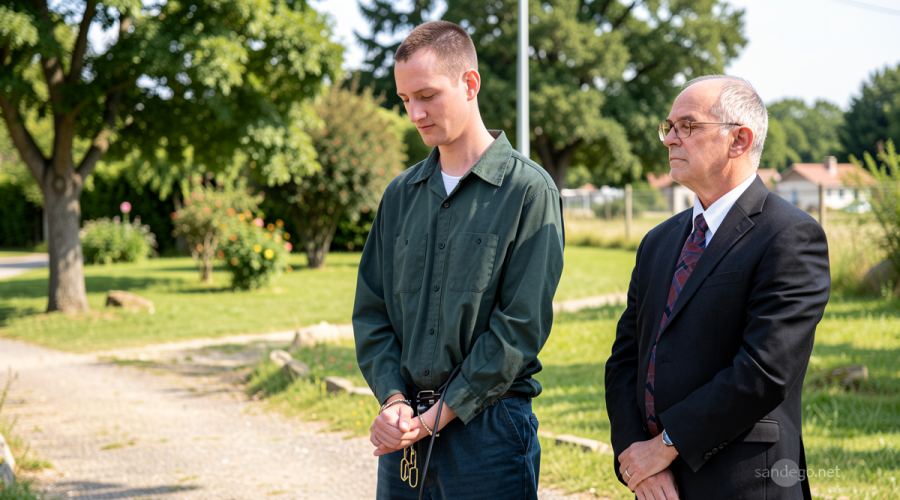
Judge Sets Parole Timeline for Dartmouth Professor Killer
Sandego.net – Robert Tulloch, now 43 years old, will become eligible for parole consideration in approximately two decades following a court decision Monday. The Vermont native was merely 17 when he and a companion murdered a married couple of Dartmouth College faculty members a quarter-century earlier. Under the new sentencing arrangement, Tulloch may seek release when he reaches the same age as one of his victims.
Agreement Reaches Courtroom Resolution
Attorneys representing Tulloch and state prosecutors successfully negotiated a settlement that eliminated the need for a three-day resentencing proceeding. Inside the Grafton County Superior Court in North Haverhill, New Hampshire, a restrained Tulloch kept his gaze lowered while court officials reviewed the brutal stabbing details. Originally receiving automatic life imprisonment without parole after entering guilty pleas to first-degree murder charges in the 2001 killings, Tulloch’s case benefited from landmark Supreme Court jurisprudence. In 2012, the nation’s highest court determined that mandatory life-without-parole sentences violate constitutional protections for juvenile offenders. This precedent subsequently received retroactive application, opening pathways to freedom for hundreds of young people serving life terms. Five New Hampshire inmates, including Tulloch, had committed their homicides as teenagers and now face potential release.
Victim’s Daughter Addresses the Court
During proceedings, Tulloch offered an apology to Veronika Zantop, one of the professors’ two daughters, who participated via video connection. She shared reflections on how her family endured the tragedy. A psychiatrist and mother of two boys, with one son matching Tulloch’s age at the time of the crimes, she acknowledged developmental changes in adolescent brains.
She emphasized that while brain development varies, she found no evidence of such change in Tulloch’s case, noting his careful preparation and methodical execution of the murders.
“This wasn’t a crime of passion or retribution,” she declared. “He wasn’t using substances, he wasn’t psychotic. There was just sheer depravity.”
She recommended that Tulloch remain incarcerated for the maximum duration possible.
Sentencing Decision and Legal Arguments
Tulloch set aside his prepared remarks after hearing the victim’s statement. “After listening to that, I feel disgusted by even thinking I could say anything that would mean anything,” he expressed. His legal team had previously submitted documentation arguing for a minimum term between 30 and 40 years, citing comparative juvenile homicide cases across New Hampshire and the United States influenced by Supreme Court decisions. Judge Lawrence MacLeod ultimately imposed a 45-year minimum sentence.
MacLeod’s decision considered applicable statutes, offense circumstances, Tulloch’s prison behavior, outcomes from similar New Hampshire cases, and Veronika Zantop’s courtroom address.
Tulloch may petition for parole in 2046 upon reaching age 62, matching Half Zantop’s age at death.
Prosecutor and Defense Perspectives
New Hampshire Attorney General John Formella issued a statement supporting the arrangement.
“The agreed upon sentence provides certainty that Tulloch will remain incarcerated for a substantial period of time, allows Tulloch to pursue some measure of rehabilitation, and it secures important protections for the community.”
Defense attorneys Richard Guerriero and Oliver Bloom highlighted Tulloch’s institutional record, noting maturity development and minimal misconduct since 2012, with no minor violations since 2017. Therapy documentation revealed expressions of “significant remorse” regarding what Tulloch characterized as a “heinous and unforgivable crime” stemming from his “warped youthful thinking” and demonstrating his “good capacity for empathy.”
The Crime and Aftermath
According to James Parker, Tulloch’s accomplice, the teenagers grew restless with their existence in Chelsea, Vermont. They devised a scheme to murder random individuals, appropriate their funds, and relocate to Australia. Over several months, they visited homes in New Hampshire and Vermont, posing as environmental survey researchers until the Zantops permitted entry. Susanne Zantop, aged 55, directed Dartmouth’s German studies division, while her husband Half instructed Earth sciences students. Parker, then 16, testified that Tulloch stabbed Half Zantop before instructing him to assault Susanne Zantop. Tulloch also delivered stabbing wounds to her. Physical evidence connecting the pair included fingerprints on a knife sheath and a blood-stained boot impression. Following police questioning, the teenagers escaped Vermont and traveled westward via hitchhiking. Authorities apprehended them weeks later at a truck stop in Indiana. Parker, who cooperated fully with investigators and accepted a guilty plea for accomplice liability to second-degree murder, secured parole in 2024 at age 40.