Inside an exclusive ‘man camp,’ where one woman is trying to save men from themselves
Sandego.net – In the heart of northern California, a unique retreat is challenging traditional notions of masculinity. Nestled in a serene valley, the setting mirrors the struggles of its participants: a place where vulnerability is both a risk and a reward. The land, shaped by years of volcanic activity, holds lessons in patience and resilience—much like the vines that thrive here, yet are susceptible to overexposure or neglect. For the men attending this five-day program, the stakes are high. They’ve invested thousands of dollars to transform, to confront their emotions, and to rediscover what it means to be human in a world that often demands stoicism.
A Feminist Counter to the Manosphere
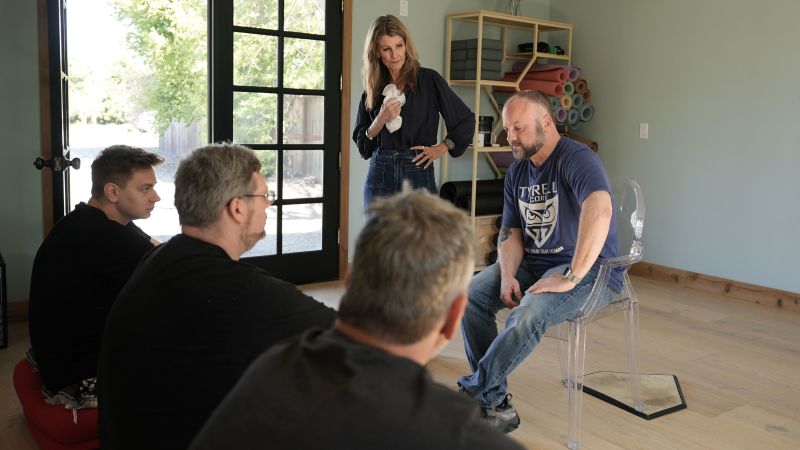
Lori Jean Glass, the founder of this initiative, envisions her retreat as a sanctuary for men seeking renewal. Unlike the hyper-masculine ideologies dominating online spaces, Glass’s approach emphasizes emotional intelligence and self-awareness. Her camps, branded as “man camps,” are led by a team of coaches, most of whom are women, and offer a structured environment for introspection. “It’s a place where men can shed their armor,” she explains, her voice tinged with optimism. “We’re not just teaching them to cry—we’re helping them understand why they’ve been avoiding it for so long.”
Glass has spent over a decade refining her methods, drawing from psychological theories and real-world experiences. Initially, her retreats were a last resort for men overwhelmed by their own emotional states, often encouraged by partners who had previously benefited from her women’s programs. But as the manosphere—social media movements like those of Andrew Tate, Adin Ross, and Myron Gaines—gains traction, more men are seeking her alternative. These influencers promote a rugged, emotionally dominant version of manhood, one that prioritizes strength over sensitivity. For Glass, this represents a crisis: a generation of men is losing touch with their inner worlds.
The Toughest Transitions
The participants in Glass’s latest retreat are a mosaic of life experiences. Matt Sanders, 61, and Jason Owens, 52, arrived grappling with the loss of loved ones—Sanders mourning his father, Owens grieving his wife. Both had spent years navigating the pressures of a hyper-masculine culture, where expressing vulnerability was seen as weakness. Their presence at the camp underscores a broader trend: men across age groups are seeking refuge from a society that increasingly rewards emotional stoicism. The retreat’s structure is designed to dismantle these barriers, starting with morning yoga and moving into one-on-one therapy, group exercises, and experiential activities like role-playing and art therapy.
“Men are struggling,” Glass tells CNN. “They’re lost in a world that values strength over connection.” This sentiment is echoed in data that highlights the growing isolation among men. A Gallup study last year revealed that 25% of young American men reported feeling lonely the previous day, a figure that has doubled since the 2021 Survey Center on American Life report. At that time, one in six men claimed they had no close friends, a stark increase from just 12% in the 1980s. These numbers reflect a cultural shift where men are less likely to seek support, even as they face higher rates of depression and suicide.
Resistance in a Masculine Landscape
Despite her efforts, Glass faces a formidable challenge: the manosphere’s pervasive influence. This online community, fueled by figures like Tate and Ross, has redefined masculinity as a competition of dominance, wealth, and control. Its rhetoric—emphasizing emotional detachment and physical prowess—has resonated with millions, especially in an era of social media polarization. For every five men who attend Glass’s retreat, tens of millions scroll through content that glorifies the “alpha male” archetype. “It’s a battle of ideas,” she says. “They’re not just telling men how to be strong—they’re telling them how to be silent.”
Yet Glass remains undeterred. She believes her approach is not just a retreat but a movement. “I want this process taught in every high school,” she insists, envisioning a future where boys are guided away from the rigid definitions of manhood that often lead to emotional burnout. Her hope is that by fostering empathy and communication, she can help men reclaim their humanity. The program’s structure is intentionally immersive, with participants spending 24/7 in a group environment that mimics the close-knit bonds of traditional male camaraderie but with a feminist twist. “We’re building a new kind of brotherhood,” she says, “one that values connection over conquest.”
From Tragedy to Transformation
Glass’s own journey is as much a part of the program as the men she guides. Her past is marked by personal loss and heartbreak, yet she sees these experiences as fuel for her mission. “I’ve walked through the fire,” she says. “Now I want to help others do the same.” The retreat’s success, she argues, is measured not just by individual change but by the ripple effect it creates. “If one man learns to open up, it could inspire a community to do the same,” she says. This vision is tested daily as participants confront their fears, often for the first time in decades.
CNN reporters Rob Picheta and David Culver recently experienced this firsthand, joining the retreat to observe its impact. They were granted access on the condition that they underwent the “Pivot process” alongside the men, immersing themselves in the routines and challenges. Days began with yoga, followed by therapy sessions that peeled back layers of emotional armor. The exercises were designed to be physically and mentally demanding, pushing participants to confront their own narratives. “It’s not just about feeling better,” one coach notes. “It’s about changing how you see yourself.”
Yet skepticism lingers. Critics argue that the retreat’s lavish setting—luxurious accommodations and steep fees—could make it seem like a privilege rather than a necessity. “Is this really for men, or just for those who can afford it?” a participant questions. Glass acknowledges the cost as a barrier but insists it’s a small price for a transformative experience. “We’re not just selling a retreat—we’re selling a chance to break free from the toxic cycles of silence and isolation.”
As the men leave the camp, they carry with them a new perspective. For some, the experience is a beginning—a step toward healing. For others, it’s a reminder of what they’ve been missing. Glass’s work, she says, is part of a larger effort to redefine masculinity in an age where it’s been weaponized. “We’re not just saving men from themselves,” she says. “We’re saving them from a culture that’s forgetting how to be human.”