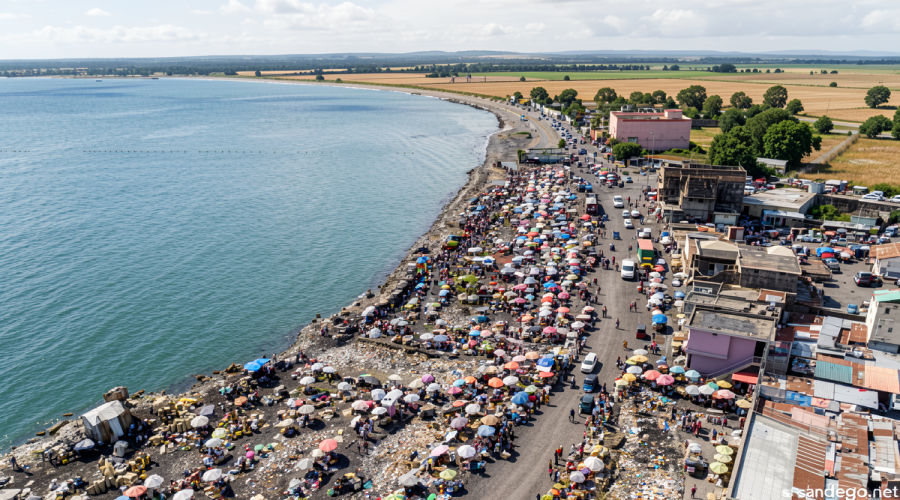
Cap-Haitien’s Strained Streets Meet a New Wave of Returnees
Sandego.net – A charter plane touched down at Cap-Haitien’s small airport on a Thursday afternoon, and 161 passengers stepped onto Haitian soil for the first time in years. According to the country’s National Migration Office, the group represented the first deportation flight from the United States to Haiti since the Trump administration revoked Temporary Protected Status for roughly 350,000 Haitian residents living in America. Some of the arrivals dropped to their knees and pressed their lips against the dirt. Others shielded their faces from the cluster of local journalists waiting at the gate and walked quickly toward the city’s already congested streets.
The flight landed hours after Department of Homeland Security Secretary Markwayne Mullin took to social media to announce the operation.
“It’s a great day to deport illegal aliens. Good morning America!”
That single post framed a moment that immigrant-rights groups had long warned would arrive: the sudden exposure of hundreds of thousands of Haitians in the United States to removal proceedings after a federal court ruling this month stripped away the temporary legal shield that had kept them from deportation and granted them work authorization.
A City Already at Breaking Point
Cap-Haitien sits on Haiti’s northern coastline, where the land meets the open Atlantic. Its geography has always carried weight. To the west lies Labadie, a gated resort complex reserved for American cruise-ship passengers and foreign tourists. Just beyond that, Ile de la Tortue has long served as a notorious transit point for human-trafficking networks. And Cap-Haitien itself carries the memory of the country’s revolutionary past, a history that now competes with a far more immediate concern: absorbing yet another wave of displaced people.
Since the magnitude-7 earthquake that struck the island in January 2010, the city has functioned as a primary refuge for internally displaced Haitians fleeing destruction and armed violence elsewhere. That internal migration has never fully receded. Add to it the political crisis that has gripped the nation since 2021, and the infrastructure strain becomes visible in daily life. Traffic crawls through narrow corridors. Municipal waste-collection points overflow onto sidewalks. At one hospital visited during reporting, patients lined up outdoors in the tropical heat, mothers cradling infants while waiting for hours for basic care.
Louis Ronald Espoir, an administrator at Hospital Fort Saint Michel in the city, described the medical situation bluntly.
“As you can see here with your own eyes, all the hospitals in the region are full despite the best efforts of the government. If they’re full with the current population, I’d be lying to say we can take in anyone else.”
Demonstène Reynold, a mechanic who has lived in Cap-Haitien for years, echoed the same exhaustion.
“Cap-Haitian alone can’t receive more people. We’re not just receiving deportees from outside of Haiti … due to the political crisis, we have people from Hinche and Port-au-Prince, from the interior of the country.”
The Debate Over Safety and Sovereignty
The administration’s decision to send Haitians back has drawn sharp criticism from immigrant-rights advocates, who point to ongoing dangers in the Caribbean nation. At the same time, critics who favor tighter immigration controls have accused the government of moving too slowly to remove undocumented residents from American cities. The administration has repeatedly insisted that Haiti is sufficiently stable to receive its own citizens, even though the State Department maintains a “do not travel” advisory for Americans visiting the country and the Federal Aviation Administration continues to bar U.S. commercial airlines from operating flights there.
In a June interview on the program “State of the Union,” Mullin defended the repatriation policy and argued that returning Haitians would bring economic benefit to their homeland. He characterized the State Department travel warning as aimed at protecting American visitors rather than Haitian nationals.
“Because they are kidnapping or trying to kidnap individuals from the United States because they feel like they – their family has the money to pay the ransom.”
That framing, however, sits uneasily with the lived experience of most Haitians. The kidnapping epidemic has been felt overwhelmingly by ordinary residents, with armed gangs routinely abducting victims from among the poorest neighborhoods. The worst concentrations of that violence remain centered on Port-au-Prince, the capital, where earlier U.S. deportation flights have also landed. Cap-Haitien, on the far side of the island, is generally regarded as spared from the worst gang activity — but residents worry that a sudden surge of newcomers could tip an already overburdened urban system into instability.
What Comes Next
Angie Bell, who served as Cap-Haitien’s mayor before the current political upheaval, said she welcomes the idea of Haitians returning home. Yet she stressed that the country must first build the institutional capacity to receive them safely.
“We need much more development, and we need more security as a preventative measure, with so many people coming in.”
Her estimate of how many additional residents the city can absorb before services collapse was cut short in the original reporting, but the question it raises is immediate: if one flight carries 161 people, how many more will follow in the weeks and months ahead? The answer will determine whether Cap-Haitien’s already stretched hospitals, roads, and municipal systems buckle under the weight of a policy decision made thousands of miles away.
Related Reading
Frequently Asked Questions
What is In the city where Haitian deportees?
In the city where Haitian deportees is the main topic of this guide. The article explains the context, practical details, and next steps readers should understand.
Why does In the city where Haitian deportees matter?
In the city where Haitian deportees matters because readers are looking for a useful answer, not just a short summary. Good content should match search intent and help them decide what to do next.