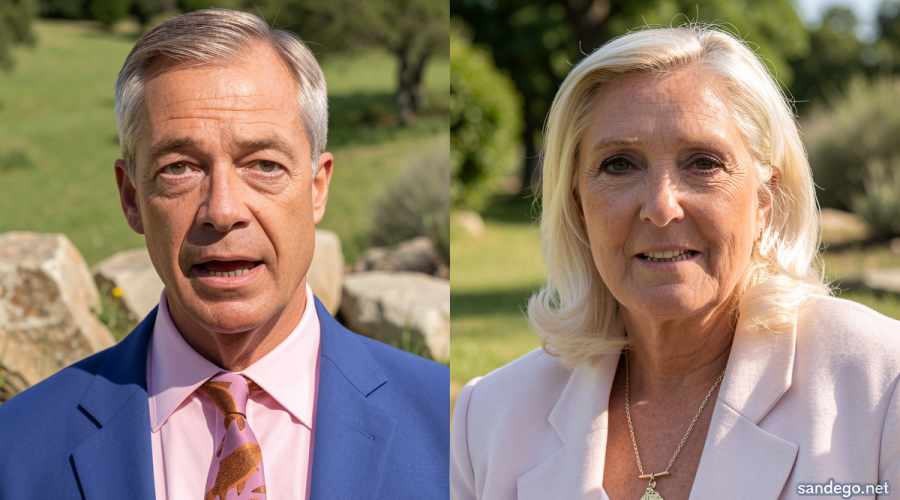
Populist Leaders Challenge Systems: Le Pen and Farage Make Their Case to the People
Sandego.net – Two of Europe’s most prominent populist figures delivered parallel declarations of defiance on Tuesday, each vowing to place their fates directly in the hands of voters rather than accepting the judgments of established institutions. Nigel Farage and Marine Le Pen, separated by geography but united by political philosophy, announced their intentions to challenge the conventional wisdom of their respective nations within a matter of hours.
Le Pen’s Defiant Return to the Presidential Race
In France, Marine Le Pen utilized the evening news broadcast to announce her fourth attempt at securing the presidency. This declaration came shortly after a judicial body confirmed that legal barriers preventing her candidacy had been sufficiently removed. The announcement followed a tense day at a Paris courthouse, where media representatives had gathered in overflow spaces to witness proceedings concerning her appeal against a 2025 criminal conviction.
The original verdict had found Le Pen, along with her National Rally party and eleven senior members, guilty of misappropriating millions of euros in European Union funds. These monies had been used to compensate party workers in France. While the court reduced the duration of her political ban, it maintained both the conviction and associated sentence. Consequently, Le Pen remains subject to a twelve-month period of house arrest under electronic monitoring—a restriction she had previously declared would render effective campaigning impossible.
Despite these obstacles, the political veteran who dedicated decades to both seizing control of her father’s party and modernizing its image announced she would continue her fight. She expressed confidence that a subsequent appeal to France’s supreme court would result in her complete vindication, asserting that ordinary citizens would serve as her ultimate judges.
Farage’s Parliamentary Resignation and Strategic Gambit
Simultaneously across the English Channel, Nigel Farage delivered an impassioned address expressing his outrage at what he characterized as a coordinated effort by political elites to remove him. The founder of Reform UK, which currently leads British polling alongside Le Pen’s National Rally in France, declared his intention to leave parliament entirely.
Having credited himself with facilitating Britain’s exit from the European Union, Farage clarified that he planned to transform the resulting by-election in his Clacton constituency into a fresh referendum. This time, however, the question would center on government officials currently examining his financial affairs. This strategic move effectively paused a parliamentary investigation into an undisclosed £5 million ($6.7 million) contribution that The Guardian reported Farage received from a cryptocurrency billionaire based in Thailand.
Additionally, the Sunday Times had documented that Farage accepted benefits from an individual previously convicted of fraud in American courts. Farage firmly rejected any allegations of impropriety, maintaining on Tuesday that he had “not broken the law in any way at all.”
International Reactions and Political Context
Both leaders’ announcements, though delivered in different languages and within distinct political frameworks, demonstrated their determination to transcend institutional constraints. Le Pen’s television appearance featured a new campaign poster depicting her with arms extended in a gesture of triumph, suggesting she views her legal challenges as potentially advantageous.
Since her 2022 presidential defeat to Emmanuel Macron, where she secured 41% of the vote, Le Pen has methodically prepared for another attempt at the Élysée Palace. She transferred leadership of the National Rally to her protégé Jordan Bardella, enabling her to concentrate on what she considers the most significant prize in French politics. Bardella has since delivered substantial victories, guiding the party to its first nationwide triumph in the 2024 European elections and subsequently to first place in the opening round of snap parliamentary elections.
The party, once dismissed as unelectable by critics, now stands as the single largest force in the National Assembly and appears poised to win the presidency according to current polling. When the candidacy ban arrived in March 2025, it struck like a thunderclap, freezing what Le Pen perceived as an inevitable ascent to power. She immediately characterized the ruling as a political verdict disguised as legal judgment, describing it as a “witch hunt” and an “affront to democracy itself.”
International figures quickly rallied to her support. US President Donald Trump condemned the sentence as “lawfare” against a political adversary, posting on Truth Social “FREE MARINE LE PEN.” The Kremlin, Elon Musk, and Hungary’s then-Prime Minister Viktor Orbán echoed similar sentiments, emphasizing that citizens rather than courts should determine political outcomes.
“The people, not the courts, should choose.”
Le Pen made clear on Tuesday evening that she expects to avoid prolonged house arrest, viewing her legal battles as opportunities to strengthen her connection with voters who see themselves as victims of establishment overreach.