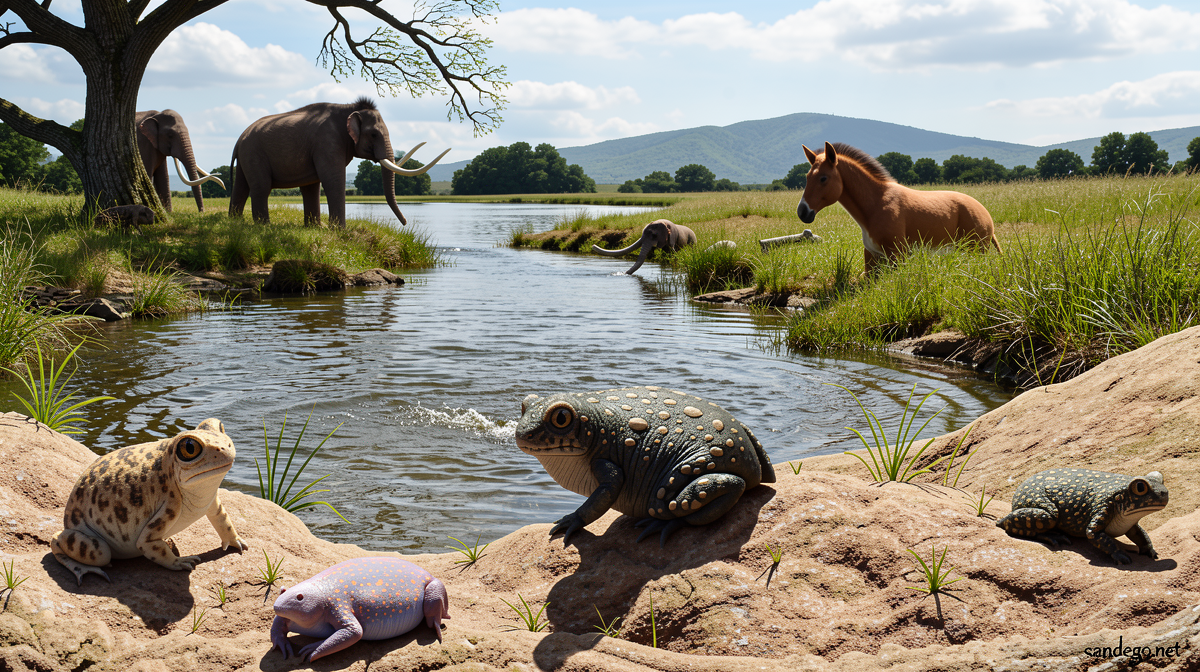
Hidden in Plain Sight: Ice Age Toad Resurfaces at La Brea Tar Pits After Nearly a Century
Sandego.net – Deep beneath the bustling streets of Los Angeles, nature has kept a remarkable secret for tens of thousands of years. The La Brea Tar Pits, those dark, bubbling pools of natural asphalt, have long been celebrated for their extraordinary collection of ice age remains. While most visitors imagine towering mammoths and fearsome saber-toothed predators when they picture these famous fossil beds, the asphalt has preserved something far more delicate and equally significant. Scientists have now identified the first extinct amphibian from Los Angeles’ ice age era, a tiny spadefoot toad that earned the scientific name Spea labreae in honor of its discovery location.
A Century-Old Discovery Reimagined
The story of this remarkable amphibian begins in 1929, when excavators pulled countless specimens from the tar pits. Among the haul were two small bone fragments belonging to the sacro-urostyle, a crucial anatomical structure that connects an amphibian’s lower spine to its hip bones. These fragments sat quietly in museum collections for nearly a century, overlooked because researchers typically focused their attention on the larger, more dramatic bones of megafauna. Smaller creatures simply did not command the same scientific interest during early excavation campaigns.
Everything changed in 2023 when Dr. J. Alberto Cruz began carefully examining the understudied collection. Cruz, who identifies primarily as a paleoecologist and paleogeographer rather than a taxonomist, approached the specimens with fresh eyes. His discovery would prove to be groundbreaking. Speaking about the unexpected find, Cruz shared his enthusiasm: “I’m more like a paleoecologist and paleogeographer, not a taxonomist. So, it is my first new species. For me, it’s very exciting.”
Cruz holds positions as a research associate at the La Brea Tar Pits and serves as a researcher for Mexico’s Quinametzin Paleontological Research Center, which operates under the National Institute of Anthropology and History. His expertise in understanding ancient ecosystems proved invaluable in recognizing the significance of these tiny fossils.
Why the Tar Pits Preserve History So Well
The unique geological conditions of the La Brea Tar Pits create an almost perfect preservation environment. The sticky asphalt functions much like flypaper, capturing organisms that wander too close and sealing them away from the elements. This natural sealant protects bones from weathering, decay, and scavengers while simultaneously shielding them from water, oxygen, sunlight, and microbial activity that would otherwise break down organic material over millennia.
Amphibian bones present particular challenges for paleontologists because they are both small and fragile, making them rare finds in the fossil record. The tar pits’ ability to preserve these delicate structures has provided scientists with unprecedented insights into prehistoric Los Angeles. Since amphibians tend to remain close to water sources and rarely venture far from their habitats, their fossilized remains offer valuable clues about ancient climate conditions in the region.
Confirming a New Species
Cruz meticulously compared the tiny fossils, each measuring approximately one centimeter or 0.4 inches in length, against reference specimens. He examined both the collection’s own holdings and 80 additional specimens housed at the Natural History Museum of Los Angeles County and the Museum of Vertebrate Zoology at the University of California, Berkeley. The comparison revealed distinctive features, particularly an axe-shaped portion of the sacro-urostyle that was considerably smaller than those found in related species. These anatomical differences confirmed that the toad represented a previously unknown species.
While researchers cannot precisely date the fossil without damaging the specimen, they know the toad existed sometime within the last 60,000 years. This timeframe corresponds to how long the tar pits have been actively trapping animals. Dr. Emily Lindsey, curator and excavation site director at the Samuel Oschin Center for Global Ice Age Research at La Brea Tar Pits, emphasized the significance of the discovery: “We’ve now doubled the number of known extinct ice age amphibians from North America, and so that’s a pretty big finding.”
Lindsey noted that small fossils largely went unnoticed during early excavation periods worldwide. “People didn’t even bother really collecting small fossils until maybe the latter part of the 20th century. So, they were ignored largely in early excavations around the world.”
Unexpected Visitors from the Tropics
While examining the same collection, Cruz uncovered another surprising amphibian fossil. The Mexican burrowing toad, the sole surviving member of the Rhinophrynidae family, had also made its way into the tar pits thousands of years ago. Today, this species inhabits the lowlands of Central America, Mexico, and extreme southern Texas. Its nearest known populations sit approximately 1,550 miles or nearly 2,500 kilometers away in southern Mexico, making the Los Angeles discovery quite extraordinary.
The presence of the Mexican burrowing toad in ancient Los Angeles suggests that the region once supported rainforest conditions characterized by abundant trees and heavy precipitation. This environmental picture aligns with what scientists have reconstructed about the area’s prehistoric climate. The fossil record of frogs and toads extends back 200 million years, providing a deep timeline for understanding how these amphibians have adapted to changing environments across geological epochs.
Understanding these ancient amphibian populations carries practical implications for modern conservation efforts. As climate patterns shift and habitats change, the fossil record offers valuable reference points for predicting how species might respond to environmental stress. The discovery of Spea labreae and the Mexican burrowing toad at La Brea demonstrates that Los Angeles once supported a richer diversity of amphibian life than previously recognized, offering hope that careful study of historical data can inform contemporary preservation strategies for endangered species facing similar challenges today.
Related Reading
Frequently Asked Questions
What is Extinct toad from the ice age discovered?
Extinct toad from the ice age discovered is the main topic of this guide. The article explains the context, practical details, and next steps readers should understand.
Why does Extinct toad from the ice age discovered matter?
Extinct toad from the ice age discovered matters because readers are looking for a useful answer, not just a short summary. Good content should match search intent and help them decide what to do next.