Egypt Uncovers Lost Byzantine-Era City in the Western Desert
Sandego.net – In a significant development for Egypt’s cultural heritage, two major archaeological discoveries were unveiled on Saturday, shedding light on the country’s ancient past. Among the highlights is a remarkably intact Byzantine-era residential city unearthed in the western desert, a location that has long been a hub of historical intrigue. This find, along with another at the Marina el-Alamein site near Alexandria, marks a crucial moment in Egypt’s efforts to revitalize its tourism industry, which has faced challenges due to political instability and the pandemic. These discoveries are expected to attract more visitors to the nation’s archaeological sites, fueling interest in its rich historical tapestry.
A Window into the Fourth Century: Dakhla Oasis
Located in Egypt’s New Valley region, the Dakhla Oasis has emerged as a focal point for uncovering ancient urban life. The recently discovered city, dating back to the fourth century, offers a glimpse into how settlements thrived during the Byzantine empire’s influence. According to Hisham el-Leithy, secretary general of the supreme council of antiquities, the site reveals intricate details about daily activities, social structures, and economic practices. The city’s layout features a grid of north-south streets intersected by east-west thoroughfares, creating open squares and communal spaces that reflect organized urban planning.
“The unearthed quarters include a network of streets that formed public spaces and facilitated daily interactions,” el-Leithy explained.
At the heart of the settlement stands a basilica church, constructed in the mid-fourth century, which overlooks the main thoroughfares. Mahmoud Massoud, chair of the archaeological mission, noted the presence of two watchtowers at the city’s perimeter, suggesting a strategic approach to defense and security. These structures, combined with fortified buildings, highlight the resilience of the community against external threats.
Among the most intriguing finds is the house of Tisous, identified as belonging to a church deacon and dating to the latter half of the fourth century. Archaeologists believe this dwelling functioned as a house church before the construction of the central basilica. Alongside this, the excavation revealed bread ovens, kitchens, and stone grinding tools, indicating a vibrant domestic economy. The presence of these artifacts underscores the practical aspects of life in the city, from food preparation to trade.
Marina el-Alamein: A Glimpse into Greco-Roman Legacy
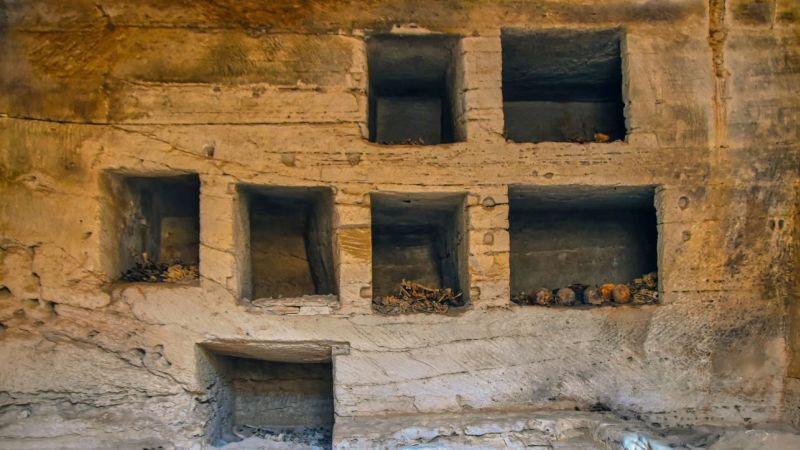
The Marina el-Alamein site, situated approximately 100 kilometers west of Alexandria, has also yielded substantial results. Archaeologists uncovered 18 ancient tombs, bringing the total found at the site to 48. The tombs include 11 rock-cut structures, averaging 8 meters in depth, and seven surface-built limestone tombs. These findings are believed to trace back to the ancient Greco-Roman port city of Leukaspis, which flourished on the Mediterranean coast until the fourth century.
Inside the tombs, researchers discovered pottery vessels, amphorae, lamps, plates, and limestone basins, providing insight into burial customs and daily life. Eman Abdel-Khaliq, the mission’s chief, highlighted the discovery of a 2.5-meter-long granite sarcophagus with skeleton remains currently under study. Nearby, the team found remnants of a plaster sphinx statue, adding to the site’s mythological and cultural significance.
“We also uncovered four gold pieces placed in the mouths of some deceased individuals, a practice known as ‘the golden tongue,’ which symbolized a connection between the living and the afterlife,” Abdel-Khaliq noted.
Another remarkable artifact is a collection of about 200 pottery fragments, classified as octraca. These fragments, used as writing material, contain inscriptions detailing commercial transactions and personal correspondence. Diaa Zahran, head of the Islamic, Coptic, and Jewish Antiquities department, emphasized the historical value of these pieces, stating they provide a unique window into the social and economic dynamics of the period.
The significance of these finds extends beyond their physical remnants. The Suez Canal, a vital trade route, complements Egypt’s tourism sector, which has become a cornerstone of the country’s economy. With tourism recovering from years of political upheaval following the 2011 uprising and the impact of the coronavirus pandemic, the recent discoveries could further stimulate interest in Egypt’s ancient landmarks.
Historical Revelations and Future Prospects
Official statistics show that Egypt welcomed a record 19 million tourists last year, a 21% increase compared to the previous year. In the first four months of 2026 alone, 6.1 million visitors arrived, surpassing the 5.7 million recorded during the same period in 2025. These numbers reflect a steady recovery, driven in part by the nation’s growing reputation as a treasure trove of antiquities.
The Dakhla Oasis, which is already on UNESCO’s Tentative List, has the potential to secure a spot on the World Heritage List. The recent discoveries at this site, combined with its existing historical value, may strengthen its case for recognition. Meanwhile, the Marina el-Alamein site continues to reveal layers of history, from its Greco-Roman origins to its Byzantine-era significance.
Both sites underscore the enduring legacy of ancient civilizations in Egypt. The artifacts, ranging from bronze coins with Byzantine emperor portraits to Latin inscriptions and Christian symbols, highlight the cultural and religious diversity of the region. The gold coins, attributed to Roman emperor Constantius II’s reign (337–361), add another dimension to the site’s historical narrative.
As Egypt’s tourism sector rebounds, these archaeological triumphs serve as a reminder of the country’s profound historical roots. The findings not only enrich our understanding of past societies but also offer a tangible link to their traditions, which could inspire future generations of historians and tourists alike. With each new discovery, the story of Egypt’s ancient past becomes more vivid, reinforcing its status as a cradle of civilization.