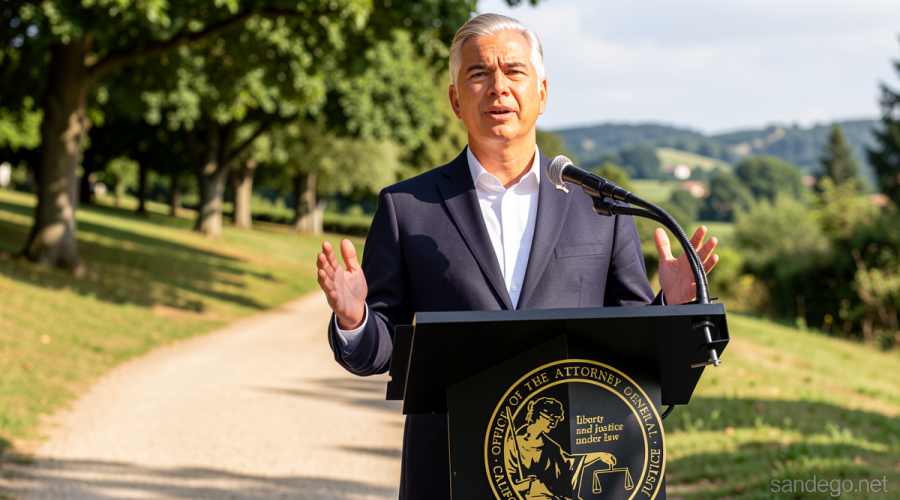
Bonta Addresses Merger Lawsuit and CNN Spin-Off Speculation
Sandego.net – Legal representatives for a coalition of twelve states seeking to halt the Paramount-Warner Bros. Discovery transaction will present their case before a federal judge this Friday. Their primary objective is securing a temporary restraining order that would prevent the entertainment giants from finalizing their proposed merger. Judge Araceli Martínez-Olguín is scheduled to review arguments from both sides during the proceedings. According to earlier CNN coverage, industry insiders anticipate the court will grant the restraining order, which would effectively suspend the merger for approximately two weeks while litigation continues.
Before the 1 p.m. Eastern Time hearing commenced, I had the opportunity to speak with California Attorney General Rob Bonta, who serves as the lead figurehead for the Democratic attorneys general opposing the transaction. When asked about the likelihood of success, Bonta expressed cautious optimism. He stated that while he remains hopeful the court will issue the TRO on Friday, he acknowledged the possibility that additional time might be required.
Clarifying Misconceptions About the Lawsuit
Bonta appeared eager to correct what he characterized as widespread misunderstandings regarding CNN, the associated financial penalties, and rumors suggesting Paramount might relocate its headquarters out of California. He criticized certain parties for extracting statements from their original context and generating unnecessary confusion. According to Bonta, the legal complaint filed by his coalition leaves no room for ambiguity.
When questioned about potential settlement discussions, Bonta provided a definitive response. He emphasized that no negotiations are currently underway because the coalition is actively engaged in litigation. The legal team has filed suit and requested both a temporary restraining order and a preliminary injunction with the goal of blocking the merger entirely. Bonta clarified that this represents their complete position at this moment.
There are no negotiations. We are suing. We are in litigation. We have sued and sought a TRO and a preliminary injunction seeking to block the merger. That’s it. That’s full stop. That’s where we’re at.
However, Bonta left the door open for future settlement possibilities. He noted that if Paramount and Warner Bros. approached the situation in good faith with a genuine offer, his office would certainly evaluate it. Crucially, any settlement would need to incorporate structural remedies rather than behavioral ones. Bonta expressed skepticism toward behavioral solutions, describing them as potentially empty promises that lack enforceability and have historically proven unreliable.
Of course, if Paramount–Warner Bros. want to come forward in good faith and sincerely want to make a settlement offer, we’ll always consider a settlement offer. And it would have to include structural remedies. We’re not interested in behavioral remedies — empty promises, self-serving promises, promises that are unenforceable, that won’t be kept, that history shows won’t be kept.
Why CNN Alone Isn’t Enough
Bonta elaborated on his preference for structural remedies, noting that he doubts a single structural solution would prove adequate unless it involved preventing the merger altogether. This clarification came in response to media speculation suggesting that Paramount might offer to spin off CNN as a potential resolution. When asked directly whether divesting CNN alone would satisfy the coalition’s demands and end the lawsuit, Bonta’s answer was emphatic.
Absolutely, 1,000%, no. Not yesterday, not today, not tomorrow. Hell no.
He explained that a CNN-focused remedy fails to address the comprehensive concerns outlined in their legal complaint. Bonta acknowledged that figures like Brendan Carr and various news organizations have been discussing the CNN angle, with some attempts to attribute these ideas to him or his associates. He firmly denied ever suggesting that a CNN spin-off would resolve the matter.
I’ll say what is actually true: A divestiture of CNN, a spinoff of CNN, a structural remedy that just applies to CNN will never, ever, ever, ever, ever resolve this case. It is not what we’re looking for. It’s not what we’re interested in. It doesn’t address our concerns.
Bonta identified the CNN discussion as part of what he perceives as an aggressive Paramount public relations campaign. He suggested the company is attempting to sway public opinion by framing the lawsuit as politically motivated rather than based on legitimate antitrust concerns. Bonta dismissed this characterization, emphasizing that the coalition’s complaint focuses on three specific markets: wide-release theatrical films, blockbuster theatrical releases, and the cable channel sector. He noted that the merger is presumptively unlawful within these markets according to established antitrust analysis.
But it’s part of this Paramount PR campaign that’s in overdrive. I think they’re trying to play to the court of public opinion. They’re suggesting that, instead of the very clear, clean antitrust analysis that we’ve done here — where I’m sure they’re on their heels because the merger in the three markets we identify is presumptively unlawful — they’re trying to say, ‘Hey, this is just political. This is a Democrat AG, and Democrat AGs just want CNN to be free of the influence of the Ellisons.’ And it’s ridiculous. I mean, that’s not part of our complaint. It’s not adjacent to our complaint. It’s not part of our complaint.
When asked whether avoiding a scenario where Paramount owns CNN would be desirable but insufficient, Bonta confirmed this characterization. He reiterated that while such an outcome would have value, it falls far short of meeting the coalition’s requirements. The proposed remedy would not adequately address the three markets central to their legal challenge.
We’re just not seeking it. It’s not the focus of our complaint. If they want to do that, I value it at more than zero. But it is very far from being close, even in the ballpark, of being sufficient. It doesn’t even touch the three markets that we’re talking about.