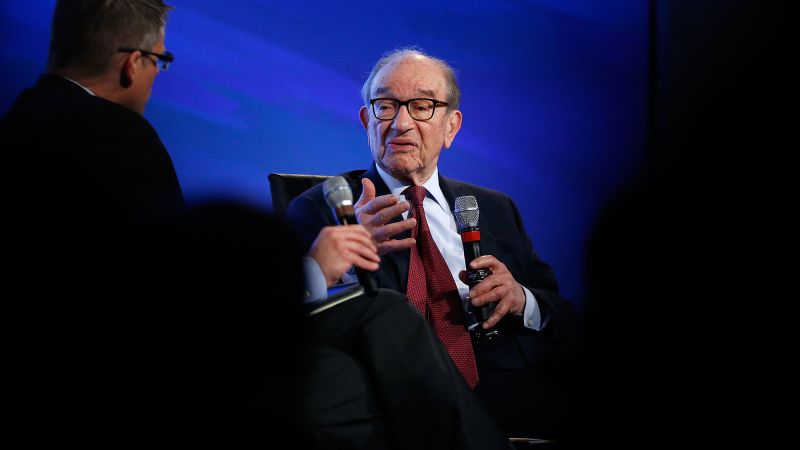
Alan Greenspan: A Legacy of Leadership and Controversy
Sandego.net – Alan Greenspan, the former chair of the Federal Reserve, has passed away at the age of 100, according to his wife, Andrea Mitchell. Known for his long tenure at the helm of the U.S. central bank, Greenspan’s legacy is marked by both acclaim and scrutiny. While he was celebrated for steering the economy through periods of growth, his decisions in the years following his departure also drew criticism for contributing to the housing crisis and financial collapse of 2008.
The Path to the Federal Reserve
Greenspan’s journey to the Federal Reserve began long before his appointment. In the 1950s, he taught economics at New York University, his alma mater, while simultaneously leading Townsend-Greenspan & Co., an economic consulting firm he co-founded. His early career also included a pivotal role in Richard Nixon’s 1968 presidential campaign, where he served as director of domestic policy research. This position later evolved into a full-time advisory role for Nixon, setting the stage for his eventual rise to the nation’s top economic institution.
A Leadership Defined by Contrasts
Greenspan’s five-year stint as chair of the President’s Council of Economic Advisers during the Nixon and Ford administrations provided him with a deep understanding of macroeconomic policy. His transition to the Federal Reserve in 1987, under President Ronald Reagan, marked the start of a transformative era. Over 18.5 years, he guided the central bank through significant economic shifts, including the stock market’s most severe single-day drop in history on October 19, 1987, dubbed “Black Monday.” In response, Greenspan reassured markets that the Fed would act as a “source of liquidity” to stabilize financial systems, a move that helped restore investor confidence quickly.
During his tenure, the U.S. economy experienced one of its most robust peacetime expansions. Unemployment rates plummeted to below 4%, stock prices reached unprecedented highs, and the federal government began recording budget surpluses for the first time in decades. These achievements solidified his reputation as a central figure in economic management. Yet, his legacy is also shaped by the challenges that arose after he stepped down in 2006.
Controversies and Critical Moments
Following his retirement, Greenspan faced mounting scrutiny over the housing bubble that burst in 2008. The crisis, which led to widespread foreclosures and bank failures, was attributed in part to the low interest rates he and the Fed had maintained during the early 2000s. Critics argued that these policies fueled speculative lending, particularly in the mortgage market, by making home purchases more accessible to borrowers with weaker credit profiles.
Greenspan himself had initially dismissed concerns about a housing bubble. In public remarks, he asserted that while individual markets might be overvalued, there was no clear evidence of a nationwide bubble. However, when the collapse occurred, he testified before the House Oversight Committee, expressing a “state of shocked disbelief.” He acknowledged that the economic damage from the bursting of the bubble was “much broader than anything I could have imagined.”
Despite this, Greenspan maintained that the low interest rates were not the primary cause of the crisis. He claimed to have been correct 70% of the time during his time in office, emphasizing his belief in the effectiveness of his policies. His stance sparked debate among economists, with some arguing that his oversight of the mortgage market was insufficient, while others defended his approach as necessary for economic growth.
The Complexity of Communication
Greenspan’s public statements were often noted for their intricate phrasing and abstract language, which left many investors struggling to grasp his intended message. This complexity was no accident; he intentionally crafted his speeches to convey nuanced economic insights, sometimes at the expense of clarity. For instance, during the 2001 recession, he reassured the public that the Fed would take decisive action, but his words were later scrutinized for their ambiguity.
One particularly memorable moment occurred in 2008, when Greenspan’s testimony before Congress highlighted the difficulties of interpreting his remarks. His wife, Andrea Mitchell, later reflected on his career, describing him as a “giant of a man” who shaped the economy across political divides. “He was always honest in acknowledging his mistakes,” she noted in a statement, underscoring his humility despite his towering influence.
Enduring Impact and Final Reflections
The Federal Reserve expressed its sorrow over Greenspan’s passing, highlighting his lasting contributions to economic policy. “Chairman Greenspan’s legacy endures at the Federal Reserve — in those he mentored directly, in the economists and public servants he inspired, and in the frameworks and practices he helped shape,” the institution stated. His influence extended beyond his time in office, as his ideas and methodologies continued to inform central banking strategies globally.
Greenspan’s career was a testament to the dual nature of economic leadership: the ability to navigate prosperity and the responsibility to address downturns. His tenure at the Fed, spanning from Reagan to George W. Bush, left an indelible mark on the U.S. economy. Even as his decisions were later questioned, they remain a critical part of the narrative of modern monetary policy. His passing marks the end of an era, yet the debates surrounding his legacy will likely persist in academic and policy circles for years to come.
“Alan passed away at our home this morning at the age of 100 from complications of Parkinson’s Disease,” Mitchell said. “He was a giant of a man who helped shape the U.S. economy for decades under presidents of both parties, but was always honest in acknowledging his mistakes.”
As the Fed continues to evolve, Greenspan’s work serves as a reference point for both triumphs and missteps. His ability to adapt to changing economic landscapes, from the tech boom to the financial crisis, showcases the complexities of central banking. While some may argue that his policies were instrumental in creating the conditions for the 2008 crisis, others credit his leadership for preventing more severe economic fallout in the 1980s and 1990s.
Greenspan’s career is also a reminder of the balance between confidence and caution. In the early days of his tenure, he was seen as a calm and authoritative figure, capable of steering the economy through turbulence. However, as the years progressed, his more measured approach was contrasted with the bold actions required to address the housing market’s collapse. This duality—of being a maestro during growth and a focal point of criticism during crisis—defines the full scope of his impact on American economic history.
His role as a Fed chair, combined with his academic and consulting work, created a unique blend of practical experience and theoretical insight. Even as he retired, his presence in economic discourse remained, with his views often cited in discussions about monetary policy. The legacy of his 18.5-year tenure is now being reevaluated in light of subsequent economic challenges, ensuring that his contributions are studied alongside the critiques that followed.
As the world continues to grapple with economic uncertainty, Greenspan’s life and work offer a rich tapestry of lessons. His ability to navigate the complexities of the economy, both in times of expansion and contraction, underscores the challenges of leading during periods of rapid change. The dual narrative of his career—celebrated for success and scrutinized for failure—ensures that his story will remain a pivotal chapter in the history of U.S. economic policy.