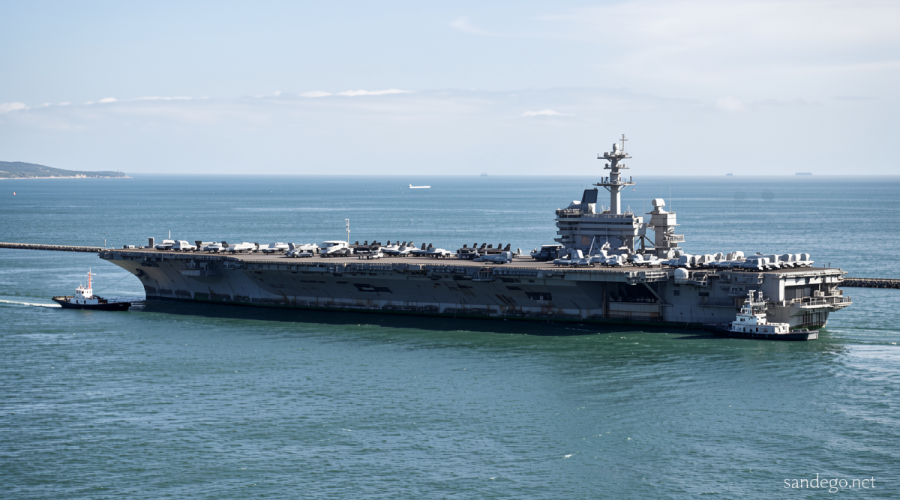
After Eight Months at Sea, USS Abraham Lincoln Finally Dockes in Thailand
Sandego.net – The rust-streaked hull of the USS Abraham Lincoln slid into the port of Laem Chabang on Wednesday, marking the first time the 100,000-ton carrier has made a port call since departing San Diego last November. The arrival, situated just south of Pattaya, closes what has become one of the most prolonged continuous deployments in the history of the United States Navy. When the ship eventually returns to Southern California later this year, sailors aboard will have spent well over a year away from home waters.
The vessel’s extended sojourn in the Persian Gulf region was driven by ongoing combat operations and blockade duties in the war with Iran. During that period, the Lincoln logged what US Sen. Richard Blumenthal described as a modern-day record for consecutive days at sea while engaged in active hostilities. The strain of that endurance pushed the ship’s crew of roughly 5,000 sailors to the breaking point, with documented morale deterioration, shortages of basic supplies, and at least one possible suicide attempt among the ranks.
Political Pressure and Official Denials
Blumenthal, a Connecticut Democrat serving on the Senate Armed Services Committee, sent a letter last month to Defense Secretary Pete Hegseth and the acting secretary of the Navy demanding answers about living conditions aboard the carrier. His words were pointed:
“There have been widespread reports of shortages of basic supplies, water contamination, plumbing issues, deteriorating mental health, deck safety concerns,” aboard the ship, he said in the letter, as well as “disruptions in the mail system, which have caused many care packages in route to the ship to be lost in transit for months.”
Hegseth responded by declaring that conditions on the Lincoln had been “completely misrepresented,” though he offered no specifics about which elements of the reporting he found inaccurate. President Donald Trump, pressed on the matter, waved away the concern entirely, remarking that the deployment was “not nearly long enough.”
Yet the Pentagon’s own actions told a different story. Shortly after the aboard problems became public knowledge, the Department of Defense announced that the Japan-based carrier USS George Washington would be redirected to the Middle East to relieve the Lincoln. The George Washington has since assumed station alongside the USS George H.W. Bush, preserving a two-carrier posture for American naval forces while hostilities with Iran continue.
Capacity Questions in the Pacific
The redeployment of the George Washington drew sharp criticism from defense analysts and regional allies. Pulling one of the Navy’s largest surface combatants out of the western Pacific leaves the service with diminished capacity to project power, reassure treaty partners, and deter adversaries such as China and North Korea. The episode underscored a persistent structural problem: the carrier fleet, already stretched thin by simultaneous commitments in multiple theaters, simply does not have enough hulls to sustain prolonged operations in one region without hollowing out another.
Adm. Daryle Caudle, Chief of Naval Operations, addressed the pressure directly while speaking to reporters in Virginia last week. He acknowledged that extended deployments exact a toll on sailors and their families, and pledged that the service would strive to introduce greater predictability into rotation schedules. Still, he conceded that wartime exigencies complicate any fixed timetable:
“I would prefer, you know, seven-month deployments. I typically am not a big fan of extensions, and I push back hard on that. But the enemy gets a vote,”
Those remarks, carried by USNI News, captured the tension at the heart of carrier operations: the ideal deployment cycle versus the reality of an adversary that does not pause for administrative convenience.
Two Additional Warships Join the Port Call
The Lincoln did not arrive alone. The guided-missile destroyer USS Frank E. Petersen Jr. docked Wednesday at Sriracha, a berth situated close to Laem Chabang, while the guided-missile cruiser USS Robert Smalls made port at Map Ta Phut, east of Pattaya. Together, the three vessels represent a visible American naval presence in Thai waters, reinforcing bilateral defense ties and offering a window of rest for crews who have spent months without shore leave.
Pattaya’s Long Military History
The choice of a Pattaya-area port is not incidental. Since the Vietnam War era, the coastal city has served as a rest-and-relaxation destination for American servicemembers rotating out of combat zones. Pattaya sits less than an hour’s drive north of U-Tapao, where a US airbase once hosted dozens of B-52 Stratofortress bombers. From that staging point, the eight-engine aircraft could reach targets in North Vietnam in three to four hours, a substantial saving in time and fuel compared with launching from Andersen Air Force Base on Guam.
At the peak of American involvement in Southeast Asia, approximately 50,000 US personnel were stationed at U-Tapao and other Thai bases. Thailand, a treaty ally of the United States, offered a geographically logical and politically stable location where troops fighting in Vietnam could decompress. A 2017 report by the Institute of Labor Economics estimated that between 11 percent and 16 percent of all visitors to Thailand during 1966–67 were American servicemembers on leave from the war. Around the perimeters of those installations and along the Pattaya coastline, a service economy grew, shaped in part by the steady flow of uniformed visitors seeking respite from the pressures of combat.
More than half a century later, the same coastline now greets a carrier crew whose ordeal was shaped not by a Cold War proxy conflict but by a direct, ongoing war in the Middle East. The rust on the Lincoln’s hull, the depleted supply lockers, and the exhausted faces of sailors stepping onto Thai soil all speak to a Navy operating at the outer limits of what sustained combat demands can impose on its people and its platforms.
Related Reading
Frequently Asked Questions
What is Aircraft carrier USS Abraham Lincoln arrives?
Aircraft carrier USS Abraham Lincoln arrives is the main topic of this guide. The article explains the context, practical details, and next steps readers should understand.
Why does Aircraft carrier USS Abraham Lincoln arrives matter?
Aircraft carrier USS Abraham Lincoln arrives matters because readers are looking for a useful answer, not just a short summary. Good content should match search intent and help them decide what to do next.