AI Stocks Face Another Turbulent Week as Market Volatility Persists
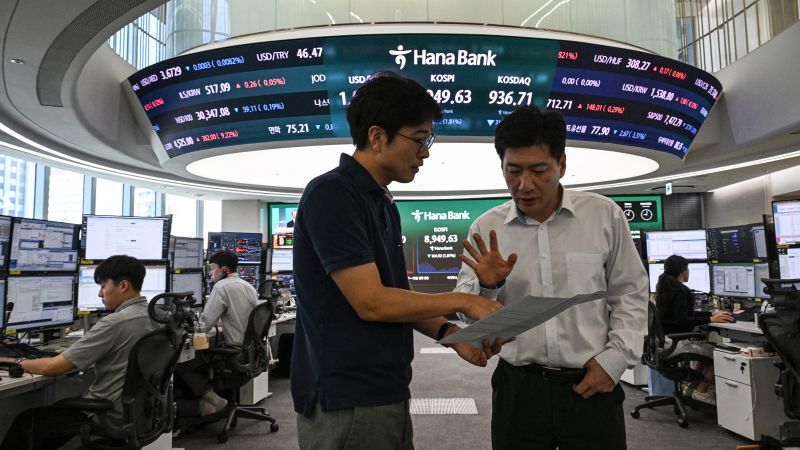
Sandego.net – The tech sector has long been a driver of stock market gains, but recent weeks have seen a sharp reversal. On Friday, the Nasdaq, a key indicator of tech performance, was poised for another 1.2% decline, continuing a downward trend that has seen it end every session this week in the red. This slump follows a dramatic drop in South Korea’s Kospi index, which fell 5.8% on the same day, adding to the growing unease among investors. The Nasdaq’s decline has been steep, dropping over 6% from its peak on June 2, signaling a broader shift in sentiment toward the industry’s future.
The Pressure of High Valuations
Investors are increasingly wary of the soaring valuations that have long supported AI stocks. For years, these companies have seen their shares inflate based on the promise of artificial intelligence, rather than tangible profit growth. This reliance on optimism has left many tech firms vulnerable when expectations fail to meet reality. The current downturn reflects a growing realization that the financial gains from AI adoption may not materialize as quickly as anticipated, despite the technology’s potential.
The challenges stem from the immense costs associated with AI development. Companies have poured billions into research, infrastructure, and talent acquisition, often without immediate returns. This has created a cycle where surging demand for AI-driven solutions has pushed up the prices of essential components, particularly high-powered chips. Semiconductor firms, struggling to keep pace with the demand, have seen their stock prices rise sharply, while the tech giants relying on these chips face a contrasting fate. The result is a K-shaped market, where some sectors thrive while others struggle.
Market Dynamics and Sector Shifts
Recent events have underscored the volatility within the AI industry. Microsoft and Meta, two of the largest tech firms, have entered bear markets, losing a fifth of their value since their recent peaks. Meanwhile, the so-called Mag 7—Amazon, Apple, Google, Nvidia, and Tesla—have experienced corrections, with shares falling at least 10% from their all-time highs. These fluctuations highlight the growing risks tied to AI investments, as companies grapple with rising expenses and uncertain profitability.
The situation is further complicated by the interplay between chipmakers and tech firms. Apple, for instance, announced on Thursday that it would raise prices for its MacBooks and iPads due to a memory shortage, a direct consequence of the surging demand for semiconductors. This decision sent Apple’s stock plummeting more than 6%, illustrating the ripple effects of supply chain pressures. Conversely, Micron, a major memory and storage chipmaker, saw its shares surge nearly 16% after reporting strong earnings, reflecting the sector’s resilience amid broader market uncertainty.
“Market dynamics are forcing the industry to reassess its trajectory,” said a financial analyst quoted in the New York Times. “OpenAI is now considering delaying its IPO due to the recent volatility, which could complicate its quest to achieve a $1 trillion valuation.”
The Kospi index, which is heavily influenced by South Korea’s tech titans—SK Hynix and Samsung—has become a microcosm of the global AI market’s instability. On Friday, the index triggered another circuit breaker, leading to a 20-minute trading halt. This came after a volatile week that saw the Kospi fluctuate dramatically, dropping 10% on Tuesday before rebounding with gains of 5% and 3% on Wednesday and Thursday, only to fall again on Friday. Such erratic movements have raised concerns about the sustainability of AI-driven growth in the region.
Rising Borrowing Costs and Broader Implications
While the tech sector has been a cornerstone of the stock market for years, its current struggles may have far-reaching consequences. The semiconductor industry, which has benefited from the AI boom, now accounts for over 19% of the S&P 500’s value. However, this growth is not without its risks. Rising bond yields and the Federal Reserve’s potential to increase interest rates in the coming months could dampen investor appetite for high-growth tech stocks. These companies, which often rely on substantial borrowing, are particularly sensitive to rate hikes, making them prime targets for market corrections.
The broader market, meanwhile, has shown signs of stability. Non-tech sectors have remained resilient, with the S&P 500 only slightly below its all-time high—just over 3% away. This contrast suggests that while tech stocks are experiencing turbulence, other industries may continue to support the market. However, the fate of the tech sector remains uncertain, and its continued decline could force the rest of the market to compensate, potentially creating new challenges.
Investors are now adopting a more cautious approach, carefully navigating the risks associated with AI investments. The fear of further losses has led many to hold back, especially as June approaches—a month historically associated with market swings. The tech sector’s recent performance has underscored the need for a more balanced perspective, as the promise of AI innovation is now being tested by the realities of high costs and slow returns.
Looking Ahead: A Test for the Market
The current volatility may serve as a turning point for the AI industry. OpenAI’s consideration of delaying its IPO highlights the growing pressure to justify high valuations. If the tech sector’s challenges intensify, the market may face a significant correction, with investors shifting their focus to other sectors. Yet, the resilience of non-tech industries offers a glimmer of hope, suggesting that the broader market can absorb the shocks of a struggling tech segment.
As the week draws to a close, the interplay between AI-driven demand and financial constraints continues to shape market dynamics. The Nasdaq and Kospi indices remain key barometers of this shift, with their movements reflecting both the potential and the pitfalls of the technology revolution. For now, the tech sector is in a state of flux, and its ability to recover will depend on its capacity to deliver consistent returns amid rising costs and economic uncertainty.
Despite the current downturn, the AI industry’s long-term prospects remain intact. The technology’s transformative potential is undeniable, but its valuation must align with actual performance. As investors weigh the risks and rewards, the market will continue to test the resilience of both the tech sector and the broader financial system. Whether this leads to a sustained correction or a rebound hinges on the ability of companies to balance innovation with profitability, a challenge that has become increasingly pressing in the wake of recent market swings.