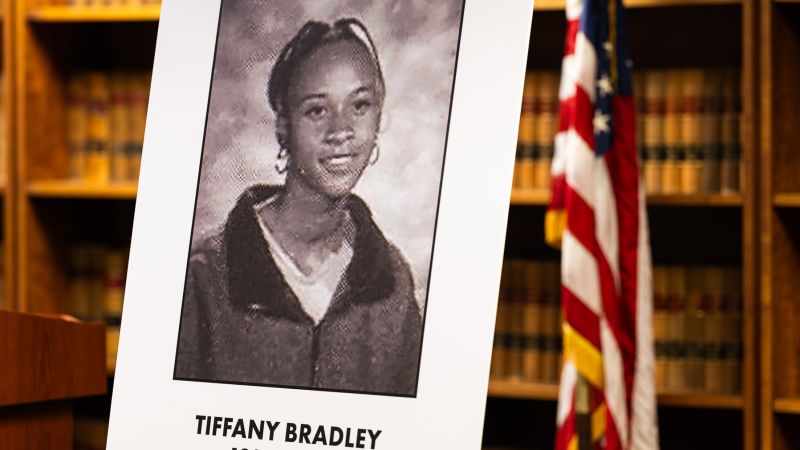
Decades-Long Mystery Solved: Teen Murder Victim Finally Given Her Name Through Genetic Genealogy
A New Chapter for Chelsea Jane Doe
Sandego.net – After spending nearly twenty-six years known only by a placeholder name, a teenage murder victim has finally been reunited with her identity. This summer, “Chelsea Jane Doe” was officially recognized as Tiffany Bradley, marking the conclusion of a prolonged investigation that had remained open for generations. The resolution represents more than just a name—it symbolizes hope for countless other unidentified victims across the nation whose stories have waited patiently for closure.
The breakthrough came through investigative genetic genealogy, an innovative approach that merges traditional DNA analysis with extensive paper trail research. While this technique has primarily served to identify criminal suspects over the last ten years, it is now equally valuable in giving voice to hundreds of unnamed Jane and John Does who have been waiting for recognition. Bradley’s niece, Shakirah Wiggins, expressed profound emotion about the development, stating through a
“The fact that we are here today is a miracle.”
She continued, noting how remarkable it seemed that after such a long passage of time, people still cared enough to restore her niece’s identity and bring her home to her family.
From Mutilated Remains to Recognized Identity
Tiffany Bradley was sixteen years old when she disappeared in November 2000, according to FBI records. Her family described her as a cheerful child who possessed a bright, radiant smile and loved athletics. Meanwhile, in Chelsea, Massachusetts—approximately three hundred miles from where Bradley vanished—local investigators had been piecing together fragments of a tragic case for decades. They possessed the remains of a teenage girl discovered in a parking lot near the Boston riverfront, along with a confession from a killer who admitted to strangling and cutting apart his victim.
Though the perpetrator was already serving time behind bars, the victim’s true identity remained elusive until recently. Chelsea police officials noted that the case had essentially stalled without new evidence to move forward.
The turning point arrived three years ago when Othram, a private forensic science organization, constructed a DNA profile from Bradley’s remains. David Mittelman, the company’s founder and chief executive officer, explained that the DNA was in “horrible condition” due to how the body parts were discovered. Nevertheless, this profile became the foundation for everything that followed. Without viable DNA, a cold case cannot progress, so investigators carefully examined every available genetic marker and combined it with genealogical research to reconstruct Bradley’s family connections.
Technology Opens New Doors for Justice
The FBI utilized the DNA profile to construct an extensive family tree, eventually matching Bradley with her brother and confirming her identity beyond doubt. This athletic, spirited girl who had been known only as Chelsea Jane Doe was finally given back her real name. The case could not have been resolved until now, thanks to significant technological advancements and the increasing number of individuals uploading their genetic information to public databases.
CeCe Moore, co-founder of DNA Justice—a nonprofit enabling anyone to contribute their genetic profile to a shared database—explained that genealogists have relied on paper records for centuries. However, approximately twenty years ago, they began incorporating DNA analysis to overcome “genealogical brick walls,” those points where traditional research hits a dead end. Moore noted that the 2018 identification of the Golden State Killer marked the first major public success using genetic genealogy, adding,
“That really changed everything.”
Following that landmark case, the FBI established a dedicated investigative genetic genealogy team, recognizing the potential to solve numerous additional cases. This initiative directly contributed to Bradley’s identification, as well as dozens of other cold case resolutions.
Another Teenager Reunited with History
Similar progress occurred last month with another unidentified teenager. The remains of a young woman who was ten weeks pregnant were identified as fifteen-year-old Cheryl Lynn Edwards, who had disappeared approximately fifty years earlier. Her body was discovered in 1975 in the Mississippi River near Clinton County, Iowa, where an autopsy revealed she had died from a gunshot wound to the head.
The Iowa Department of Public Safety labeled her “Jane Clinton Doe” and submitted the case to the DNA Doe Project, a collective of volunteer genetic genealogists. Sixteen volunteers collaborated over a single weekend, quickly identifying a couple from Louisiana as Edwards’ grandparents. They then traced the grandparents’ children and discovered that their eldest son had a daughter who “vanished from the records in the 1970s,” according to Trish Bird, a volunteer genetic genealogist involved in the investigation.
Iowa DPS contacted a relative of Edwards and verified that she had indeed gone missing. Direct DNA testing ultimately confirmed Edwards’ identity, completing another remarkable cold case resolution. Both Bradley and Edwards cases demonstrate how public DNA databases have transformed the landscape of forensic investigation, offering new possibilities for identifying victims whose stories had been lost to time.
Related Reading
Frequently Asked Questions
What is A miracle?
A miracle is the main topic of this guide. The article explains the context, practical details, and next steps readers should understand.
Why does A miracle matter?
A miracle matters because readers are looking for a useful answer, not just a short summary. Good content should match search intent and help them decide what to do next.