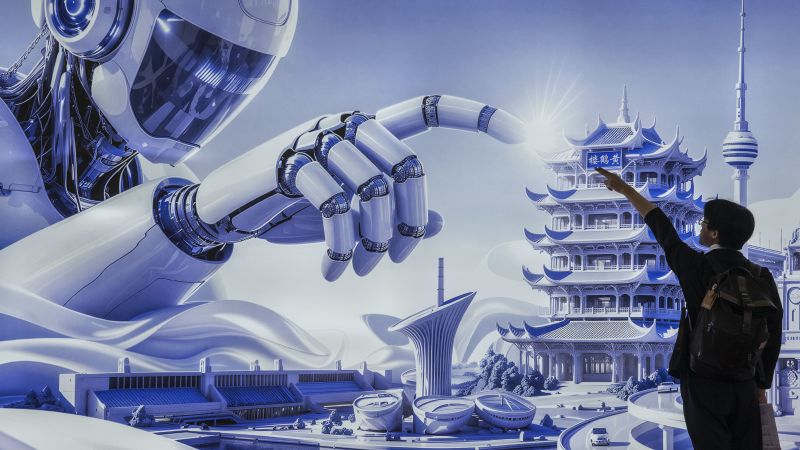
China’s Humanoid Robots: Captivating the World, Testing Their Limits
Sandego.net – China’s humanoid robots have captivated global audiences, showcasing remarkable advancements in artificial intelligence and engineering. During last year’s Spring Festival Gala, these machines performed dazzling dance routines that symbolized the nation’s growing technological influence. However, the rise of a rental market has begun to reveal the practical constraints of these innovations. Ai Lin, a Hangzhou-based e-commerce influencer, transformed the event’s impact into a business opportunity by investing $30,000 in his first humanoid robot. His service, which charges 3,000 yuan ($443) per day for rentals, now caters to events, exhibitions, and even sentimental moments like marriage proposals. Yet, as demand surges, the rental sector highlights the distance between these robots’ viral appeal and their real-world utility.
China’s Strategic Push in AI Robotics
China’s ambitions in humanoid robotics extend far beyond spectacle. The country is channeling billions into research and development, aiming to solidify its position in the global race for advanced automation. As economic growth slows and labor shortages intensify, experts suggest that humanoids could redefine productivity. “Industrial capabilities have traditionally been a stronghold for nations like Germany, Japan, and the US,” said Lian Jye Su, chief analyst at Omdia, a firm specializing in AI and robotics. “But China’s humanoid robots have positioned the nation to lead the next wave of technological evolution.” This strategic focus aligns with the broader goal of reducing reliance on human labor in repetitive tasks.
The market potential for China’s humanoid robots is immense. Morgan Stanley predicts that by 2050, over a billion units could be operational, creating a market worth more than $5 trillion. However, this growth is projected to take at least a decade, as the technology matures. China’s dominance in industrial robotics, such as robotic arms in manufacturing, has now expanded to humanoid models. Last year, the country accounted for the majority of global humanoid deliveries, outpacing competitors like Tesla and FigureAI. Despite this progress, challenges remain in scaling these robots for everyday applications.
Rental Markets: A Test of Practicality
The rental market for China’s humanoid robots has emerged as a crucial platform to assess their viability. Entry-level models are now available for as low as 3,500 yuan ($517) per day, including shipping and operator support. This accessibility has drawn thousands of entrepreneurs, with state-run media reporting over 153,000 rental businesses nationwide. AGIBOT’s subsidiary, SHAREBOT, recently projected that the market could reach $1.5 billion by 2026, as seen in its 5,500 rental orders in just three months. Such figures suggest a growing appetite for integrating these machines into daily life.
For Ai Lin, the rental market has become a pivotal moment in his journey. “The Spring Festival Gala made me realize China’s humanoid robots have become a common sight in the near future,” he remarked. The event’s widespread coverage ignited interest in robotics, prompting entrepreneurs to explore new revenue streams. Social media influencers now promote these rentals, emphasizing their ability to create memorable experiences. However, as the novelty fades, some operators are noticing a decline in demand. Zhao Xiaohong, a 52-year-old investor, admitted that while China’s humanoid robots have initially driven interest, their long-term value remains uncertain.
China’s humanoid robots have demonstrated both promise and limitations. While they excel in showy performances, their operational independence remains limited. “Current models are still dependent on human operators—they’re more like oversized toys,” Ai Lin noted. This reliance on manual control highlights a key challenge: achieving the autonomy required for tasks such as factory assembly or household chores. The rental market, therefore, serves as a testing ground for consumer expectations and the technology’s readiness for broader adoption. As competition intensifies, the success of China’s humanoid robots will hinge on overcoming these hurdles.