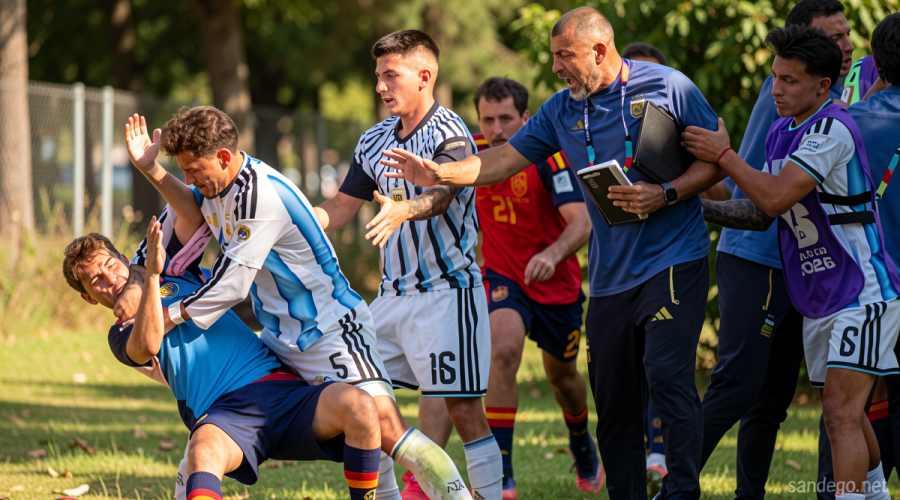
FIFA Hands Down Harshest World Cup Final Sanctions in Decades After Argentina–Spain Brawl
Sandego.net – The disciplinary fallout from last month’s World Cup final in East Rutherford, New Jersey, reached its formal conclusion on Friday when FIFA confirmed suspensions for three Argentine players, a coaching ban, and substantial financial penalties against the Argentine Football Association. At the center of the storm sits midfielder Leandro Paredes, who received a ten-match ban after physically confronting Spanish opponents in the minutes following Argentina’s defeat. The severity of that punishment places it alongside the most punishing individual sanctions ever levied in the tournament’s history.
What Happened on the Pitch
The final itself had been a one-sided affair for much of its duration. Spain controlled possession and created the clearer chances, while Argentina struggled to generate meaningful attacking threat. The match was ultimately decided when forward Ferran Torres found the net during the second half of extra time, after Argentina midfielder Enzo Fernández had been sent from the field. That single goal sealed Spain’s title and ignited a volatile post-match confrontation.
In the immediate aftermath, Paredes seized Spain center-back Eric García by the throat and shoved midfielder Gavi to the turf. FIFA’s disciplinary panel classified the incidents as assault cases, triggering the maximum available individual sanctions.
The Bans and Fines
Paredes’ ten-game suspension effectively removes him from the Argentina squad for an entire year. Under the current FIFA international calendar, ten competitive or friendly fixtures fall between now and June 2027, and none of those dates currently carry competitive weight — meaning the ban could run entirely through warm-up friendlies with no actual tournament or qualifier affected.
Defender Nahuel Molina drew a seven-match ban, while Thiago Almada received a one-game suspension. Monetary penalties accompanied each: Paredes and Molina each owe $90,000, and Almada $30,000. On the Spanish side, Gavi was also handed a one-match ban, which will cost him Spain’s Nations League fixture against England at Wembley on September 26.
Argentina’s coaching staff was not spared. Roberto Ayala, serving as a coach within the national setup, received a three-game ban plus a $30,000 fine.
Historical Precedent
The scale of Paredes’ punishment draws immediate comparison to two earlier episodes. In 2014, Uruguay striker Luis Suárez was stripped of all football for four months — including appearances for his new club Barcelona — and an additional eight competitive matches for his national side after biting Italy’s Giorgio Chiellini during a group-stage match in Brazil. More recently, in 2013, Croatia’s Josip Šimunić received a ten-game ban after using a megaphone to lead supporters in a chant associated with the country’s pro-Nazi regime during World War II, following a World Cup qualifying playoff victory. Paredes’ sanction matches that duration exactly.
AFA’s Response and Appeal Path
The Argentine Football Association confirmed it intends to challenge the longer bans and associated fines. The federation outlined its legal strategy in a public statement:
“The AFA legal department will, in a timely manner, request from FIFA the grounds for the reviewable rulings in order to file appeals with the governing body’s appeal committee, while retaining the future option of appealing to the CAS as a final recourse.”
CAS, the Court of Arbitration for Sport, sits in Lausanne and serves as the ultimate judicial body for international sport disputes. AFA’s stated approach mirrors the standard two-tier appeal route available to national federations.
Broader Penalties Against the Association
Beyond individual players, FIFA fined AFA $110,000 for a catalogue of incidents spanning the tournament. Among them: Argentine supporters carried a political banner referencing the Falkland Islands dispute after the semifinal victory over England, and discriminatory chanting by fans was documented in multiple matches. Separately, the association was ordered to allocate $100,000 toward anti-racism initiatives.
FIFA also mandated that Argentina’s next home international be played in a stadium restricted to half its normal capacity. A second stadium-related sanction and an additional $100,000 fine were deferred, to be activated only if further infractions occur during a probationary window.
Prize Money and Context
Argentina collected $34 million in World Cup prize money from FIFA for its run to the final. That sum, while substantial, now sits alongside the accumulated fines and the operational costs of managing a squad missing key players for up to a year.
For Spanish fans, the final’s memory remains anchored to Torres’ extra-time strike and his post-match celebration wearing a cap styled after the American political slogan, reading “Make Spain Great Again.” The image became one of the tournament’s most discussed visuals, capturing both the euphoria of victory and the cultural crosscurrents that now thread through global football.
The disciplinary decisions leave Argentina’s near-term international schedule significantly altered, with questions over squad composition, coaching continuity, and fan relations all hanging in the balance until any appeals are resolved.
Related Reading
Frequently Asked Questions
What is Paredes banned 10 games as FIFA?
Paredes banned 10 games as FIFA is the main topic of this guide. The article explains the context, practical details, and next steps readers should understand.
Why does Paredes banned 10 games as FIFA matter?
Paredes banned 10 games as FIFA matters because readers are looking for a useful answer, not just a short summary. Good content should match search intent and help them decide what to do next.