MAC Files Formal Appeal to Overturn Michigan’s Last-Second Victory Over Western Michigan
Sandego.net – The aftermath of a chaotic final minute in college football has produced one of the most pointed institutional confrontations in recent memory. On Tuesday, the Mid-American Conference formally lodged appeals demanding that Western Michigan University be credited as the victor of Saturday’s contest against Michigan — a game decided by a 13-12 scoreline built on a desperation throw in the closing seconds. The appeal targets not the outcome of a single play, but the procedural machinery that allowed that play to occur in the first place.
The Play That Sparked the Dispute
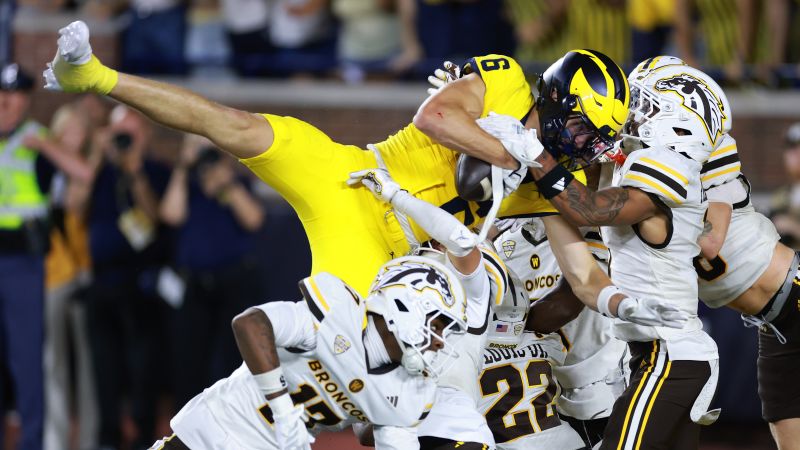
With Michigan trailing by a single point, quarterback Bryce Underwood launched a deep pass toward the end zone. On the broadcast feed and in the stadium’s visible displays, the game clock appeared to strike zero before the ball reached its intended receiver. The pass fell incomplete, and for a moment the Western Michigan Broncos seemed to have survived the final snap.
Then officials initiated a replay review. The determination that emerged from the booth: one second of game time remained. That single second was restored to the clock, and Michigan was granted an additional play. Underwood used it. He found wide receiver JJ Buchanan in the end zone for a 13-12 score, sealing a win that many observers immediately questioned.
The Clock That Wasn’t on Screen
The Big Ten Conference offered an explanation for the ruling. According to the league, the clock that governed the decision was not the one viewers saw on television or the one displayed in the stadium. Instead, officials relied on a separate timekeeping feed embedded within the conference’s replay system. That internal clock, the Big Ten stated, showed one tick of time still available when the incomplete pass was in flight.
The distinction matters enormously. College football’s replay protocols specify which clock reading controls when officials adjudicate end-of-game timing disputes. The MAC’s position is that the protocol designates the clock visible on the program feed — the same reading fans and players see — as the authoritative source. By turning to a different, non-public timekeeping signal, the conference argues the replay crew departed from established procedure.
Steinbrecher’s Statement
MAC commissioner Dr. Jon Steinbrecher laid out the conference’s case in a written statement released Tuesday. His language was pointed and specific:
“After further study and investigation, it is now evident that replay protocol was not properly followed in determining whether time remained on the game clock at the conclusion of the Western Michigan vs. Michigan football game.”
He continued, detailing the procedural failure:
“The established replay protocol requires that the game clock displayed on the program feed be used in determining whether time remained. Instead, the Big Ten Conference replay crew relied upon the clock feed embedded within its replay system. As a result, one second was placed back on the game clock and an additional play was awarded.”
Steinbrecher was careful to frame the issue not as a matter of judgment but as a mechanical error:
“This was not a judgment regarding the proper amount of time to place on the clock. It was an error in the application of the established replay protocol governing this specific end-of-game timing situation. Had the protocol been properly followed and the program-feed clock been used, no additional play would have been awarded, and Western Michigan would have won the game, 12–7.”
What the MAC Is Asking For
The conference’s appeal is directed at two bodies: the NCAA Football Bowl Subdivision Oversight Committee and the College Football Playoff selection committee. Steinbrecher asked both to recognize the Broncos as the official winner of the contest “for purposes of their respective rankings, evaluations and selection deliberations, and take such other corrective action as may be within their authority.”
In practical terms, that means the MAC wants the win recorded under Western Michigan’s name in any standings, seeding, or selection calculus that flows from the game. It does not ask for a rematch or a replay of the final play. It asks for the bookkeeping to be corrected.
Why This Matters Beyond One Scoreboard
The stakes extend well past a single Saturday afternoon. Michigan’s victory, however it is ultimately recorded, feeds into Big Ten standings and potentially into playoff positioning. Western Michigan’s record, meanwhile, shapes its own conference standing and bowl-eligibility picture. A one-point margin and a single restored second of clock time can ripple through an entire season’s narrative.
More broadly, the episode lands in a long-running debate about transparency in college football officiating. Fans have watched replay reviews for years and have grown accustomed to the idea that what they see on screen is what officials see. When a different, invisible clock becomes the arbiter of a game’s outcome, the trust between the sport and its audience takes a measurable hit. The MAC’s appeal, whether it succeeds or fails, forces a public reckoning with which timekeeping signal should govern the most consequential moments of a football game.
The Big Ten has not yet issued a formal response to the MAC’s filing. The NCAA Oversight Committee has not announced a timeline for review. For now, the scoreboard still reads Michigan 13, Western Michigan 12 — but the question of who truly won that game has moved from the field into the corridors of college football’s governing bodies, where it may remain for weeks.
Related Reading
Frequently Asked Questions
What is Michigan clock controversy escalates as MAC appeals?
Michigan clock controversy escalates as MAC appeals is the main topic of this guide. The article explains the context, practical details, and next steps readers should understand.
Why does Michigan clock controversy escalates as MAC appeals matter?
Michigan clock controversy escalates as MAC appeals matters because readers are looking for a useful answer, not just a short summary. Good content should match search intent and help them decide what to do next.