‘I am a living statue’: How DR Congo’s most famous soccer fan keeps Lumumba’s legacy alive
Sandego.net – The Democratic Republic of Congo’s debut in the World Cup against Portugal marked a significant moment in the nation’s sports history. This was the country’s second appearance at the global tournament, with its first having occurred decades earlier under the name Zaire. The match carried immense cultural weight, as fans anticipated a historic performance from their team. Yet, the event felt incomplete without one figure: Michel Kuka Mboladinga, the unofficial 12th man for Les Léopards. Known as “Lumumba Vea” or “Lumumba Lives,” Mboladinga’s presence in the stands became a symbol of national pride, even as the team’s progress on the field captured the world’s attention.
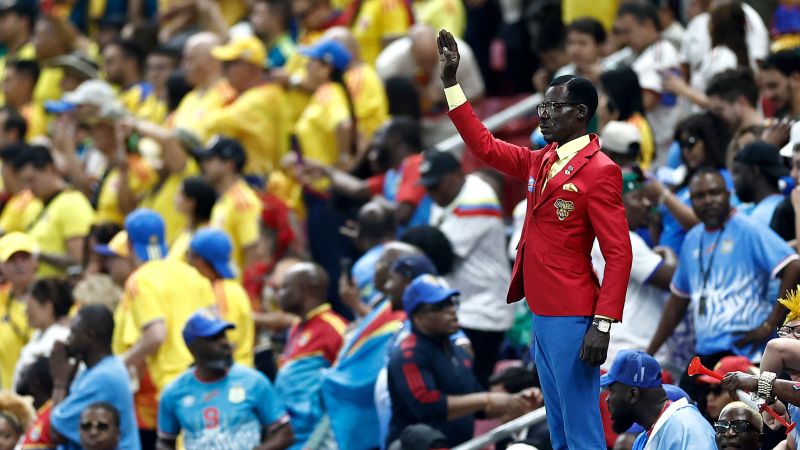
Yoane Wissa’s goal in the opening match, a towering header just before halftime, was a milestone for the DRC. It secured their first World Cup point and goal, but the moment was overshadowed by the absence of Mboladinga. His iconic pose—arms raised, motionless, and eyes fixed on the action—had become a global spectacle. This ritual, first showcased during the 2025 Africa Cup of Nations in Morocco, had already drawn international admiration. Now, as the World Cup began, it carried renewed significance, linking the team’s journey to a legacy of resistance and unity.
A tribute to a revolutionary leader
Mboladinga’s stance is a homage to Patrice Émery Lumumba, the first prime minister of the newly independent Congo. His resemblance to the late leader has made the tribute all the more poignant. Lumumba, who was assassinated in January 1961 at the age of 35, remains a revered figure in Congolese history. His vision for a free and sovereign nation resonates deeply with Mboladinga, who sees football as a vehicle to revive that spirit.
The connection between Mboladinga and Lumumba is more than superficial. The historical leader’s speeches, particularly his address on June 30, 1960, at the Palace of the Nation in Léopoldville (now Kinshasa), have become foundational to Congolese identity. In that speech, Lumumba denounced Belgian colonialism, declaring, “Morning, noon and night, we were subjected to jeers, insults and blows because we were ‘Negroes.’” His words echoed the struggles of a nation striving for self-determination, a message Mboladinga carries into the modern era through his unwavering stance.
Dr. Reuben Loffman, a historian specializing in DR Congo, emphasized Lumumba’s enduring influence. “His scathing remarks of June 1960 were not only fundamental to his reputation but also marked him out in the United States’ mind,” Loffman told CNN Sports. “During the Cold War, his nationalism was seen as a threat, and people feared he was a communist.” Yet Lumumba’s true ambition was simple: to return Congo to its people. “He just wanted Congo for Congolese,” Loffman noted, underscoring the leader’s unyielding commitment to his homeland.
Lumumba’s legacy is woven into the fabric of Congolese culture, even as his life was cut short. His assassination, orchestrated by then-president Joseph Kasa-Vubu, was a brutal act that silenced a voice of national pride. Three months after his iconic speech, Lumumba was ousted from power, leading to his capture by military forces under Mobutu Sese Seko. This marked the beginning of a dark chapter, where Lumumba was tortured and executed by firing squad in 1961. His body was later dismembered, and his remains dissolved in acid, leaving only a gold-crowned tooth as a symbol of his enduring presence.
From revolution to recreation
Despite the violence that ended his life, Lumumba’s ideals continue to inspire. For Mboladinga, football is a modern battlefield where the spirit of independence is rekindled. “Patrice Lumumba is a symbol of unity,” Mboladinga said during the World Cup, from Mexico. “He taught Congolese to stand and be proud.” His frozen posture during matches mirrors Lumumba’s unshakable resolve, creating a powerful visual link between the past and present.
Malcolm X, the American civil rights icon, once praised Lumumba as “the greatest Black man who ever walked the African continent.” This endorsement highlighted the leader’s international stature and his role in shaping African nationalism. Today, Mboladinga’s actions carry that same weight, transforming the stadium into a living memorial. While fans cheer and dance, he remains still, embodying the patience and perseverance that defined Lumumba’s era.
The World Cup has become a stage where historical memory meets contemporary sport. For the DRC, it’s more than a competition—it’s a celebration of resilience. Mboladinga’s presence ensures that every match is not just a game, but a reminder of the nation’s fight for freedom. His tribute has sparked conversations about how football can preserve cultural narratives, bridging generations through shared symbols and stories.
Lumumba’s impact on Congolese history is undeniable. His leadership during the transition from colonial rule to sovereignty made him a beacon of hope. Yet, his assassination also marked the beginning of decades of political instability. Mobutu’s regime, which lasted from 1965 to 1997, suppressed dissent and erased Lumumba’s memory. But even as the country faced decades of turmoil, his image endured. Mboladinga’s dedication has helped reestablish Lumumba as a central figure in Congolese consciousness.
The DRC’s recent World Cup journey has mirrored this revival. From their first goal to the growing support for their team, the nation’s pride is palpable. Mboladinga’s role in this movement is unique. His daily ritual—standing motionless with one hand raised—has become a ritual in itself, drawing parallels to Lumumba’s iconic speeches. It’s a gesture that resonates with both local fans and global observers, highlighting the unbroken thread between Congolese history and its present.
As the World Cup progresses, Mboladinga’s presence continues to remind the world of Lumumba’s enduring influence. His tribute is a testament to the power of symbols in shaping national identity. In a sport that often celebrates individual achievement, he stands as a reminder that collective memory and historical figures can inspire even the most modern of arenas. The DRC’s journey in the tournament is not just about results—it’s about reclaiming the stories that define them.
From the jungles of the Congo to the stadiums of the World Cup, Lumumba’s legacy lives on. Mboladinga’s pose is more than a fan’s gesture; it’s a declaration of unity, a call to remember the struggles that forged the nation. As the team plays, the stands echo with the spirit of a leader who once stood before the Palace of the Nation, demanding recognition for his people. In this way, the Beautiful Game becomes a platform for history, ensuring that the past remains a guiding force in the present.