How Smartphones and the New York Knicks Redefined Brooklyn’s Block Party Tradition
Sandego.net – In the heart of Brooklyn’s Fort Greene neighborhood, the streets transformed into a living archive of collective excitement as the New York Knicks’ playoff journey reached a pivotal moment. The Eastern Conference Finals, marked by the team’s improbable comebacks and dominant late-game performances, had turned into a cultural phenomenon. What began as a conventional sports event evolved into a digital spectacle, with smartphones at the center of an unprecedented fan phenomenon. For many, the act of watching the Knicks was no longer passive; it had become a performative ritual, blending real-time engagement with the curated chaos of social media.
The Rise of the Meta Watch Party
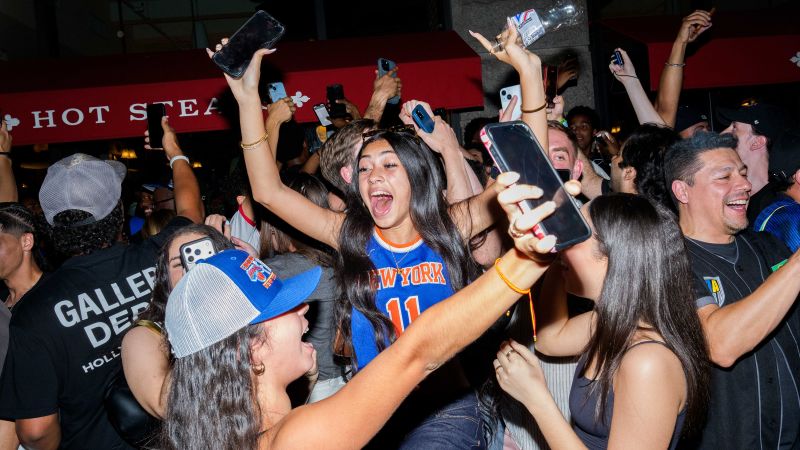
Outside Madison Square Garden, the official watch parties had grown into more than just gatherings—they were now digital echo chambers, reflecting the mirror-like obsession of phone screens. Semi-professional streamers, equipped with gimbals to stabilize their cameras, orchestrated antics designed to maximize viral potential. These efforts drew crowds who, in turn, pulled out their own devices to document the event, creating a feedback loop of content creation. Legacy news crews, once the sole arbiters of sports storytelling, now found themselves competing with the immediacy of fan-generated material. The result was a surreal layering of observation, where every moment was both lived and recorded simultaneously.
“It felt, if not quite dystopian, at least vaguely depressing.”
As the playoffs advanced, the author couldn’t shake the sense that smartphones had become an invisible force shaping the experience. The spectacle of the Knicks’ resurgence was no longer confined to the arena—it was everywhere, from the edges of sidewalks to the screens of strangers. The off-court narrative, too, was a product of this digital age, as the team’s passionate fanbase, long dormant after a 53-year championship drought, found new life through the lens of social media. The Knights of the Knickerbocker, once a relic of the 1970s, had been reborn as a 21st-century phenomenon, their legacy rekindled by the interconnectedness of modern fandom.
A Generation Reunited Through Screens
The Knicks’ journey had bridged a generational gap that once seemed insurmountable. Fans who cheered for the team in their childhoods—when the 1973 championship was the last shared memory—had grown into parents, grandparents, and grandparents of fans. The team’s resurgence felt like a family heirloom being passed down, with each new generation adding their own layer of interpretation. The pride of the older crowd was mirrored in the enthusiasm of the younger ones, who now saw the Knicks not just as a sports team but as a cultural symbol. This connection was amplified by the ubiquity of smartphones, which allowed fans to engage with the game in real time, regardless of their physical location.
At a major intersection in Fort Greene, the atmosphere was electric. The streets, usually bustling with daily life, were now a mosaic of picnics, beach chairs, and beverages, all arranged in anticipation of the Knicks’ final push. The crowd, a mix of longtime supporters and newcomers, had gathered to watch the game projected onto the side of a Cuban restaurant’s building. The sight of the court under the neon glow of the projection screen felt like a modern-day arena, where the city’s collective heartbeat was synchronized by the flicker of a pixelated ball. Yet, the celebration was short-lived. As the crowd swelled, the police intervened, citing traffic concerns, and the game was turned off for a brief period.
The Paradox of Presence and Distance
Despite the interruption, the spirit of the block party endured. Fans, undeterred by the temporary setback, continued to watch the game on their phones, a testament to the power of digital immersion. The sidewalks, which lacked stadium-style seating, became a theater of fragmented attention, with individuals scrolling through their screens while others chanted slogans from nearby. This juxtaposition of proximity and distance—where the crowd was physically close but emotionally fragmented—highlighted the tension between traditional fan culture and the new era of mediated fandom.
At the heart of this transformation was the Knicks’ ability to transcend their on-court performance and become a cultural touchstone. Their playoff run, though filled with setbacks and triumphs, had captured the imagination of a city yearning for connection. The author noted how the team’s victories were not just wins but milestones, each one contributing to a visual narrative that affirmed the Knicks as a symbol of Brooklyn’s resilience. The block party, in its essence, was a celebration of this renaissance, a moment where the city’s history and its future collided in the form of a basketball game.
Yet, the role of smartphones in this spectacle was both enabling and limiting. While they allowed fans to participate in real time, they also distanced them from the shared experience of a live crowd. The author mused on the irony of the omnipresent iPhone, a device that had turned the Knicks’ journey into a curated performance. The glow of the screen, though a constant companion, felt slightly anachronistic, as if the game’s magic was now filtered through a digital lens. This paradox was evident in the way fans clung to their phones even as they stood shoulder to shoulder with strangers, their eyes fixed on the same screen but their attention divided.
Legacy and the Future of Fandom
As the Knicks clinched their historic victory, the city’s collective memory was rewritten. For the first time in decades, the team had rekindled a sense of pride that spanned generations. The author reflected on how sports, by nature, collapse time and space, creating a shared language across eras. The Knicks’ success, however, was a reminder that this shared language now included the voice of social media, where every moment was amplified, debated, and reshaped. The team’s run had not only brought fans together but also redefined the way they interacted with the game, turning their spectating into a performance art.
The Knicks’ story was one of transformation, both on and off the court. The team’s victories were not just about basketball but about reclaiming a place in the city’s narrative. The block party in Fort Greene, though temporary, had become a microcosm of this shift. It was a space where the past met the present, where the struggle of previous decades was replaced by the exuberance of the current moment. The author concluded that while the spectacle of the game was undeniable, its essence had been subtly altered by the presence of smartphones. Yet, this alteration was not a loss but a reimagining—a new way of celebrating a team that, for a city, had always felt like home.
Looking back, the Knicks’ journey was a masterclass in modern fandom. The interplay between legacy and innovation, between the physical and the digital, had created a unique cultural phenomenon. The city, once divided by the long absence of a title, now stood unified in its enthusiasm. And though the block party had its limitations, it was a reminder that sports, in all its forms, remain a unifying force. The Knicks had not only won a championship but had also reignited the spirit of a community that had waited lifetimes for the moment they would finally be seen as champions. The future of fandom, it seemed, would be shaped by the very devices that had once distanced us but now brought us together, in a way that felt both familiar and foreign.